
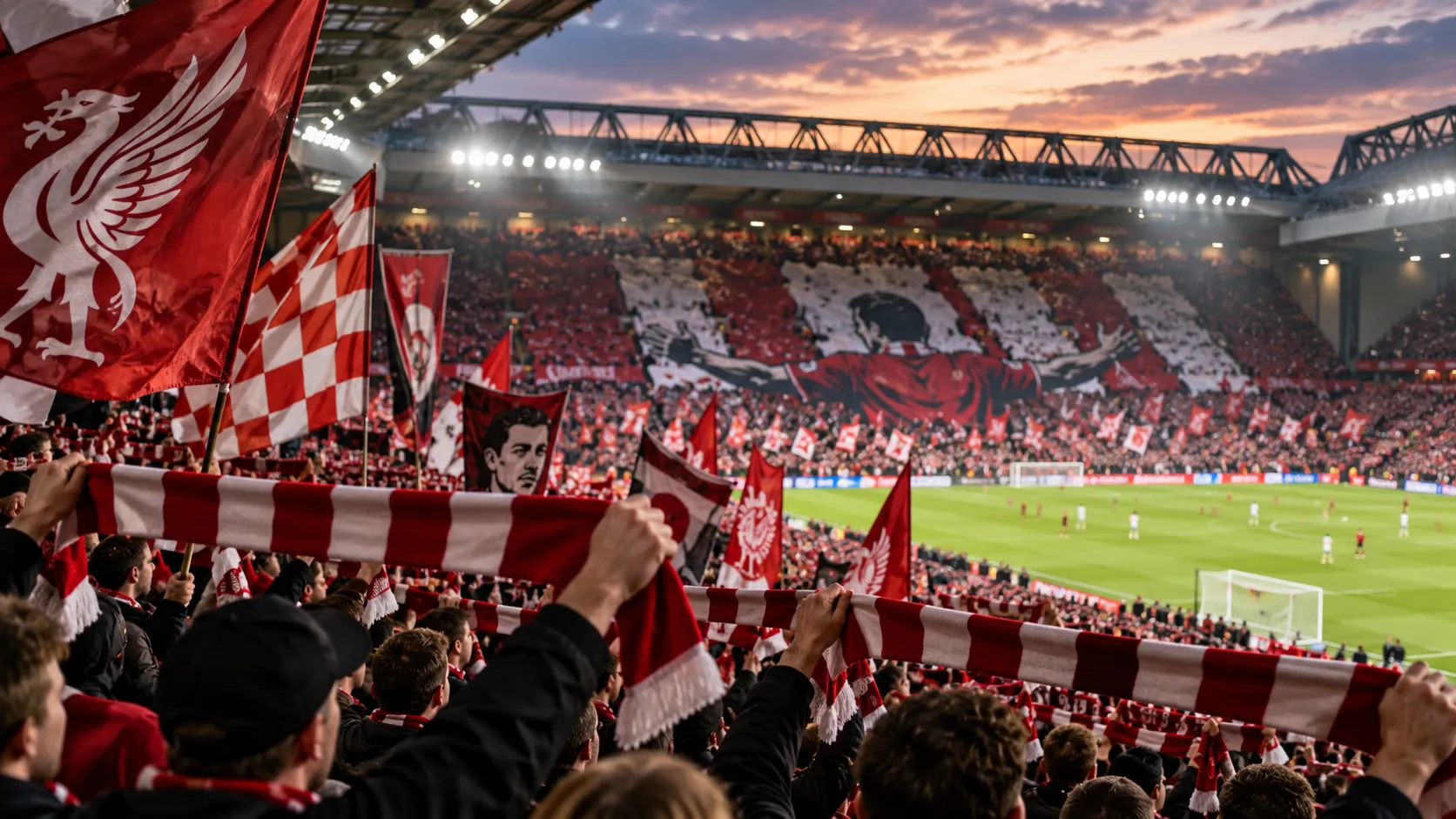
A football supporter does not need to say which club they follow for everyone around them to understand. A scarf wrapped around the neck, familiar colors hanging from a railway bag, a flag carried toward the stadium, or a handmade banner raised above a crowd can communicate identity before a single chant begins. These objects are simple enough to appear ordinary outside football, yet inside supporter culture they can carry decades of memory, rivalry, local pride, family history, and emotional attachment. They allow loyalty to become something other people can immediately see.
This visual language is one of the reasons football crowds look so different from ordinary audiences. Supporters do not simply occupy seats while wearing whatever happened to be convenient that day. Many arrive carrying pieces of club identity with them, transforming stands into recognizable territories of color and symbolism. Scarves, banners, flags, shirts, badges, rosettes, and choreographed displays can all perform different functions, but together they express the same basic idea: the people in the crowd are not anonymous spectators. They belong to something, and they want that belonging to be visible.
Supporter Symbols Developed Before Modern Merchandise
Modern club shops can make football identity appear to be entirely commercial. Supporters can buy official scarves, shirts, hats, flags, jackets, and almost every imaginable object carrying a crest. Yet visible supporter identity existed long before football clubs developed sophisticated merchandising businesses. Historical photographs show crowds using homemade clothing, rosettes, scarves, flags, and other objects to distinguish themselves and express allegiance. Supporters often created what they needed rather than waiting for a club or sportswear company to sell it to them.
This homemade tradition matters because it reveals something fundamental about football culture. The symbols were useful because supporters wanted to participate visually in the identity of the team. Commercial football later recognized the value of that desire, but it did not create the underlying impulse. National Football Museum collections preserve matchday clothing, banners, rattles, programmes, and other objects precisely because supporter culture has always produced its own material history. Ordinary objects can become historically important once thousands of people use them to express football belonging.
The Scarf Became One of Football’s Simplest Identity Markers
Among all supporter objects, the scarf may be the most immediately recognizable. It is practical in cold weather, easy to manufacture in club colors, inexpensive compared with many other items, and visible even when supporters wear ordinary coats underneath. Traditional bar scarves use repeated bands of team colors, creating an object that can identify affiliation without requiring a crest, sponsor, player name, or complicated design. Their simplicity is part of their durability.
A scarf can also be used in several ways during the same matchday. It can be worn around the neck on the journey, held above the head during an anthem, waved after a goal, tied to a railing, exchanged with another supporter, or kept for decades as a personal souvenir. National Football Museum projects still use the traditional bar scarf as a symbol of football nostalgia and community, showing how strongly the object remains associated with supporter history. A piece of knitted fabric has become one of football’s most portable representations of loyalty.
Colors Allow Supporters to Recognize One Another Instantly
The power of the scarf comes partly from football’s long attachment to club colors. A particular combination may be understood immediately by people who follow the sport, sometimes before a badge is visible. Supporters arriving at a station or motorway service area can identify one another through those colors, while streets surrounding the ground gradually become visually dominated by the home club as kick-off approaches. Color transforms individual supporters into a recognizable collective.
The meaning of club colors extends far beyond supporter accessories. Shirts carry the same identity on the pitch, creating a visual connection between players and people in the stands. That relationship is explored in How Football Shirts Became Symbols of Identity and Belonging. Scarves extend that principle beyond the playing kit. They allow supporters to participate in the club’s visual identity without needing to dress exactly like the players.
Scarves Help Turn Singing Into a Visual Ritual
One of the most powerful uses of a football scarf occurs when thousands of supporters raise them together. The gesture may accompany a club anthem, a significant European night, a final, or an important moment of remembrance. Individually, each scarf is small. When an entire stand holds them horizontally above head height, however, the repeated colors create a visual pattern stretching across the stadium. The crowd begins to look coordinated even without formal choreography.
The effect becomes especially powerful when singing accompanies the gesture. Football culture often combines sound and image rather than treating them separately. Supporters sing the same words while displaying the same colors, turning thousands of individual people into one recognizable body. The development and meaning of that collective voice is explored in Why Football Fans Sing: The History and Meaning of Stadium Chants. Scarves give those chants a visual form that television cameras and people across the pitch can immediately understand.
A Supporter’s Scarf Can Become a Personal Archive
The cultural value of a scarf does not depend on rarity or financial worth. A cheap item bought outside a ground can become almost irreplaceable if it accompanies someone through years of matches. The fabric may remind a supporter of their first visit, a parent who bought it, a promotion season, an away trip, or a friendship maintained through football. Wear and fading can increase rather than reduce its emotional importance because they prove how long the object has been part of someone’s supporting life.
FIFA has documented supporters who carried the same scarf through hundreds of matches and journeys across many countries. Stories like these demonstrate why football memorabilia cannot always be understood through collecting value alone. The significance lies in use. A scarf may be mass-produced, yet the experiences attached to one particular example are unique. Football repeatedly transforms standardized objects into highly personal possessions because supporters connect them with memories that cannot be reproduced.
Away Days Give Scarves Another Layer of Meaning
Supporter colors become particularly visible when people travel away from home. A scarf seen in another city announces that the wearer has crossed geographical territory to follow the team. Groups gathering at railway stations, motorway services, airports, pubs, and unfamiliar streets make their allegiance visible as they travel. The object becomes both a marker of club loyalty and evidence of the journey itself.
This helps explain why scarves often appear so prominently in photographs of travelling supporters. They remain visible when jackets cover shirts, and they can easily be raised when the away section begins singing. The wider culture surrounding those journeys is explored in The Culture of Away Days: Travel, Loyalty, and Life on the Road. Away travel turns supporter symbols into mobile territory: club colors temporarily appear in places where another team’s identity normally dominates.
Half-and-Half Scarves Reveal How Football Traditions Keep Changing
Not every scarf has the same cultural status. Half-and-half scarves, which display the colors and names of both competing teams, have become familiar outside major fixtures and tourist-heavy grounds. Some supporters enjoy them as souvenirs marking a particular match, especially a rare European tie or first visit to a famous stadium. Others dislike them because traditional supporter identity is normally based on choosing one side rather than visually combining both teams.
The disagreement is revealing because it shows that football symbols do not have fixed meanings. National Football Museum describes half-and-half scarves as part of the modern match-going experience and as objects that commemorate meetings between teams. Their presence produces debate precisely because the scarf already carries such strong ideas of allegiance. What one supporter considers a harmless memory object, another may interpret as contradicting the tribal clarity historically associated with football colors.
Banners Allow Supporters to Say More Than Colors Alone
A scarf communicates allegiance efficiently, but a banner can communicate an argument, joke, tribute, demand, or message. Supporters have painted words onto sheets, stitched elaborate flags, produced professionally printed designs, and created enormous displays covering entire sections of stadiums. Because a banner can contain language and images, it gives a crowd the ability to express something more specific than club affiliation alone.
This has made banners one of football’s most flexible supporter tools. They can welcome a player, commemorate a title, insult a rival, criticize an owner, honor someone who has died, mark an anniversary, or communicate with the team before an important match. National Football Museum includes banners within its collections of supporter behavior and activism, reflecting their role as historical evidence. A banner is not merely decoration; it can record what a fan base cared about at a particular moment.
Some Banners Become Part of Football History by Accident
A supporter can create a banner for one match without realizing that the words may outlive the occasion. One memorable example emerged at the 1968 League Cup Final, when a Leeds supporter displayed a banner referring to defender Norman Hunter as “Bites Yer Legs.” The phrase became attached to Hunter’s public identity and survived far beyond the match itself. A temporary piece of supporter humor had effectively helped create a nickname remembered decades later.
This example demonstrates the unpredictable power of terrace creativity. Clubs employ media departments and branding specialists, but supporters can still invent language that becomes more memorable than official campaigns. A phrase succeeds because other people repeat it, journalists use it, and the culture accepts it. Football supporters do not only consume club identity; they continually produce new parts of it themselves.
Banners Can Transform the Stand Into a Giant Canvas
At the largest scale, supporter displays extend far beyond individual banners. Flags, cards, fabric sheets, placards, and coordinated mosaics can turn an entire stand into one image before kick-off. These displays are often referred to as tifos, a term associated particularly with organized supporter culture in continental Europe but now understood much more widely. Some require weeks of planning, significant fundraising, careful measurements, and large numbers of volunteers.
UEFA has documented supporter groups working with clubs to create mosaics, flags, banners, and other displays that contribute to stadium atmosphere. In many football cultures, unveiling a new tifo has become part of the anticipation surrounding a major fixture. The display may exist for only a few minutes, yet the preparation can involve extraordinary effort. Supporters create something temporary precisely because the collective act of producing and revealing it matters more than its physical lifespan.
Modern Tifos Combine Art With Collective Identity
A large football display can function almost like public art created by a temporary community. Images may reference club founders, former players, city landmarks, historic triumphs, supporter slogans, or local mythology. The visual language often makes sense most clearly to people familiar with the club’s history. Outsiders may see an impressive picture, while home supporters recognize layers of references connected to their own identity.
This is where football culture becomes particularly distinctive. The stadium provides a huge but temporary exhibition space, and the audience also acts as the artist. Supporters hold cards, lift fabric, move flags, and coordinate timing while simultaneously watching the match. Stadium architecture provides the physical surface on which that creativity is displayed, a relationship examined more broadly in Football Stadiums: The Sacred Places Where Football Culture Lives.
Flags Can Represent More Than the Club Itself
Football flags often carry the club badge or colors, but supporter displays can also communicate geography. Town names, neighborhood names, national flags, regional symbols, and supporter-group identities frequently appear around grounds. An away end filled with flags bearing the names of different towns shows how widely the travelling support has gathered while still belonging to one football community.
This connection between club and geography is especially important because supporters often understand football identity through place. A club may attract a worldwide audience while remaining rooted in a particular city or neighborhood. The relationship is explored in Football and Local Identity: Why Clubs Represent Their Communities. Flags make those geographic relationships visible, allowing supporters to show both where they come from and which football institution connects them.
Rivalries Give Visual Symbols a Different Intensity
Colors become sharper when the opposing colors carry emotional meaning. During a derby or historic rivalry, scarves, flags, banners, and displays emphasize the separation between the two supporter communities. A stadium may appear divided into clearly identifiable blocks, each attempting to dominate visually and acoustically. Supporters use symbols to demonstrate that their side belongs to one tradition while the opponents represent another.
Banners during rivalry matches frequently reference old results, trophies, local geography, famous incidents, or jokes that would mean little to neutral spectators. Their effectiveness depends on shared knowledge between both sides. The deeper history behind this process is explored in Why Football Rivalries Mean More Than the Result: Identity, History, and Belonging. Visual supporter culture gives rivalry physical form before a ball has even been kicked.
Supporter Symbols Can Become Instruments of Protest
The same objects used to celebrate a club can also be used against the people controlling it. Scarves, banners, flags, and colors have repeatedly become tools of supporter protest when fans believe owners or administrators are damaging the institution. A stadium offers protesters a visible audience, while televised matches can carry their message far beyond the ground. Supporter identity therefore gives ordinary objects political power within football.
National Football Museum preserves a Blackpool protest scarf connected to the long campaign against the club’s former owners. During that period, supporters boycotted home fixtures and used organized protest to demand change. Other fan movements have similarly adopted alternative colors or specially designed scarves to make dissatisfaction visible. The object works because supporters already understand scarves as signs of belonging; changing their colors or message can demonstrate that loyalty to the club is not necessarily the same as support for those running it.
Protest Shows That Supporters See Clubs as More Than Businesses
Football protest often appears when supporters believe a conflict exists between the long-term identity of a club and the decisions of temporary owners. A scarf or banner can express the idea that the institution belongs culturally to generations of supporters even if its legal ownership rests elsewhere. This is why protests may use historic colors, traditional names, old badges, or references to the local community. Fans present themselves as defenders of continuity.
Such campaigns reveal the deeper meaning of supporter symbols. If a scarf were merely merchandise, it would have little political significance. It matters because wearing one communicates membership of a community with its own history and expectations. When thousands use the same visual message, individual dissatisfaction becomes a collective statement visible across the stadium and through television coverage.
Scarves Can Also Become Symbols of Solidarity and Mourning
Football supporter objects are not limited to celebration and confrontation. They can take on entirely different meanings after tragedy or loss. Scarves may be placed outside stadium gates, tied to railings, left beside statues, or arranged alongside flowers and messages. Something normally worn to express loyalty becomes an offering associated with remembrance and solidarity.
One scarf preserved by the National Football Museum was among many laid between Anfield and Goodison Park following the Hillsborough disaster. Its significance comes not from unusual craftsmanship but from the context in which it was placed. Supporter colors that normally distinguish one group from another can become symbols of shared grief. Football’s visual language can therefore express unity beyond rivalry when circumstances require it.
The Same Object Can Mean Rivalry One Week and Unity the Next
This flexibility is one of the most remarkable features of football symbolism. A scarf can be raised while challenging an opponent during a match, exchanged with an opposing supporter after a European trip, and later placed at a memorial representing solidarity. The physical object does not determine the meaning by itself. Context, gesture, place, and collective understanding do.
Football crowds repeatedly demonstrate this ability to shift between confrontation and community. FIFA has documented stadium moments in which supporters raised scarves, banners, and flags while singing together, including occasions when rival groups temporarily set competition aside. The possibility does not make rivalry less real. Instead, it shows that supporter identity contains more than one emotional register.
Handmade Objects Carry a Different Kind of Authenticity
Official merchandise provides consistency and quality, but homemade supporter objects often possess a cultural value that mass-produced products cannot reproduce. A banner painted on an old sheet, a scarf knitted by a relative, or a flag stitched by supporters contains visible evidence of personal effort. Imperfect lettering or uneven construction may actually strengthen the sense that the object belongs to the people who made it rather than to a marketing department.
National Football Museum collections and educational materials document homemade scarves and rosettes used by supporters in earlier generations. Even today, supporter groups continue producing their own banners and displays despite having access to professionally manufactured alternatives. The desire is not simply to possess club-branded material. Creating the object is itself a form of participation, allowing supporters to contribute something tangible to the visual culture surrounding their team.
Television Increased the Audience for Supporter Displays
A banner inside a stadium once communicated mainly with the people physically present. Television changed that scale dramatically. A well-positioned message can now be seen by millions of viewers, photographed by media organizations, captured in highlights, and circulated online. Supporters increasingly understand that the stand is not only part of the stadium environment but also part of the broadcast image.
This encouraged more ambitious displays while giving protest banners and visual messages greater potential reach. Television cameras often focus on large mosaics, flags, emotional supporters, or coordinated scarf displays because they help communicate the atmosphere surrounding the event. The wider transformation caused by broadcasting is explored in How Television Changed Football Forever. Supporter symbols became part of how football presents itself to audiences far beyond the turnstiles.
Social Media Made Temporary Displays Permanent
Traditional tifos and banners are often temporary. A mosaic may disappear within minutes, while a handmade message may be used only once. Digital photography and social media changed that relationship with time. Images of a supporter display can circulate worldwide within seconds and remain searchable for years after the physical object has disappeared. The audience for supporter creativity is therefore no longer limited by stadium capacity.
This has also accelerated the exchange of ideas between fan cultures. Supporter groups can see what happens in other leagues, learn new visual techniques, and adapt styles to their own traditions. A display in South America, Europe, Asia, or Africa can inspire supporters elsewhere almost immediately. Football supporter culture remains deeply local, but its creative vocabulary now travels globally at extraordinary speed.
The Meaning of a Symbol Depends on Who Controls It
Commercial football has learned to reproduce supporter aesthetics. Club marketing may use scarf imagery, banners, street-art typography, or terrace-style photography because these visuals communicate authenticity and passion. The relationship can become uncomfortable when supporters feel traditions created from below are being repackaged primarily to sell products. Something that began as spontaneous cultural expression can become part of commercial branding.
This does not automatically make official use meaningless. Clubs and supporters often share the same symbols legitimately, and many fans enjoy professionally produced merchandise. The tension appears when commercial presentation feels disconnected from the people whose traditions created the imagery. Football culture constantly negotiates this boundary between community identity and commercial ownership. A scarf can simultaneously be a product sold in a shop and a deeply personal object whose meaning cannot be purchased.
Supporter Displays Require Cooperation Behind the Scenes
Large visual displays can appear spontaneous to people watching on television, but many require extensive organization. Supporter groups may need to raise money, design artwork, order materials, communicate with club officials, arrange stadium access, distribute cards, and explain what thousands of people need to do. One mistake in positioning can distort an image intended to stretch across an entire stand.
UEFA’s guidance on supporter liaison recognizes that clubs and supporter representatives can work together on tifos, mosaics, flags, and banners while maintaining necessary safety procedures. This cooperation demonstrates that supporter culture and stadium management do not always need to exist in opposition. When communication works, clubs can provide the practical conditions while supporters retain creative control over the atmosphere they produce.
Visual Traditions Differ Across Football Cultures
Not every football country or club uses supporter symbols in exactly the same way. Some stadium cultures emphasize enormous tifos and continuous flag movement, while others historically placed greater emphasis on scarves, songs, rosettes, banners, or spontaneous crowd behavior. Certain supporter groups organize highly coordinated displays, whereas other fan bases value a less structured appearance. The diversity is part of what makes global football culture distinctive.
UEFA has described supporter environments where flags, banners, noise, and choreographed routines form central parts of terrace culture. These traditions should not be treated as though one style represents the universal model of an authentic football crowd. Supporter culture develops from local history. The objects may be similar, but the way people use them can reveal important differences in how clubs and communities understand themselves.
Symbols Help New Supporters Learn How Belonging Works
Children attending their first matches often encounter football identity visually before they understand its history. They see which colors everyone wears, which scarves rise during certain songs, which flags represent supporter groups, and which banners refer to people or events they may not yet recognize. Over repeated visits, those visual clues gradually become meaningful. The stadium teaches culture through observation.
A parent handing a child a scarf therefore does more than provide clothing for cold weather. The gesture can communicate that the child is being included within an existing football tradition. Years later, the same person may bring another generation to the ground and repeat the process. Symbols help make football identity transferable because they give abstract ideas such as loyalty, history, and belonging a physical form that people can hold.
Supporter Symbols Survive Because They Are Easy to Reinterpret
Football changes rapidly, but scarves and banners remain useful because they adapt. A traditional scarf can use the same club colors for decades even as badge designs, players, sponsors, and stadium architecture change. A banner can respond to whatever issue matters this week and then disappear. Old forms survive because supporters continually give them new content.
This flexibility distinguishes living culture from museum history. Scarves and banners are preserved by museums because they document the past, yet similar objects continue appearing every weekend. National Football Museum explicitly treats banners, clothing, tickets, programmes, fanzines, and other supporter materials as significant parts of football heritage. The archive keeps growing because fan culture is still creating historical evidence in real time. :
Why Simple Objects Can Carry So Much Meaning
A football scarf contains no goals, trophies, songs, or memories by itself. A banner begins as fabric, paint, or printed material. Their cultural importance comes from the people who use them and the experiences attached to them. Once an object has travelled to hundreds of matches, been raised during defining moments, belonged to someone important, or represented a supporter movement, its meaning can become impossible to separate from football history.
This process explains why supporter symbols often survive even as the sport becomes increasingly digital. A phone can display a club badge, but holding a scarf above the head with thousands of other people creates a physical experience. Social media can reproduce a tifo image, but standing beneath the display while the stadium reacts is something different. Football remains unusually attached to physical rituals because supporters value not only what symbols represent but what they allow people to do together.
From Scarves to Banners, Supporters Make Belonging Visible
Football supporter culture is filled with complicated histories, but many of its most powerful expressions use remarkably simple materials. Wool becomes a scarf, fabric becomes a flag, an old sheet becomes a protest banner, and thousands of colored cards become an image stretching across a stand. The transformation happens because supporters agree on what those objects mean. They recognize the colors, references, gestures, and traditions connecting one person with thousands of others.
That is why scarves and banners remain important even in stadiums filled with giant screens, digital advertising, mobile phones, and modern entertainment technology. They belong to supporters in a way many other parts of the matchday do not. Fans can make them, carry them, raise them, exchange them, preserve them, protest with them, and leave them behind in remembrance. Football needs no complicated technology to make belonging visible. Sometimes all it takes is a piece of fabric in the right colors held by someone who knows exactly what those colors mean.


