
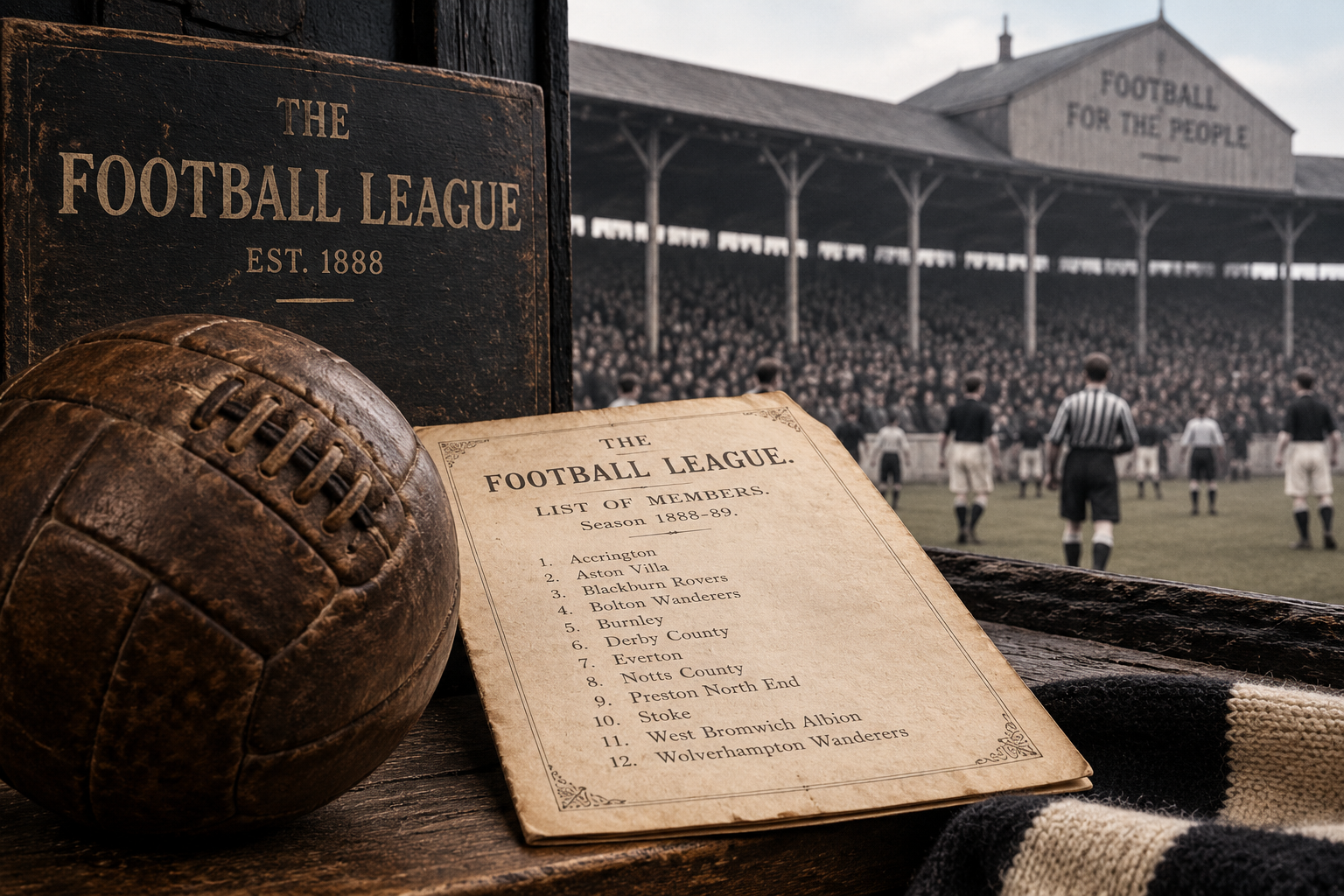
Before league football, a club could win a memorable cup tie and still have no reliable way to measure an entire season. Fixtures were often arranged individually, friendly matches filled much of the calendar, and the FA Cup offered prestige without providing clubs with a regular competitive programme. The creation of the Football League in 1888 changed that structure. For the first time, a group of leading clubs committed themselves to a sustained competition in which results accumulated, positions could be compared, and success depended on performance across months rather than one afternoon.
The importance of the Football League therefore goes far beyond the creation of another tournament. It helped organize the calendar, stabilize club finances, make the league table central to football culture, strengthen the relationship between clubs and their communities, and eventually provide a framework for promotion, relegation, player regulation, broadcasting, and national competition. Much of what supporters now regard as the normal rhythm of a football season grew from the organizational changes that league competition made possible.
Why Football Needed More Than Cup Matches and Friendlies
By the 1880s, association football was becoming too popular and too commercially significant to depend entirely on loosely arranged fixtures. Professionalism had been legalized by the Football Association in 1885, allowing clubs to pay players openly and making reliable income increasingly important. A professional squad needed regular matches, regular crowds, and a calendar that allowed administrators to plan ahead. The development of paid football is explored further in The Birth of Professional Football and How It Changed the Sport.
Friendly matches could attract large attendances, but they lacked the competitive continuity clubs increasingly needed. The FA Cup offered enormous prestige, yet elimination could end a club’s major competitive programme early in the season. What football lacked was a structure in which clubs could meet one another repeatedly under a shared schedule and where every result contributed to a larger competition. The solution would fundamentally change how clubs, players, newspapers, and supporters understood time in football.
William McGregor and the Idea of Regular League Competition
One of the central figures in the development of league football was William McGregor, a businessman and director of Aston Villa. McGregor believed leading clubs needed a more dependable programme of fixtures. His proposal brought together clubs from the Midlands and the north of England and contributed to the formation of the Football League in 1888. The new competition began with twelve members: Accrington, Aston Villa, Blackburn Rovers, Bolton Wanderers, Burnley, Derby County, Everton, Notts County, Preston North End, Stoke, West Bromwich Albion, and Wolverhampton Wanderers.
The geographical pattern reflected where professional football was particularly strong at the time. This was not yet a national league covering every major football region, nor did it immediately resemble the huge pyramid that later developed. What mattered was the principle. Member clubs agreed to participate in a common competition whose value depended on cooperation. Rivals still competed fiercely on the pitch, but off it they now needed one another to maintain a functioning schedule and a credible league.
The 1888–89 Season Turned Results Into a Continuing Story
The first Football League season began in September 1888. Preston North End quickly established themselves as the competition’s dominant side and completed the inaugural campaign without losing a league match. Their success became historic, but the greater organizational innovation was happening around them. Individual games were no longer isolated events. Each result affected a club’s position relative to every other member, and supporters could follow changes in the standings as the season progressed.
This changed the meaning of consistency. In a knockout competition, one poor afternoon can end a campaign. League football rewards the ability to collect results repeatedly. A draw away from home, a sequence of narrow victories, or a difficult run of fixtures could now be understood as part of a larger pattern. The league table translated dozens of separate matches into a single narrative that supporters could follow from the opening weeks until the championship was decided.
Home and Away Fixtures Created a Seasonal Rhythm
Regular league competition also helped establish the home-and-away rhythm that remains central to football. Clubs hosted opponents and travelled to face them elsewhere, creating recurring journeys between industrial towns and growing urban centres. Administrators had to think about transport, fixture dates, player availability, gate receipts, policing, and the practical demands of staging matches week after week. Organization became as important off the pitch as performance was on it.
For supporters, regular fixtures gave weekends a predictable sporting pattern. The National Football Museum notes that after the Football League was established, Saturday football rapidly became an important part of working-class leisure. Railway networks helped supporters travel to both home and away matches, contributing to traditions that later became an important part of football culture. SwiftPeakX explores the travelling side of this culture in The Culture of Away Days: Travel, Loyalty, and Life on the Road.
The League Table Changed How Supporters Understood Success
The league table may now look like one of football’s most ordinary objects, but its cultural importance is enormous. It allows every club to be placed within the same competitive framework. Supporters can see not only who is first and last but how many points separate teams, which clubs are improving, and which matches could change the balance of a season. Newspapers eventually made standings a familiar part of sports coverage, and later radio, television, teletext, websites, and mobile applications turned league positions into information followed almost continuously.
This made football a conversation that continued between matches. A supporter could discuss form, points, remaining fixtures, and the performances of rivals long after leaving the stadium. Clubs were no longer judged only by trophies or memorable individual results; finishing position itself became meaningful. Even a season without a championship could contain battles for promotion, survival, qualification, or simply superiority over a local rival.
Promotion and Relegation Developed Gradually
It is important not to project the modern football pyramid directly onto the first season of 1888. The original Football League consisted of a single division, so the familiar system of automatic movement between divisions did not yet exist. Expansion came later. A Second Division was introduced in 1892 as the League grew and incorporated additional clubs, creating the possibility that sporting performance could determine movement between levels.
The early system still differed from the automatic promotion and relegation familiar today. Clubs initially faced a series of test matches between teams from the two divisions, and automatic movement developed later. Over time, however, the principle became one of the defining features of English league football: success could carry a club upward while failure could send it down. That gave consequences to positions throughout the table and helped create the sense of sporting jeopardy that remains one of league football’s most powerful attractions.
League Membership Made Clubs More Permanent Institutions
A regular competition encouraged clubs to think beyond the next match. They needed administrators, grounds capable of hosting repeated fixtures, systems for registering players, dependable finances, and relationships with other member clubs. League membership created obligations as well as opportunities. Football increasingly required governance because a competition involving many independent clubs could function only when participants accepted common procedures.
This helped transform clubs from relatively informal sporting organizations into enduring institutions tied to towns and cities. A club represented the same community week after week and season after season, building rivalries and traditions through repetition. Supporters could inherit the habit of following a league campaign from parents and grandparents because the structure itself provided continuity even when players, managers, and owners changed.
Professionalism and League Football Reinforced Each Other
The Football League appeared only three years after professionalism was legalized, and the two developments reinforced one another. Paid players made football more demanding economically, while regular league fixtures gave professional clubs a more reliable competitive programme. Successful teams needed recruitment, training, contracts, and financial planning on a scale that earlier football had rarely required. The League increasingly became involved in systems governing player registration and movement between clubs.
Those systems did not always benefit players equally. Rules governing registration, wages, and transfers could give clubs considerable control over footballers’ careers, leading eventually to organized challenges from players and changes in employment rights. The longer history of this relationship is explored in The History of Football Transfers and the Fight for Player Freedom. League organization made professional football more stable, but it also created new arguments about power, money, and who should control the labour that produced the game.
Regular Competition Expanded Football’s Audience
League football gave spectators something that isolated matches could not provide: anticipation stretching across an entire season. A fixture in autumn could matter because of what it meant for spring. A run of victories could create belief, while a sequence of defeats could threaten a club months before the final table was settled. Attendance therefore became connected not only to the attraction of a particular opponent but to the wider story of where the team stood and what remained possible.
This continuing narrative became extremely valuable when mass media developed. Newspapers could publish results and tables every week. Radio could describe decisive matches to listeners who were unable to attend. Television eventually turned league football into a national and international spectacle. The relationship between broadcasting and the sport became particularly important in the twentieth century, a transformation discussed further in How Television Changed Football Forever.
The League Model Spread Far Beyond England
The organizational idea proved highly adaptable. Football associations and clubs elsewhere developed league competitions suited to their own geography, finances, sporting traditions, and institutional structures. Not every country copied England exactly. Some leagues developed regional stages, championship playoffs, different calendar systems, or structures without promotion and relegation. Yet the core concept became almost universal: clubs play a scheduled series of matches, results accumulate, and performance over time determines a ranking.
This system also complemented the development of international football. Domestic leagues created stable club competitions while national associations and international bodies built competitions across borders. As both forms expanded, football became increasingly organized around calendars in which domestic leagues, cups, and international fixtures had to coexist. SwiftPeakX examines that wider development in How International Football Competitions Shaped the Modern Game.
The Premier League Split Showed How Powerful League Organization Had Become
The influence of league organization became especially visible in 1992, when England’s leading clubs left the Football League’s First Division to form the Premier League. The change was driven partly by questions of television revenue, commercial power, and control. The top division was now governed separately, but promotion and relegation continued to connect it with the Football League below. The organizational structure created in the nineteenth century had become valuable enough that arguments over who controlled it could reshape the economics of the entire sport.
The Football League itself continued and later became known as the English Football League, administering the Championship, League One, and League Two. The names, commercial arrangements, and governing institutions have changed, yet the principle remains recognizable: clubs compete through a scheduled season in which every match contributes to a table. That continuity demonstrates how durable the original league idea proved to be.
Why the Football League Changed More Than the Fixture List
The Football League changed football because it organized uncertainty. Nobody knew which club would win, but everyone knew that the answer would emerge through a structured sequence of matches. That framework made seasons comparable, created predictable fixtures, strengthened the financial foundations of professional clubs, encouraged supporter routines, and gave newspapers and broadcasters a continuing story to tell. The system did not remove football’s unpredictability; it gave that unpredictability a structure.
Modern supporters may take tables, fixture lists, promotion battles, relegation pressure, and weekly league programmes for granted, but all depend on the idea that clubs agree to measure themselves repeatedly within the same competition. The Football League of 1888 was small compared with the football system that followed, yet its organizational principle became one of the foundations of the modern game. Football was no longer simply a collection of matches. It had become a season.
Continue Exploring SwiftPeakX
The creation of league football makes more sense when viewed alongside the rise of professionalism and the later growth of international competition. Continue with The Birth of Professional Football and How It Changed the Sport, The History of Football Transfers and the Fight for Player Freedom, and How International Football Competitions Shaped the Modern Game. Together, these developments show how football evolved from a loosely organized pastime into a structured professional sport capable of sustaining clubs, competitions, and supporter cultures across generations.


