The kick-off is one of football’s simplest rituals, yet its rules have changed over time. Explore how the restart was standardized and why modern teams now use it as a tactical opportunity.
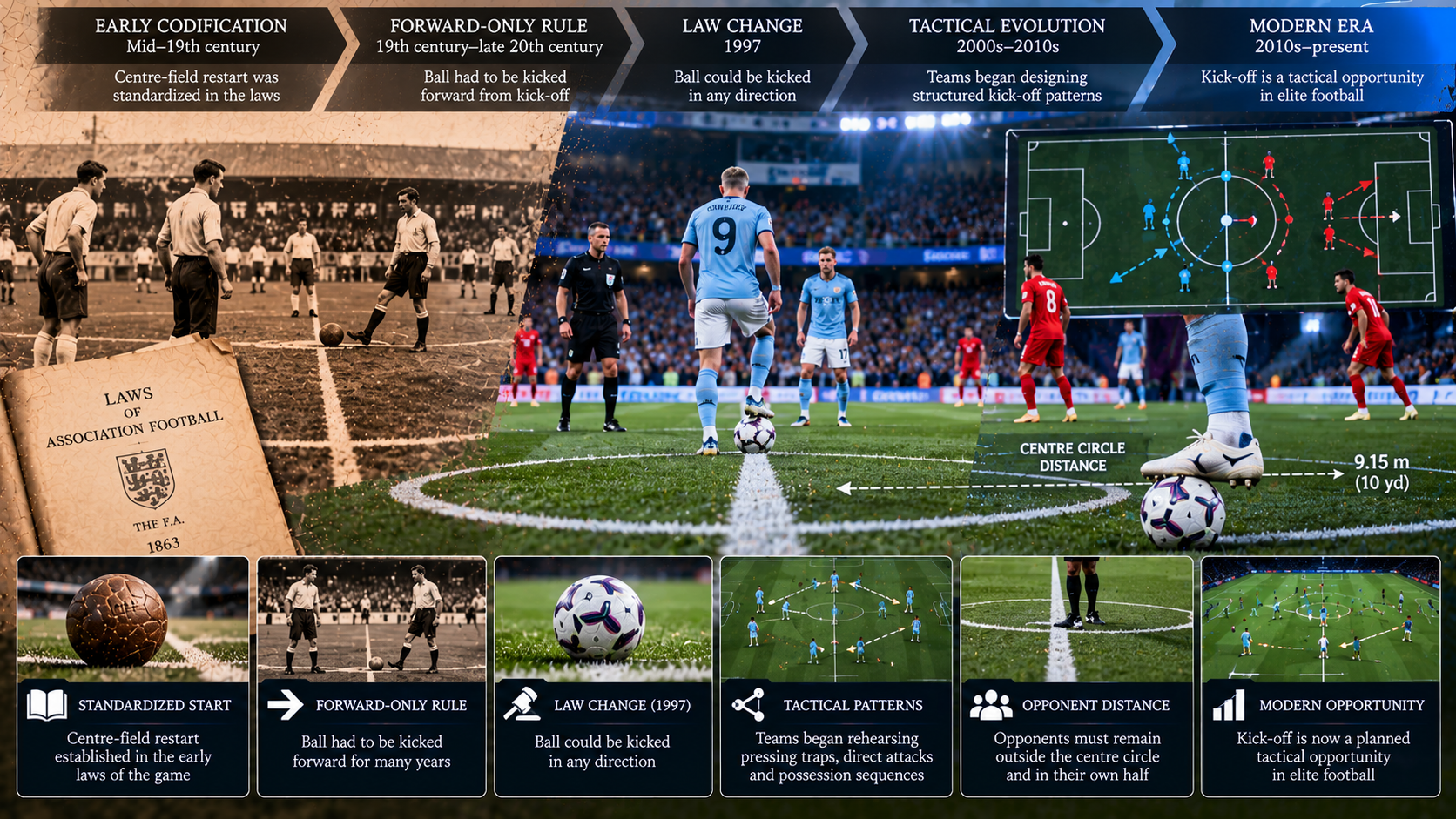
This is a story of accumulated adjustments rather than one decisive invention. The Early codification stage saw association football standardized a centre-field restart to begin play; the Set-play era stage saw teams began rehearsing pressing traps, direct attacks and possession patterns from the first touch.
Written by: SwiftPeakX Editorial Team
Last editorial review: October 2026
Editorial note: This article was reviewed for topic-specific wording, historical clarity, source transparency and natural readability. References are listed at the end for verification and further reading.
Key Takeaways
The kick-off starts each half and extra-time period and restarts play after a goal.
Modern law requires the ball to be stationary on the centre mark and opponents to respect the centre-circle distance.
Law changes eventually allowed the kick-off to be played in any direction, expanding tactical options.
Elite teams now design first-phase patterns from kick-off just as they do for other restarts.
Historical Foundations
Every football match begins with the simplest ritual in the sport: the ball at the center spot, players arranged in their halves, and the referee authorizing play. Yet the kick-off has changed over time as the laws became more precise about player position, direction of the kick, and what happens after a goal.
For many years the ball had to move forward from kick-off, a requirement that shaped the familiar two-player restart. A later law change allowed the ball to be kicked in any direction, making one-player kick-offs practical and immediately visible across professional football. The change looked small but showed how lawmakers simplify procedures when an old restriction no longer serves a clear purpose.
Kick-offs have also become tactical opportunities. Teams rehearse direct attacks, long diagonal balls, pressing traps, and possession patterns from the opening whistle or after conceding. Because every opponent must begin outside the center circle and in their own half, the restart creates a temporary geometric structure that coaches can exploit.
Standardization prevents disputes at the most basic moments of a match. The laws define where the ball goes, where players stand, when it is in play, and what happens if procedures are violated. Those details ensure that a match in one country starts under the same basic conditions as a match elsewhere. Kick-off history is a reminder that football’s global simplicity depends on painstakingly standardized procedures.
Why a standardized start matters
A match needs a neutral, repeatable way to establish possession at the beginning of a period and after a goal. The centre mark and opponent-distance rules create predictable geometry before open play begins.
That predictability is important for refereeing because every player knows where they are permitted to stand. It also gives coaches a rare moment when the exact starting positions are known in advance.
The centre circle is functional, not decorative
The circle marks the distance opponents must respect at a kick-off. Its geometry protects the team taking the restart from immediate contact while still allowing the opponent to organize around the halfway line.
Once the ball is kicked and clearly moves, those restrictions disappear and normal play begins. A familiar field marking therefore exists because of a specific law requirement rather than visual tradition alone.
Why the backward kick changed routines
For many years supporters associated kick-off with two players standing over the ball because the first touch had to send it forward. Allowing the ball to move in any direction made one-player restarts practical and let teams circulate backward immediately.
The change simplified the procedure while expanding tactical choice. It is a good example of a small law amendment having a visible effect on match ritual without changing football’s identity.
Kick-offs became rehearsed attacks
Because the opponent must begin at a prescribed distance, teams can prepare passing sequences or direct balls before the match. Some use safe possession, while others target a channel or attempt a quick territory gain. That makes kick-offs became rehearsed attacks a genuine turning point in the wider story of Kick-Off rather than a minor historical detail.
Analysts can study how opponents press from kick-off and design the first few passes accordingly. The value is modest compared with corners or free kicks, but elite football looks for advantages in every repeatable situation.
Restart behavior affects match rhythm
A kick-off after conceding can become a psychological reset, while a late restart can be rushed by a team chasing the score. Referees also manage delays and ensure players return to their own halves.
These moments show how the law intersects with game state and emotion. The restart is ceremonial in appearance but competitive in consequence from the instant the referee signals.
Timeline: Key Turning Points
Period Development Why It Mattered
Early codification Association football standardized a centre-field restart to begin play. The match gained a recognizable opening procedure.
Centre-circle era Distance requirements around the ball became embedded in the laws. The restart created guaranteed initial space for the team in possession.
Modern law A kick-off starts halves, extra time and play after goals. The same procedure covers several key transitions in the match.
2016 law revision The ball no longer had to move forward at kick-off. A single player could play it backward or sideways, immediately widening tactical design.
Set-play era Teams began rehearsing pressing traps, direct attacks and possession patterns from the first touch. The restart became a small but genuine coaching opportunity.
Why This Still Matters
Kick-off looks simple because players perform it constantly, yet its history shows how even basic restarts reflect broader ideas about fairness and flow. Changes to positioning and the direction of the first touch have made the restart less ceremonial and more tactically flexible. Teams can now use kick-off as the beginning of a rehearsed attacking pattern rather than merely a neutral way to start play. That makes Law 8 a useful example of how small wording changes can alter behavior without changing the recognizable structure of the game.
Kick-offs also reveal how quickly teams exploit even modest law changes. When the ball no longer had to move forward first, players gained more options for immediate possession and rehearsed routines. Some teams now use the opening seconds to attack space directly, while others prioritize control. The restart is still simple enough for every level of football, but elite teams have shown that simplicity does not prevent tactical detail.
Common Misconceptions
The kick-off must be played forward.
Not under modern law. The ball can be kicked in any direction once the other requirements are met.
Two players are required at the centre spot.
One player can take the kick-off; the old two-player image came largely from the former forward-movement requirement.
You cannot score directly from a kick-off.
A goal may be scored directly against the opponents from the kick-off under current Law 8.
Related SwiftPeakX Reading
The Offside Rule: How Football’s Most Debated Law Evolved
Why Football Has Extra Time: The History of Playing Beyond 90 Minutes
The History of the Throw-In: How Football Settled the Restart From Touch
Frequently Asked Questions
Who takes the kick-off after a goal?
The team that conceded the goal restarts play.
Where must the other players stand?
Except for the kicker, players must be in their own half, and opponents must remain outside the required distance until the ball is in play.
When is the ball in play?
When it is kicked and clearly moves after the referee’s signal.
Why did kick-offs start looking different after 2016?
The law change allowing the ball to move in any direction removed the need for a traditional forward touch and made one-player restarts common.
A Simple Restart With Tactical Consequences
The first entry, Early codification, establishes the baseline. Association football standardized a centre-field restart to begin play. The match gained a recognizable opening procedure.
A second stage appears under Centre-circle era. Distance requirements around the ball became embedded in the laws. The restart created guaranteed initial space for the team in possession.
A further turning point appears at Modern law. A kick-off starts halves, extra time and play after goals. The same procedure covers several key transitions in the match.
Another shift is visible in 2016 law revision. The ball no longer had to move forward at kick-off. A single player could play it backward or sideways, immediately widening tactical design.
The chronology closes under Set-play era. Teams began rehearsing pressing traps, direct attacks and possession patterns from the first touch. The restart became a small but genuine coaching opportunity.
The Bottom Line
The enduring lesson is that Kick-Off has always been shaped by context. The Early codification entry answers one set of conditions; the Set-play era entry answers another. Future changes will face the same test: whether they improve the experience without losing the function people still value.
Sources & Further Reading
IFAB — Law 8: The Start and Restart of Play
IFAB — Laws of the Game archive
IFAB — Laws of the Game