
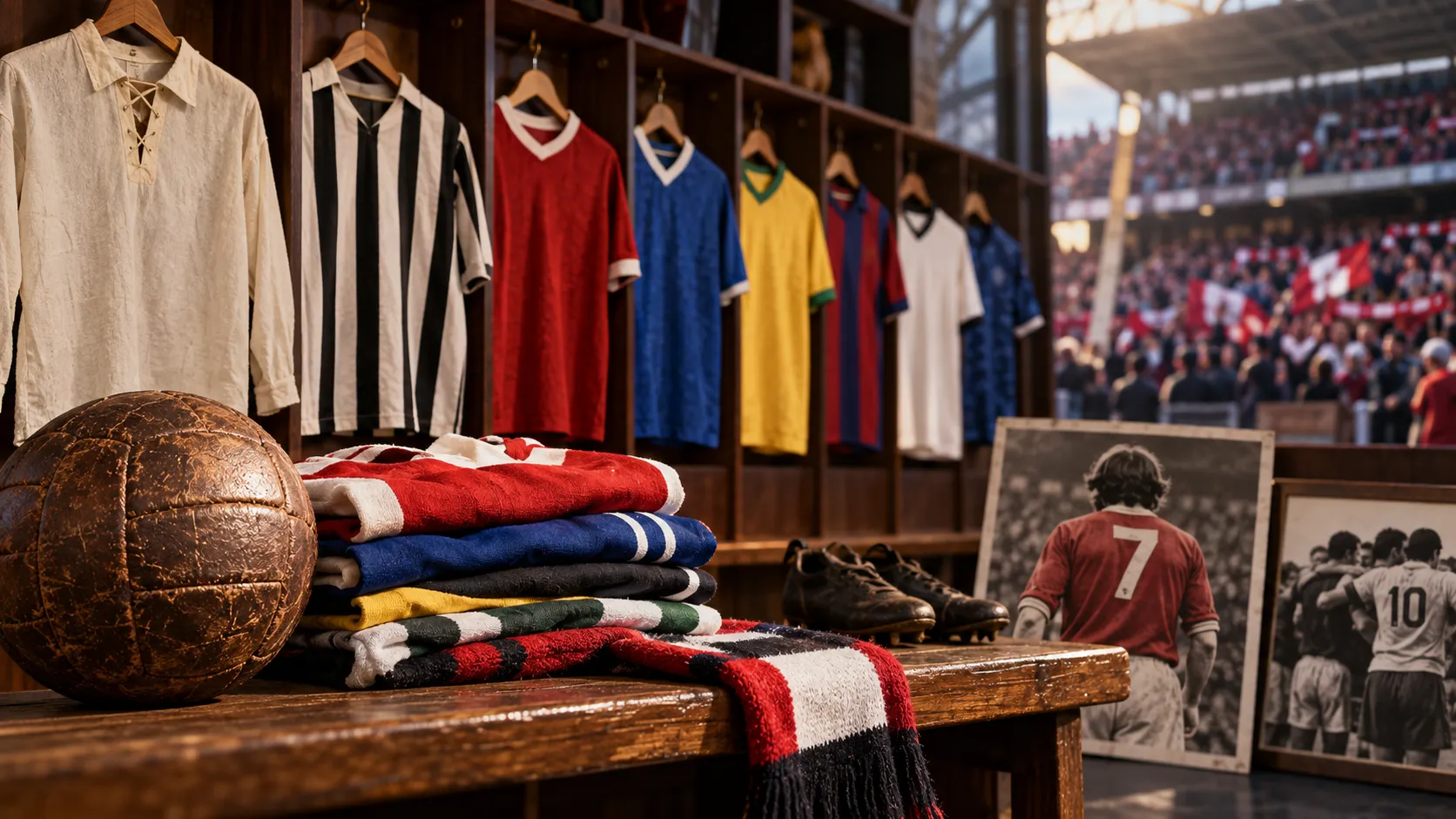
A football shirt begins as a piece of sporting equipment, but for supporters it rarely remains only that. A particular combination of colors can identify a club before its badge is visible, while an old shirt can immediately bring back memories of a stadium, a player, a season, or a person with whom football was once shared. Supporters wear shirts thousands of miles from the club they represent, children inherit loyalties through them, and collectors preserve designs that disappeared from the pitch decades ago. Few objects demonstrate as clearly how football can turn something practical into something deeply personal.
This transformation did not happen overnight. Early football shirts were designed primarily to distinguish one team from another and to survive the physical demands of the game. Over time, however, club colors became traditions, badges connected teams to particular places, numbers became associated with roles and famous players, manufacturers turned kit design into a recognizable industry, and replica shirts allowed supporters to wear almost the same clothing as the players they admired. The football shirt gradually moved beyond the touchline and became an expression of identity, memory, fashion, community, and belonging.
Early Football Shirts Were Designed for Function Before Fashion
The earliest organized football teams did not possess the lightweight technical shirts familiar to modern players. Clothing reflected the materials and manufacturing possibilities of the nineteenth century, meaning shirts could be heavy, relatively simple, and far less comfortable in wet conditions than modern sportswear. The National Football Museum preserves a heavy wool shirt associated with the first official international match between Scotland and England in 1872, providing a striking reminder of how different early football clothing was from today’s highly engineered kits.
At that stage, the main purpose of distinctive clothing was practical identification. Two teams needed to be recognizable during a match, particularly as organized fixtures brought together players who might otherwise wear similar everyday sporting clothing. Colors, stripes, halves, hoops, and other patterns gradually provided clubs with consistent appearances. Once teams began using particular combinations repeatedly, those practical distinctions acquired history. A color chosen because it was available or visually useful could eventually become something supporters regarded as inseparable from the club itself.
Club Colors Became a Visual Language
Football supporters can often identify a club without reading its name. Red shirts with particular details, blue combinations, black-and-white stripes, claret and blue, green and white, or other established patterns can carry immediate associations. That recognition exists because football clubs repeated their colors across generations until the visual combination became part of their public identity. Even when manufacturers change collar shapes, materials, patterns, or trim, supporters generally expect the underlying visual tradition to remain recognizable.
The reasons clubs adopted particular colors vary considerably, and many have histories involving earlier organizations, local connections, influential individuals, or changes intended to distinguish one team from another. SwiftPeakX explores those stories more directly in Why Football Clubs Wear Their Colors: The Stories Behind Iconic Kits. What matters culturally is that once colors become established, supporters begin treating them as inherited symbols rather than temporary design choices. A color can become shorthand for belonging to a club and, in some places, to a community surrounding that club.
A Football Shirt Can Represent a Place
Clubs are often connected to cities, towns, districts, industries, and local histories, so their shirts can carry meanings far beyond the team itself. Wearing a club shirt in the streets surrounding its stadium can express attachment to a place as much as support for eleven players. For supporters who move away from their hometown, the same shirt can become a portable connection to somewhere they still consider home. Football clothing therefore allows geographical identity to travel with the supporter.
This connection becomes especially visible when clubs incorporate local symbols, traditional colors, landmarks, or historical references into their kits. Even small design details can generate strong reactions because supporters interpret them within a larger cultural story. A manufacturer may see a stripe, pattern, or shade primarily as a design element, while supporters may compare it with decades of club history. The football shirt occupies an unusual position where commercial design constantly interacts with inherited identity, making apparently minor changes emotionally significant.
The Club Badge Added Another Layer of Belonging
Colors can identify a team from a distance, but the badge gives that identity a more concentrated symbol. Club crests often incorporate animals, civic imagery, monuments, historical objects, initials, or other references connected to the organization and its surroundings. When placed over the chest, the badge transforms the shirt from a generic sports garment into something explicitly tied to one football institution. Supporters frequently speak about wearing the badge with pride because it represents a history larger than any individual player or season.
Badges themselves have changed over time, sometimes becoming simplified for modern branding and digital use. Those changes can provoke strong debate because supporters do not experience a crest merely as a corporate logo. It may appear on childhood shirts, family photographs, stadium signs, scarves, programmes, and memorabilia accumulated over decades. The wider history of these symbols is explored in The Meaning Behind Football Club Badges and How They Evolved. On a football shirt, color and crest work together to make belonging immediately visible.
Numbers Turned Shirts Into Individual Symbols
For early generations of football, the shirt primarily represented the team rather than an individual player’s personal brand. The introduction and later standardization of shirt numbers added another layer of meaning. Numbers originally helped identify positions and players, making it easier for officials and spectators to understand who was performing particular roles. Over time, however, certain numbers developed cultural associations of their own. The number 9 became closely connected with central goalscorers, while number 10 acquired an especially powerful association with creative and influential attacking players.
These traditions gave supporters new ways to connect a shirt with football memory. A club’s colors might remain largely constant, but a number could immediately recall a specific player or generation. The history is explored further in The History of Football Shirt Numbers and Their Changing Meaning. Modern squad numbering has made the connection between player and shirt even stronger, while names printed above numbers allow supporters to express loyalty not only to the club but also to particular footballers.
Names on Shirts Strengthened the Connection With Players
For much of football history, spectators recognized players through numbers, appearance, position, and familiarity rather than surnames printed across the back of the shirt. That gradually changed as football broadcasting expanded and tournaments sought clearer ways to identify individuals. FIFA Museum notes that the 1994 World Cup was the first edition of that competition in which player names appeared on shirts. What now seems completely normal was therefore a relatively recent addition to international football presentation.
The effect extended far beyond making television identification easier. A supporter buying a shirt could increasingly choose not only a club design but the identity of a particular player. Children began wearing the names of their heroes, while famous numbers and surnames became recognizable combinations in their own right. The shirt consequently occupied two levels of identity at once: the badge represented the collective institution, while the name and number celebrated an individual within it. Modern football merchandising developed strongly around this combination.
The Replica Shirt Changed Supporter Culture
Perhaps the most important step in turning shirts into everyday supporter symbols was the growth of the replica-kit market. Wearing club colors through scarves and other clothing had long been part of football culture, but mass access to shirts closely resembling those worn by players created a much more direct visual connection between the pitch and the crowd. Supporters could effectively place themselves inside the same design system as the team they followed rather than merely observing it from the stands.
The National Football Museum identifies Admiral as a key pioneer of this transformation, highlighting the 1973–74 season as a landmark in the development and commercial sale of the replica football shirt. During the 1970s, manufacturers increasingly recognized that kit design could appeal directly to supporters as well as clubs. Shirts consequently became brighter, more deliberately styled, and more commercially distinctive. The supporter was no longer merely watching the kit; the supporter had become part of its market and cultural life.
Manufacturers Turned Kit Design Into an Industry
As replica shirts grew in popularity, sportswear companies acquired greater influence over how football looked. Manufacturers introduced recognizable stripes, shoulder details, collars, geometric patterns, fabric technologies, and design languages that could identify the company almost as quickly as the club. The shirt became a collaboration between sporting tradition and industrial design. Clubs wanted recognizable identity, manufacturers wanted products capable of attracting buyers, and supporters judged whether each new design respected or disrupted the visual history they valued.
This tension explains why football shirt launches can generate unusually intense discussion. A new kit exists for only a season in many cases, yet supporters compare it with decades of predecessors. A design viewed negatively at launch can later become nostalgic if it becomes associated with a successful team or memorable period. Conversely, an attractive shirt can be remembered less fondly if supporters connect it with disappointment. Football kits demonstrate that design cannot be separated from the events that happen while players are wearing it.
Sponsorship Changed the Visual Surface of the Shirt
Commercial sponsorship introduced another major transformation. The shirt had once displayed relatively limited information, but its highly visible position made it valuable advertising space as television audiences expanded. Sponsor names and logos gradually became common across club football, sometimes becoming so closely associated with particular shirt designs that supporters remember the two together decades later. A commercial element intended for temporary marketing could therefore become part of football nostalgia.
This creates an interesting contradiction. Sponsors change for business reasons, yet supporters can develop sentimental attachments to the appearance they created. An old sponsor may remind someone of childhood, a championship season, a favorite player, or the first shirt they owned. The meaning no longer comes from the company itself but from the period represented by the design. Once again, football culture takes something commercially temporary and transforms it into a vehicle for memory.
Shirts Allow Supporters to Display Loyalty Publicly
A football shirt communicates quickly. Someone walking through an airport, city center, school, or railway station can be recognized as a supporter without saying anything. Another fan may respond with a smile, conversation, joke, or rivalry simply because the colors create an immediate social signal. This is one reason shirts matter so much to supporters who live far from their club. They allow affiliation to become visible in environments where the stadium and local community are physically absent.
That visibility is especially powerful on matchday. Thousands of people arriving in similar colors create the sense that individual supporters belong to something collectively larger. Scarves, flags, banners, and shirts combine to transform stands into visual representations of club identity. During rivalry matches, those contrasts can become even more pronounced as different sections of a stadium display competing colors. SwiftPeakX examines that wider relationship between football and collective identity in Why Football Rivalries Mean More Than the Result: Identity, History, and Belonging.
Children Often Receive Football Identity Through a Shirt
For many supporters, the first football shirt arrives before they fully understand league tables, tactical systems, or club history. It may be given by a parent, grandparent, sibling, or relative who is passing on an existing family loyalty. The child learns that certain colors mean something important because people around them already treat those colors with affection. In this way, a shirt can participate in the transmission of football identity between generations.
Years later, supporters frequently remember their first kit with unusual clarity. They may remember the season, player on the back, birthday on which they received it, or family member who bought it. Even after the garment becomes too small to wear, its emotional value can remain. This helps explain why old children’s shirts are sometimes preserved alongside photographs, programmes, and tickets rather than treated as ordinary used clothing. Football gives fabric the ability to store family memory.
Match-Worn Shirts Carry a Different Kind of Meaning
A replica allows supporters to share the design worn on the pitch, but a match-worn shirt occupies another category because of its direct relationship with a particular event or player. Museums preserve famous shirts because the physical object was present during moments that became part of football history. The National Football Museum’s collections include shirts connected to major matches and celebrated players, illustrating how sporting clothing can eventually become a historical artifact worthy of preservation alongside trophies, photographs, and documents.
The attraction is easy to understand. A famous goal exists in video footage and statistics, but the shirt worn during that moment provides a tangible connection to the event. Marks, fabric, stitching, numbering, and signs of use can make an object feel unusually immediate even decades later. Supporters collecting match-worn shirts are therefore not merely interested in clothing. They are acquiring physical evidence of football history, with provenance often determining much of the object’s cultural and financial significance.
Success Can Turn an Ordinary Design Into an Icon
Football history repeatedly demonstrates that a shirt’s reputation can change because of what happens while it is being worn. A design launched without enormous attention can become legendary after a championship, cup triumph, memorable international tournament, or iconic individual performance. Once photographs of celebrations are repeated for decades, the shirt becomes visually inseparable from the event. Supporters begin recognizing not merely a color pattern but an entire sporting story.
The reverse can happen as well. Some shirts become associated with painful defeats, relegations, controversial incidents, or disappointing periods. This shows why football design is unusually dependent on memory. Fashion normally evaluates clothing through appearance, material, and cultural context, but a football shirt acquires an additional layer determined by unpredictable sporting events. Designers create the object, yet players and supporters determine much of the meaning it eventually carries.
Away and Third Kits Expanded the Possibilities of Design
Home colors tend to be protected by tradition, leaving designers limited freedom to alter the most recognizable parts of club identity. Away kits and later third kits provide much greater opportunity for experimentation. Clubs have appeared in colors rarely associated with their traditional image, while manufacturers have used these designs to introduce unusual patterns, historical references, regional influences, and bold visual ideas that might be considered too disruptive for a home shirt.
Some alternative kits disappear from memory almost immediately, while others become cult objects precisely because they are unusual. Supporters may remember a distinctive away design long after more conservative home shirts from the same era are forgotten. This freedom also helped football clothing move closer to fashion because designers could create products attractive even to people who were not attending matches regularly. The kit increasingly existed in wardrobes as well as stadiums.
Retro Shirts Turned Football Memory Into Fashion
As generations of supporters grew older, shirts from their youth gained new significance. Designs from the 1970s, 1980s, 1990s, and early 2000s began appearing again in stadiums, music culture, streetwear, and specialist collections. Some supporters wanted authentic originals, while others preferred officially reproduced versions that recreated famous designs. The football shirt had developed enough history to support nostalgia around its own past.
That transition is explored more deeply in How Retro Football Shirts Moved From the Terraces Into Fashion. Retro shirts demonstrate that supporter identity is not limited to the current season. Wearing an older design may express affection for a previous era, a legendary player, a family connection, or a version of football the supporter associates with particular memories. A shirt can therefore locate someone culturally in football history as well as identify which club they support.
Football Shirts Became Collectible Objects
Once shirts accumulated historical and cultural meaning, collecting naturally expanded. Some collectors focus on one club and attempt to document every home and away design. Others specialize in national teams, particular tournaments, manufacturers, goalkeepers, match-worn examples, rare sponsors, or kits associated with individual players. The National Football Museum treats football shirts as part of both equipment history and fan culture, reflecting the fact that they now occupy several categories simultaneously: sporting objects, design objects, memorabilia, and fashion.
Collecting also encourages close attention to details that casual observers might overlook. Collar shapes, manufacturer logos, badge embroidery, fabric patterns, sleeve patches, sponsor variations, numbering materials, and differences between player-issued and retail shirts can all matter. What appears from a distance to be the same design may contain numerous variations. The football shirt consequently supports a specialist culture similar to other forms of historical collecting, where authenticity and context can become as important as appearance.
Global Support Changed What Wearing a Shirt Means
The international growth of football broadcasting transformed the geography of supporter identity. People can develop lifelong attachments to clubs located in countries they have never lived in, and football shirts allow those relationships to become visible. A club once associated overwhelmingly with a particular neighborhood can now have its colors worn across Asia, Africa, the Americas, Europe, and elsewhere. The shirt has become one of the easiest ways for global supporters to participate physically in a culture they often experience through television and digital media.
This global reach does not necessarily erase local identity. Instead, modern football shirts frequently exist between the two. Their colors and badges still refer to specific clubs and places, while the people wearing them may form communities spread across continents. Supporter groups gather to watch matches thousands of miles from the stadium, creating local rituals around a distant team. The same shirt therefore connects several scales of belonging at once: individual, community, club, city, and global fan culture.
Fashion Changed How Shirts Are Worn
The football shirt is no longer restricted to matchday. It may be worn with jeans, jackets, trainers, or streetwear without the wearer being on the way to a stadium at all. Designers and fashion labels have increasingly drawn inspiration from football aesthetics, while classic kits appear in music videos, festivals, casual clothing, and collaborations between sports brands and fashion companies. The boundary between supporter merchandise and everyday fashion has consequently become much less clear.
This shift can produce tension because football supporters may value authenticity and cultural connection while fashion consumers are sometimes attracted primarily to appearance. Yet the overlap also demonstrates how influential football visual culture has become. Stripes, crests, numbers, sponsor graphics, collars, and training-wear aesthetics have escaped their original sporting context. A garment once designed only to identify players on a muddy pitch now participates in global conversations about style and cultural identity.
Modern Shirt Technology Is Almost Invisible to Supporters
While supporters often focus on colors and design, the shirt worn by modern professional players is also a piece of technical sportswear. Heavy wool has given way to lightweight synthetic materials engineered around ventilation, moisture management, movement, and reduced weight. Manufacturers continually adjust fabric construction and fit, while player versions may differ from supporter replicas in materials or detailing. Technological development has therefore transformed the physical object even when traditional colors make it appear historically continuous.
The contrast with football’s earliest shirts is remarkable. A nineteenth-century wool garment and a modern performance jersey serve the same basic identification purpose, yet they belong to completely different worlds of textile technology. This continuity helps explain the cultural strength of the shirt. The material can change, manufacturers can change, sponsors can change, and design techniques can change, while supporters continue recognizing the essential idea: these are the colors representing their team.
Shirt Changes Can Reveal the Limits of Commercialization
Because modern clubs release new kits regularly, football shirts are deeply connected to commercial revenue. Supporters understand that relationship, but commercial logic does not completely control emotional response. A shirt seen as disrespectful to traditional colors or overloaded with unnecessary design elements can receive significant criticism even if it is intended to generate sales. Fans often judge the product according to historical expectations that are difficult to measure commercially.
This creates an unusual relationship between consumer and product. Supporters are customers, but many also feel themselves to be custodians of traditions the club should respect. They may accept experimentation while insisting that certain symbols remain recognizable. The football shirt consequently demonstrates a wider tension within modern football: clubs operate as commercial organizations while also representing identities and histories that supporters believe cannot simply be redesigned according to ordinary market logic.
A Shirt Can Outlive the Player Who Wore It
Players transfer, retire, and eventually become part of club history, but the shirts associated with them may continue appearing in stadiums decades later. A famous surname on the back can introduce younger supporters to players they never watched live. Parents can explain why a particular number mattered, while archive footage gives the garment new meaning. Shirts therefore help football memory travel between generations in a form that is easy to see and wear.
This is particularly powerful when a player becomes strongly associated with one period of a club’s identity. Supporters may continue wearing that player’s shirt not because they are unable to accept the present, but because football loyalty contains its own personal chronology. Current players represent what the club is now; old shirts represent where the supporter has already been. Both can exist inside the same stadium, turning the crowd into a visual archive of different football generations.
Why Football Shirts Became Symbols of Belonging
The football shirt became culturally powerful because it combines several forms of identity within one simple object. Its colors can represent a club, its badge can represent history and place, its number can recall a position or legendary player, its sponsor can locate it within a particular era, and its design can trigger memories of matches and people. When worn by a supporter, those meanings become personal. The shirt communicates not merely which team someone follows but a small part of their football history.
That is why supporters keep shirts long after they stop fitting, search for designs they owned as children, wear old kits to modern matches, and preserve famous examples in museums and private collections. The football shirt succeeded first because teams needed to distinguish themselves on the field. It endured because supporters discovered that the same colors could distinguish communities off it. More than a century later, a shirt remains one of football’s simplest and most powerful answers to the question of belonging: these are my colors, this is my club, and this is part of who I am.


