
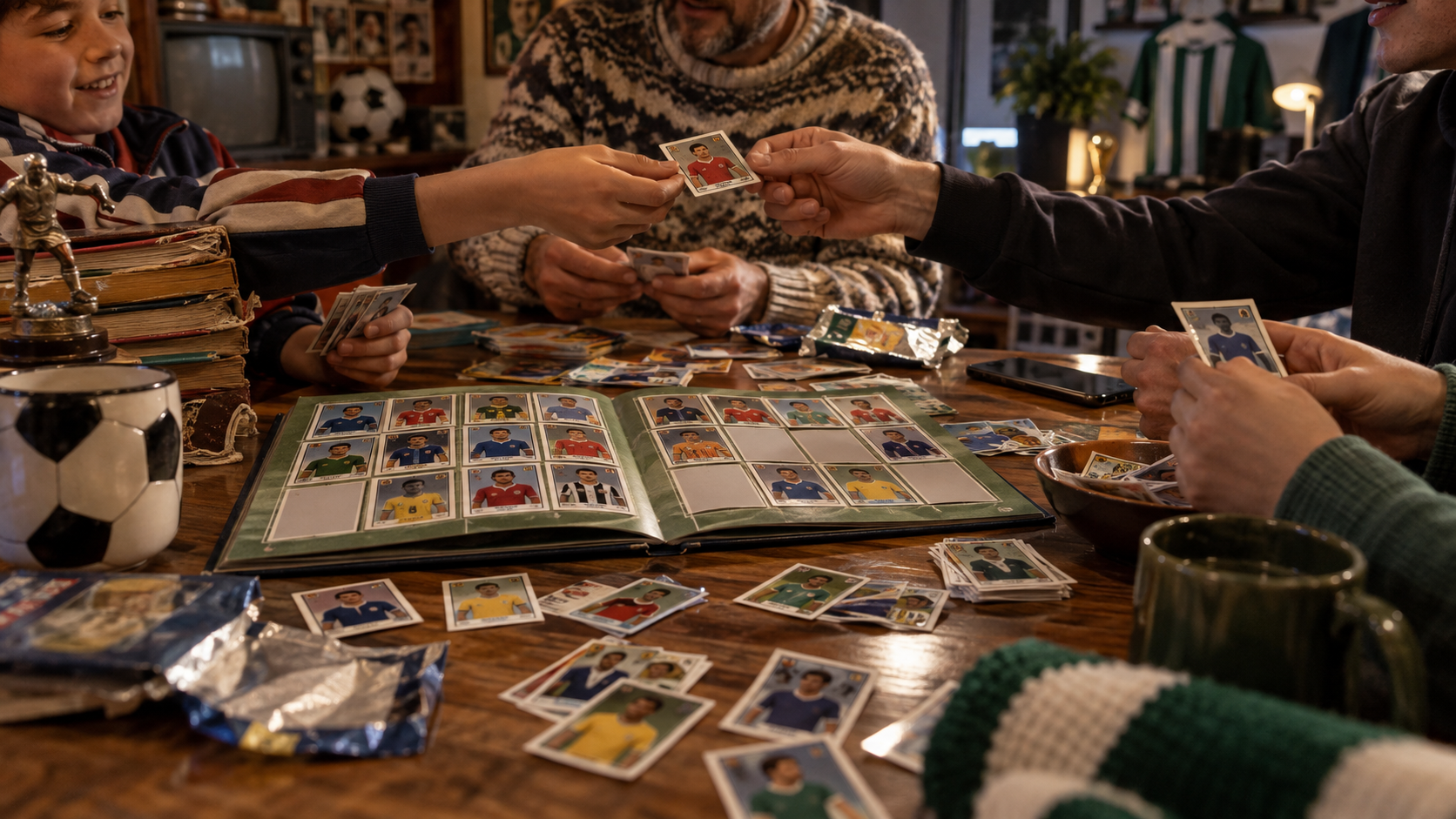
A football sticker album begins with emptiness. Pages are printed with hundreds of numbered spaces, but the players, badges and team photographs are missing. Filling those spaces turns watching football into a different kind of activity: packets are opened, duplicates accumulate, friends compare collections, and one apparently ordinary defender can suddenly become more desirable than the most famous striker in the tournament.
For generations of supporters, that process has become part of football culture in its own right. Sticker albums have introduced young fans to unfamiliar teams, provided a physical record of seasons and international tournaments, and created their own social rituals around trading. The phrase “got, got, need” could transform a school playground into an improvised marketplace where the currency was not money but missing numbers.
The appeal is unusually durable. Television coverage expanded, football information moved online, player databases became available instantly and digital collectibles appeared, yet the physical album survived. Understanding why means looking beyond the stickers themselves. The real culture developed around collecting, exchanging and remembering them.
Football Images Were Collected Before Sticker Albums
Football supporters were collecting images of players long before self-adhesive stickers became familiar. Cigarette cards, trade cards, postcards and photographs had already turned footballers into collectible subjects during the late nineteenth and twentieth centuries.
Those earlier objects established an important idea: supporters could possess a small visual representation of players they might otherwise know only from newspapers, radio reports or occasional visits to a stadium.
The sticker album changed the structure of that collecting. Instead of simply building a pile of individual images, collectors received a book that told them exactly what belonged in the collection and exactly what was still missing.
A blank numbered space created an objective. Finding the corresponding sticker provided a small moment of completion. Repeating that process hundreds of times transformed collecting from the accumulation of objects into a project with a visible beginning and end.
Panini and the Rise of the Modern Football Album
The company most closely associated with this culture is Panini. Founded in Modena, Italy, in 1961, Panini developed its long-running Calciatori football collection around Italian football. The format proved well suited to a sport organised around clearly defined clubs, squads, badges and competitions.
Football also gave publishers something especially useful: constant renewal. Players transferred, young prospects appeared, promoted teams arrived, shirts changed and each season produced another version of the football world that could be collected again.
The album therefore did not need to remain a one-time novelty. Completing one edition did not end the hobby because a new season could make much of the previous collection historically valuable but immediately outdated.
Mexico 1970 Turned the World Cup Into a Collection
The decisive international step came with the 1970 FIFA World Cup in Mexico. FIFA’s own historical material on Panini identifies Mexico 1970 as the first Panini album dedicated to the World Cup.
The scale was different from a domestic league collection. A World Cup album placed players, national teams, coaches and tournament imagery from multiple countries inside one book. A supporter who mainly followed local football could suddenly encounter a much wider map of the game.
This was particularly significant in an era when supporters could not instantly search a player profile or watch clips from almost every major league. A sticker album could act as a visual introduction to footballers who had received little coverage in the collector’s home country.
The connection between tournaments and collecting became remarkably durable. International competitions already encourage supporters to look beyond their normal club loyalties; sticker albums gave them another reason to learn the squads. SwiftPeakX explores that broader expansion of football horizons in How International Football Competitions Shaped the Modern Game.
The Album Became a Guide to Players You Had Never Seen
Older sticker albums had an informational function that is easy to underestimate from a digital perspective. Before searchable databases, streaming platforms and social media, supporters did not have effortless access to every squad competing in an international tournament.
A collector might open a packet and encounter a defender from a country whose domestic league was almost never shown on local television. After receiving the same player twice, seeing his national shirt and finding his place in the album, the name became familiar before the player had even appeared in a match the collector watched.
Children could learn flags, countries, shirt colours and football names almost accidentally. The album did not present itself as an educational textbook, but completing it required paying attention to the structure of the football world.
Why Empty Spaces Matter So Much
The psychology of the album depends heavily on what is absent. Early in a collection, opening packets is easy because almost every sticker is new. As the pages fill, progress becomes increasingly difficult.
A collector can reach a point where only a small number of empty spaces remain. By then, opening a famous player already owned several times may be disappointing, while finding an otherwise unremarkable full-back can feel like a major victory.
The album therefore creates its own temporary hierarchy. Football fame does not always determine collecting value. What matters is the relationship between the sticker in someone’s hand and the blank spaces remaining in that particular book.
This personal variation is important because two collectors can value the same packet completely differently. One may receive three duplicates; another may need all three.
Duplicates Turned Collecting Into a Social Activity
If every packet contained only stickers a collector needed, football sticker culture would probably have developed very differently. Duplicates can be frustrating, but they create the conditions for swapping.
A repeated sticker has little immediate value for the person who already owns it, yet it may fill another collector’s most stubborn empty space. Once two people have different duplicates and different needs, an exchange becomes possible.
That simple mechanism produced one of the most recognisable rituals associated with football stickers. School playgrounds, homes, streets and youth football clubs became temporary exchange points. Collectors carried bundles of duplicates and rapidly moved through one another’s piles looking for something missing.
The practice developed its own informal language. Expressions such as “got, got, need,” “swaps” and “shinies” became immediately understandable among collectors in Britain, while other countries developed their own versions of the same ritual.
Sticker Swapping Created Its Own Economy
Most childhood sticker swaps were not formal transactions, yet they quickly developed ideas of value. One ordinary duplicate could be exchanged for another ordinary duplicate. A badge, foil sticker or particularly desirable player might be treated differently.
Collectors negotiated according to what they needed rather than following an official price list. Someone close to completing a page might willingly exchange several stickers for the final missing image. Another collector with no interest in that sticker might reject exactly the same offer.
This gave collecting a social dimension that simply purchasing a completed set could not reproduce. The finished album was the objective, but negotiation was part of the experience.
Badges and Special Stickers Changed the Rhythm of Opening a Pack
Football albums rarely treated every image in exactly the same way. Team badges, national emblems, trophies, mascots, team photographs and foil finishes could visually separate certain stickers from ordinary player portraits.
That difference gave opening a packet another layer of anticipation. A glimpse of reflective material or an unusual shape could reveal that something special was inside before the collector had even identified the subject.
The attraction reflects football’s wider dependence on visual identity. Supporters recognise clubs through colours, badges and shirts as much as through written names. The same visual language appears elsewhere in fan culture, from replica kits to scarves and banners.
SwiftPeakX looks at one part of that relationship in How Football Shirts Became Symbols of Identity and Belonging.
A Sticker Album Freezes One Version of Football in Time
One reason old albums become fascinating decades later is that they preserve details that seemed ordinary when they were printed. Hairstyles, shirt designs, badge shapes, sponsors and photographic styles can identify an era almost immediately.
The squad lists also capture football at a particular moment. Players who later became legends may appear as young members of a team. Others who were major names at the time may now be remembered mostly by supporters of that generation.
An album can even preserve expectations that were quickly overtaken by events. Printing schedules mean that football collections have sometimes included players who were later left out of tournament squads, while late replacements were missing from the original book.
These imperfections can make an album more historically interesting. It records what the football world looked like — or was expected to look like — when the collection went to print.
Collecting Became Part of the Build-Up to Major Tournaments
A tournament sticker album often arrives before the tournament itself. That timing extends the fan experience backwards.
Instead of waiting for the opening match, supporters can begin learning teams, comparing squads and searching for missing stickers weeks beforehand. The ritual of collecting becomes part of the anticipation.
This is especially effective for competitions such as the World Cup because the participating teams may be unfamiliar to one another’s supporters. A completed page can make a distant national team feel recognisable before it plays.
By the time the tournament begins, some collectors already have memories attached to players they have not yet watched in that competition. A sticker repeatedly received as a duplicate can suddenly become the face seen scoring on television days later.
Sticker Albums Became Objects of Memory
The cultural importance of an old album is not limited to the football information printed inside it. Research on football sticker collecting has also described albums as artifacts of memory — objects through which collectors connect football history with personal experience.
A person opening an old album may remember the tournament, but also the shop where packets were bought, the friend who supplied a difficult sticker, the pages that were completed first or the one empty space that remained unfinished.
Marks of use can strengthen those associations. Stickers placed at an angle, handwritten notes, folded corners or worn covers show that the album was handled rather than preserved as a museum object.
That distinguishes many football stickers from memorabilia designed from the beginning to remain untouched. Traditionally, stickers were supposed to be peeled, traded, stuck and handled repeatedly.
Women’s Football Entered the Sticker Tradition
The history of football stickers also reflects which parts of the game publishers considered visible enough to become mass-market collectibles.
The National Football Museum identifies the 2011 FIFA Women’s World Cup in Germany as an important milestone: Panini produced a Women’s World Cup sticker collection for the first time.
The significance went beyond providing another product. Sticker collections place players in everyday spaces — shops, schools and homes — and encourage supporters to learn names and faces. Inclusion in that familiar format offered another sign of women’s football becoming more visible within mainstream football culture.
Later women’s tournaments continued to demonstrate how collectibles can participate in the expansion of a supporter culture rather than merely document it after the fact.
Adults Never Completely Gave Up the Album
The stereotype of sticker collecting belongs to childhood, but the practice has always had an adult audience as well. Some collectors continue buying current editions; others return during World Cups after years away from the hobby.
Nostalgia is part of the attraction. Opening a packet repeats an action remembered from school years, while tournament albums can reconnect different generations within the same family.
An adult who once collected with classmates may later open packets with children of their own. The players change, the design changes and the price changes, but the basic ritual remains recognisable.
This intergenerational quality helps explain why the football sticker album has remained culturally visible for so long. It can be introduced to a new collector without requiring the older one to abandon their own memories of the format.
Vintage Stickers Created a Different Kind of Collecting
Over time, some football stickers moved from childhood objects into the memorabilia market. Early stickers of famous players, rare variants and complete historical albums can attract specialist collectors and substantial prices.
That market should not be confused with the everyday culture that made sticker albums popular. Most packets were originally opened by people hoping to fill an album, not by investors trying to preserve every item in perfect condition.
The difference matters. A rare vintage sticker may now be valuable because so many original examples were peeled, exchanged, damaged or permanently stuck into albums exactly as their publishers intended.
The Internet Expanded the Playground
Digital communication could have made traditional swapping obsolete. Instead, it often expanded it.
Collectors began posting lists of duplicates and missing numbers online. During the 2014 World Cup, social media became a prominent meeting place for sticker exchanges, allowing people to arrange swaps beyond their immediate school, workplace or neighbourhood.
The mechanism remained almost unchanged. One person still had something another person needed. The difference was that the potential trading partner could now live hundreds of kilometres away.
The old playground language even migrated online, with expressions such as #GotGotNeed becoming useful ways for collectors to find one another.
Digital Albums Changed the Format but Not the Basic Idea
Football collecting itself has also become digital. Virtual albums can reproduce the concepts of opening packs, obtaining duplicates, trading and attempting to complete a collection without requiring physical paper.
FIFA Collect’s later digital celebration of historical Panini World Cup albums demonstrates how comfortably the old collecting language can move onto new platforms. Album covers and stickers that once existed only as physical objects can now be revisited digitally.
Yet the digital version does not erase the distinctive qualities of paper. A physical sticker can be passed across a table. A packet has to be torn open. A sticker can be positioned badly and remain slightly crooked for the rest of the album’s life.
Those details may seem trivial, but they are part of why collectors form memories around the object rather than simply the image printed on it.
Why Football Is So Well Suited to Sticker Collecting
Football provides an unusually large set of things to collect. A supporter can care about players, clubs, national teams, badges, shirts, stadiums, managers and competitions simultaneously.
It is also a sport built around repetition and renewal. Domestic seasons return each year. International tournaments return in cycles. Squads change without making the older versions meaningless.
This allows sticker albums to do two apparently contradictory things. Every new edition celebrates the present, while keeping older editions creates an archive of the past.
The same process can be seen in other supporter objects. Scarves, banners and shirts acquire meaning because they connect visual material with particular clubs, places and memories. SwiftPeakX explores that wider symbolic world in From Scarves to Banners: The Symbols That Unite Football Supporters.
The Finished Album Is Only Part of the Story
A completed sticker album appears to be the final objective: no empty spaces, no missing numbers and no reason to keep searching. But focusing only on completion misses much of what made the hobby culturally important.
The memories usually come from the process. Opening a packet before school. Discovering another duplicate. Protecting a shiny badge. Negotiating a swap. Finally locating one stubborn player. Comparing progress with friends. Starting again when the next tournament arrived.
That is why a football sticker album can remain meaningful even when every statistic printed inside it is decades out of date. The information becomes historical, while the experience attached to the object remains personal.
A Football World Small Enough to Hold in Your Hands
Football itself never reaches completion. A league ends and another season begins. A World Cup champion is crowned and qualification eventually starts again. Players retire and new names take their places.
The sticker album offers the opposite experience. For one season or tournament, football is divided into numbered spaces and completion seems possible. The collector can see exactly what is missing and, eventually, fill the final gap.
That simple structure helped create a culture that survived major changes in media and technology. The stickers mattered, but so did the duplicates, the playground negotiations, the empty pages and the people who helped fill them. More than six decades after Panini’s early football collections, opening a packet still turns a vast global sport into something small enough to trade with a friend.
Recommended Sources for Further Reading
- Panini Group — About Us and the History of Panini Collecting
- FIFA Collect — Panini Legacy and the History of FIFA World Cup Albums
- National Football Museum — 2011 Women’s World Cup Stickers
- The Guardian — Swapsies and Shinies: 60 Years of Panini Football Stickers
- The Guardian — How World Cup Sticker Swapping Expanded Through Social Media
- Alejandro Uribe-Tirado — Football-Soccer Sticker Albums as Collecting, Social Practice and Artifacts of Memory


