
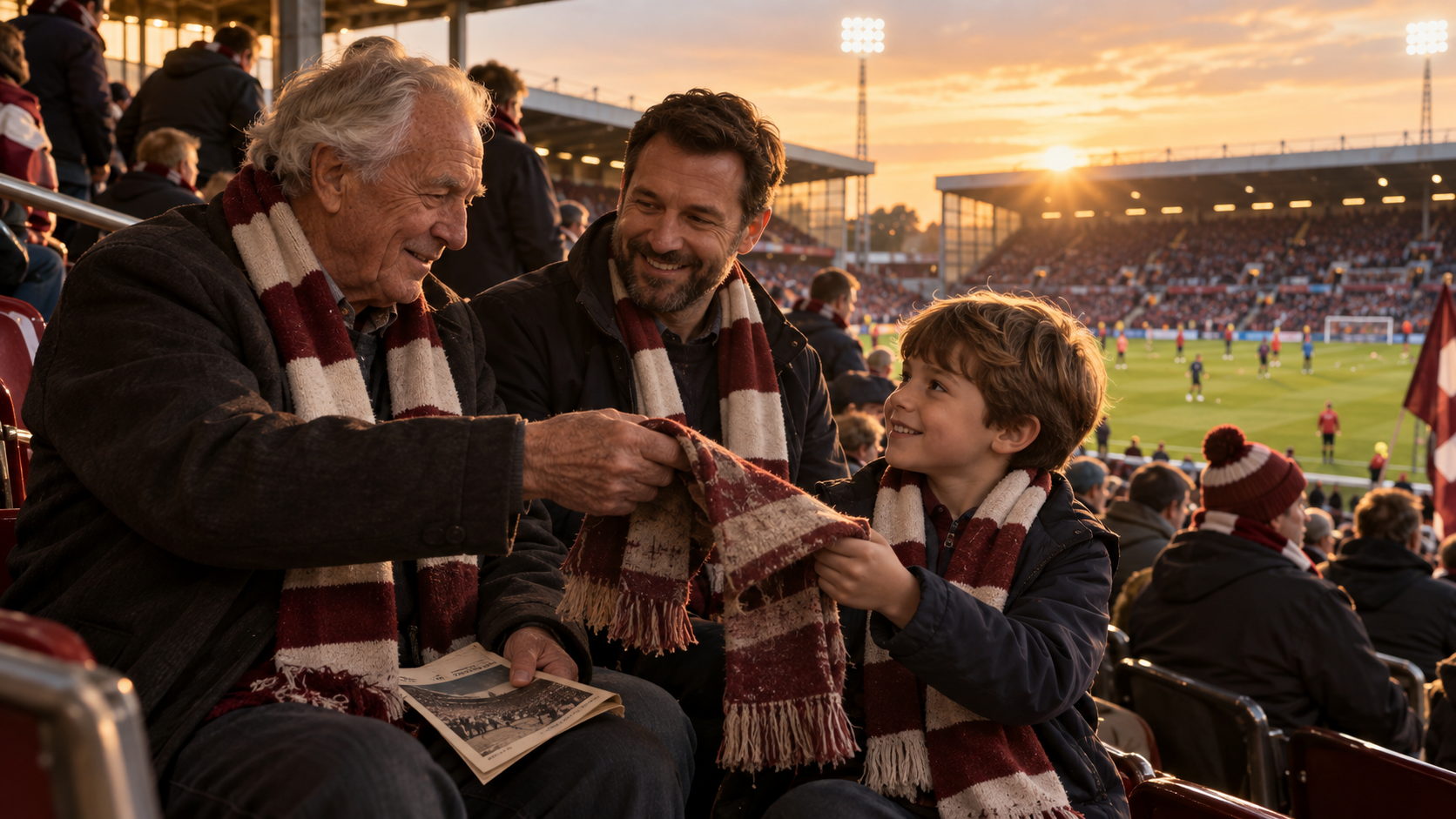
A child rarely begins supporting a football club by studying league tables and making a rational comparison. More often, the introduction is much smaller. A parent puts a scarf around their shoulders. A grandparent talks about an old match. A sibling celebrates a goal in the living room. Someone buys the child a shirt before they fully understand what the badge represents.
Years later, those ordinary moments can become the beginning of a lifelong football identity.
This is one reason club loyalty can survive far longer than players, managers and even stadiums. Football support is often learned socially. Families pass down stories, colours, matchday routines and emotional habits until a club that originally belonged to someone else begins to feel personally meaningful to the next generation.
The process is powerful, but it is not automatic. Children can reject the family club, follow a different team, become attached to an individual player or engage with football in ways their parents never did. Club loyalty is therefore better understood as cultural transmission rather than inheritance in the literal sense: families create the conditions for allegiance, but every generation still interprets football for itself.
Football Loyalty Often Begins Before a Child Understands the Game
A very young supporter may recognise colours before tactics, players or league positions.
The club appears through objects and routines. A shirt hangs in a bedroom. A parent becomes unusually emotional on Saturday afternoon. A badge appears on mugs, scarves or photographs. Certain songs are heard repeatedly. Match results change the mood of people in the house.
Before the child can explain what supporting a club means, they may already understand that this particular team matters to the family.
Research into sports-team identification has repeatedly found that parents and close family members can be important socialising influences during childhood. The precise pattern varies between households and cultures, but football fandom often begins through repeated exposure to people whose emotional attachment is already established.
The Family Club Is Often Presented as Something That Already Exists
One distinctive feature of inherited football loyalty is that the child often enters a story already in progress.
The parent did not begin supporting the club when the child was born. There are already memories, heroes, disappointments and grudges. Some matches have become family legends. Former players are spoken about as though everyone should know them.
The child therefore receives more than a current team. They receive a version of the club’s past filtered through family memory.
A grandparent might remember standing at an old ground. A parent may describe a promotion season, relegation battle or cup run. These stories teach the younger supporter which moments are supposed to matter.
The wider relationship between club and community gives those stories additional meaning. SwiftPeakX explores that connection in Football and Local Identity: Why Clubs Represent Their Communities.
The First Shirt Can Work Like an Introduction
For many children, one of the earliest physical signs of club allegiance is clothing.
A miniature football shirt can be given as a birthday present long before the recipient knows the starting eleven. Family photographs may show children wearing club colours before they can remember doing so.
The shirt matters because it makes identity visible. The child is not merely watching somebody else’s club; they are dressed as part of it.
As the child gets older, the meaning can change. The first shirt may become too small but survive in a drawer. Another is associated with the first match attended. A later one recalls a favourite player or successful season.
Clothing gradually becomes part of family memory rather than simply merchandise. The wider history of this relationship is explored in How Football Shirts Became Symbols of Identity and Belonging.
Watching Together Teaches More Than the Rules
A child watching football with relatives learns the game and the culture surrounding it at the same time.
They learn why a particular opponent receives a different reaction. They discover which former player is still admired and which departure remains controversial. They notice when family members become nervous, optimistic or angry.
Much of this knowledge is not formally explained. It is absorbed through repetition.
The child learns when a match is important because everyone else behaves as though it is important. Rivalries, traditions and expectations become understandable through emotional context before they are understood historically.
In this way, football fandom resembles other forms of cultural learning. The younger person observes how people around them behave and gradually acquires the language required to participate.
The First Match Can Turn a Family Story Into a Personal Memory
Watching television can introduce a club, but attending a match often changes the scale of the experience.
The child encounters the journey, the streets around the ground, the size of the stands, the smell of food, the noise of the crowd and the sudden movement when a goal is scored.
For the adult, many of these details may already be routine. For the child, they are new.
This difference makes first-match stories unusually durable. Supporters frequently remember who took them, where they sat or stood, the opponent and sometimes even details that had little importance to the result.
The match becomes significant because football memory and family memory overlap. Even an unremarkable draw can remain important if it was the afternoon when a parent or grandparent first led someone through the turnstile.
A Matchday Routine Can Become a Family Tradition
Repeated attendance produces rituals that extend beyond the match itself.
The family may take the same route, meet in the same place, buy food from the same stall or enter through the same part of the stadium. None of these actions directly affects the football, yet repetition gives them emotional weight.
Years later, the ritual can become almost as memorable as the matches.
A child who once followed an adult through that routine may eventually become the person organising it. The direction of care changes, but the matchday sequence survives.
This is one way family fandom creates continuity without requiring football itself to remain unchanged.
Songs Are Learned by Joining In
Football chants are another form of knowledge that can pass between generations without formal teaching.
A young supporter hears a parent and thousands of strangers singing the same words. At first, only the rhythm may be familiar. After repeated matches, more of the song becomes recognisable until the child eventually participates without needing instruction.
Older chants can survive even after the players, managers or circumstances that originally inspired them have disappeared.
This gives stadium singing an intergenerational character. The same song can be performed by people whose first matches occurred decades apart.
SwiftPeakX examines the wider development of this tradition in Why Football Fans Sing: The History and Meaning of Stadium Chants.
Objects Can Become Family Football Archives
Football families often accumulate objects without deliberately creating an archive.
Old scarves remain in cupboards. Programmes are stored in boxes. Match tickets survive inside books. Photographs show relatives outside stadiums that may no longer exist. Shirts from different decades accumulate until they begin to document changes in sponsors, manufacturers and design.
The objects gain meaning because somebody can explain them.
An old ticket is simply printed paper until a parent describes the match attached to it. A faded scarf becomes more significant when a grandparent explains where it was worn.
This oral context allows memorabilia to connect generations who never experienced the same period of football.
Supporting the Same Club Creates Shared Time
Families naturally contain different generations with different daily lives. Football can provide one recurring event that everybody understands.
A parent and adult child may live separately but still discuss every match. Grandparents can compare current players with footballers from their own youth. Siblings who disagree about many things may still share the same reaction to a late winner.
This recurring calendar matters. Seasons structure conversation through fixtures, derbies, cup rounds, transfer windows and promotion or relegation battles.
The club gives family members a subject that continually renews itself without requiring their relationship to begin again.
Loyalty Can Survive Generations of Different Players
One striking feature of club support is how little continuity exists on the pitch compared with the continuity in the stands.
A grandparent’s favourite player may have retired before the youngest family member was born. The manager changes. Owners change. The badge may be redesigned and the stadium rebuilt.
Yet the family still describes itself as supporting the same club.
This helps explain why football allegiance is often directed toward an institution rather than an individual team of players. The squad is temporary. The club provides the long-term thread that allows memories from several generations to be treated as parts of one story.
Winning Is Not Necessary for Loyalty to Be Passed Down
If football allegiance depended entirely on success, struggling clubs would find it extremely difficult to maintain support over generations.
Families demonstrate why that does not always happen.
A child may inherit attachment to a club that has not won a major trophy during their lifetime because the value of the team is not limited to trophies. It may represent the city, neighbourhood, family history or simply years of shared experience.
Periods of failure can even generate stories that become part of the inheritance. Older supporters remember difficult seasons and teach younger ones that loyalty was tested long before they arrived.
This does not mean supporters enjoy losing. It means sporting success is only one element in explaining why some attachments remain durable.
Family Influence Is Strong, but It Is Not Automatic
The familiar story of a child following the family club can make football allegiance sound predetermined. Research suggests something more complicated.
Parents can strongly influence early fandom, but children encounter other influences as they grow. Friends, school, local geography, television, famous players, social media and sporting success can all compete with family tradition.
A family may provide the first club somebody knows without providing the club they eventually choose.
This distinction matters because authentic supporter culture cannot simply be imposed. A parent can take a child to matches, buy a shirt and explain family history. The emotional attachment that follows still belongs to the child.
When a Child Chooses the Rival
The strength of the family tradition becomes especially visible when it breaks.
Research by Ilan Tamir examined fathers whose sons chose to support different football clubs. The study found that this apparently simple sporting disagreement could be experienced as disruption to family legacy and football heritage.
That reaction reveals how much meaning adults sometimes place on transmission. Supporting the same club is imagined as continuity between generations, so choosing another team can feel larger than an ordinary difference in sporting preference.
In everyday life, the outcome can range from playful rivalry to genuine disappointment. Mixed-club households may develop their own traditions, with family members attending different matches or turning derby days into internal competitions.
The break in continuity does not necessarily destroy football’s family role. Sometimes it simply changes its form.
The Story Is Bigger Than Fathers and Sons
Older research on football fandom often placed considerable emphasis on fathers introducing sons to the game. That relationship is real and well documented, but it should not be mistaken for the only route through which football culture moves between generations.
Mothers, daughters, grandparents, siblings, aunts, uncles and other relatives can all transmit football allegiance.
Changes in stadium demographics and the growth of women’s football have also made many traditional assumptions about the “typical” football family increasingly inadequate.
A daughter may inherit a club from her mother. A grandparent may be responsible for the first season ticket. An older sibling may become the strongest football influence in the household.
The important element is repeated social connection, not one fixed family structure.
Migration Can Separate the Family Club From the Family Home
Football families do not always remain geographically close to their club.
People move for work, education or family reasons. Children may grow up hundreds or thousands of kilometres from the stadium their parents once attended regularly.
In these situations, club loyalty can become one connection with a place the younger generation knows mainly through family stories.
Television and digital media make this easier than it was for earlier generations. A family living far from its original city can still watch matches together, follow club media and maintain rituals that once depended on physical proximity.
The result can be a form of inherited local identity experienced from a distance.
Global Football Gives Children More Choices Than Earlier Generations Had
A child growing up in the modern football environment encounters far more teams than many previous generations did.
International leagues are broadcast widely. Highlights circulate instantly. Players communicate directly with global audiences through social media. Video games make distant clubs and footballers familiar before a child has ever visited their country.
This means family influence now competes with a much larger football marketplace.
A recent study of 436 self-identified football fans in Indonesia found generational differences in digital engagement and highlighted the growing influence of athlete-centred identification. The findings belong to a specific sample and should not be treated as universal, but they illustrate a wider change: younger supporters can form strong attachments through individual players and online media as well as through family or locality.
The family club therefore survives in an environment where alternative loyalties are constantly visible.
A Famous Player Can Complicate Inherited Loyalty
Children often discover football through players rather than institutions.
A spectacular forward, goalkeeper or international star can become the first reason someone watches a particular team. If that player later transfers, the young supporter faces a choice that older family-based models of fandom did not always anticipate.
Do they remain with the club or follow the player?
For an established supporter, the answer may appear obvious because the club existed before the player and will remain after them. For a child whose first emotional connection was with the footballer, the distinction can be less clear.
Family socialisation can gradually shift the focus from the temporary star toward the longer history of the club, but it cannot guarantee that transition.
Season Tickets Can Function as Intergenerational Objects
Few football objects represent continuity as clearly as a long-held season ticket.
The value is not only access to matches. A regular seat can become part of family geography inside the stadium. Supporters know the people around them, the route to the seat and the view of the pitch.
Recent research into English football fandom has described season tickets, youth concessions and senior concessions as important elements within intergenerational supporter culture. Interviews with fan activists during the 2024–25 season showed concern that rising prices and reductions in concessions could make it harder for older and younger supporters to attend together.
This highlights a practical truth: traditions can only be passed down if the next generation has opportunities to participate.
Ticket Prices Can Become a Cultural Problem, Not Only a Financial One
The cost of football is usually discussed economically, but family fandom gives ticket pricing a cultural dimension.
If parents cannot afford to bring children regularly, the next generation loses one traditional route into matchgoing culture. If older supporters give up season tickets, decades of social connection inside one part of the stadium may end with them.
This does not mean supporter culture disappears. Young fans can engage through television, local supporter groups, women’s football, lower divisions or digital communities.
But the form of transmission changes when attending together becomes difficult.
New Generations Do Not Simply Copy the Old Ones
Even when club allegiance survives intact, the way supporters express it can change.
An older generation may have followed football through newspapers, radio and weekly stadium attendance. Their children may combine matches with television coverage, podcasts and online discussion. A younger generation may experience the same club through short-form video, digital communities and constant access to players’ lives.
The badge remains the same while the surrounding culture changes.
This is why intergenerational football culture should not be understood as perfect replication. Traditions are transmitted and then adapted.
A young supporter can inherit the club while developing a completely different way of supporting it.
Grandparents Can Connect Children With a Football World That Has Disappeared
One of the distinctive qualities of intergenerational fandom is access to memories from before someone’s own lifetime.
A grandparent can describe standing terraces that have been rebuilt, players known only through old footage and journeys made before modern transport or television coverage.
The younger supporter cannot directly remember those experiences, but they become part of their understanding of what the club has been.
This produces layered football memory. One generation remembers an event personally; another remembers hearing the story.
After enough repetition, both can treat the moment as part of family history.
Football Can Preserve Relationships Through Changing Life Stages
Family routines rarely remain unchanged forever. Children become adults. People leave home. Work patterns change. Parents age.
Football can provide continuity through those transitions.
A parent who once bought every ticket may later be driven to the stadium by the child they introduced to football. The younger supporter may begin explaining new players to the older one. Eventually, responsibility for preserving the routine can move to the next generation.
This reversal is one reason club loyalty can become emotionally powerful. The football remains a recurring activity while the relationship around it changes.
The Club Becomes a Container for Family Memory
Over decades, it can become difficult to separate football memories from family memories.
A promotion is remembered because of who watched it together. A stadium may be associated with a relative who has since died. A scarf may matter because of the person who originally owned it rather than because of its design.
The club becomes a reference point through which different stages of life are remembered.
This explains why football inheritance can continue even when sporting reasons for choosing the club appear weak. Supporters are sometimes protecting a connection with people as much as a connection with a team.
Loyalty Is Passed Down Through Participation, Not Genetics
The language of football often describes supporters as though allegiance were inherited automatically: born into the club, football in the blood, generations of the same family.
The metaphors are powerful, but the actual process is social.
Children hear stories. They are taken to matches. They receive shirts. They watch adults react. They learn songs and rivalries. They encounter objects connected with earlier seasons. Repetition gradually turns somebody else’s loyalty into an experience of their own.
Sometimes the process works exactly as the older generation hopes. Sometimes it produces a supporter who loves the same club but expresses that attachment differently. Sometimes the child chooses another team entirely.
That uncertainty is important. Football families do not manufacture identical supporters. They provide traditions that each generation decides how to carry forward.
Why Football Families Matter to Club Culture
A football club survives through institutions, finances and competition, but its cultural continuity depends heavily on people deciding that the club remains worth caring about.
Families are one of the places where that decision is repeatedly renewed.
A child is shown the badge. A story is retold. A first match becomes a memory. Years later, that supporter may repeat part of the process with someone younger.
The players on the pitch will be different and the stadium may have changed, but the act of introducing another person to the club connects one football era with the next.
That is the deeper meaning of inherited loyalty. It is not simply supporting the team a parent supported. It is the continual movement of football memory between people who never experienced exactly the same version of the game.
Recommended Sources for Further Reading
- The Sociological Review — Intergenerational (In) Securities in English Football Fandom: Locality, Loyalty and Legacy
- Men and Masculinities — I Love You Kid, But…: Intergenerational Soccer Fandom Conflict
- Frontiers in Psychology — The People’s Game: Evolutionary Perspectives on the Behavioural Neuroscience of Football Fandom
- Soccer & Society — Football Fandom: A Bounded Identification
- Polis — The Evolutionary Approach to Cultural Transmission: The Case of Football Fandom
- Soccer & Society — Rebalancing Loyalties: Athlete Branding and Digital Engagement Across Generations in Indonesia’s Football Fans


