
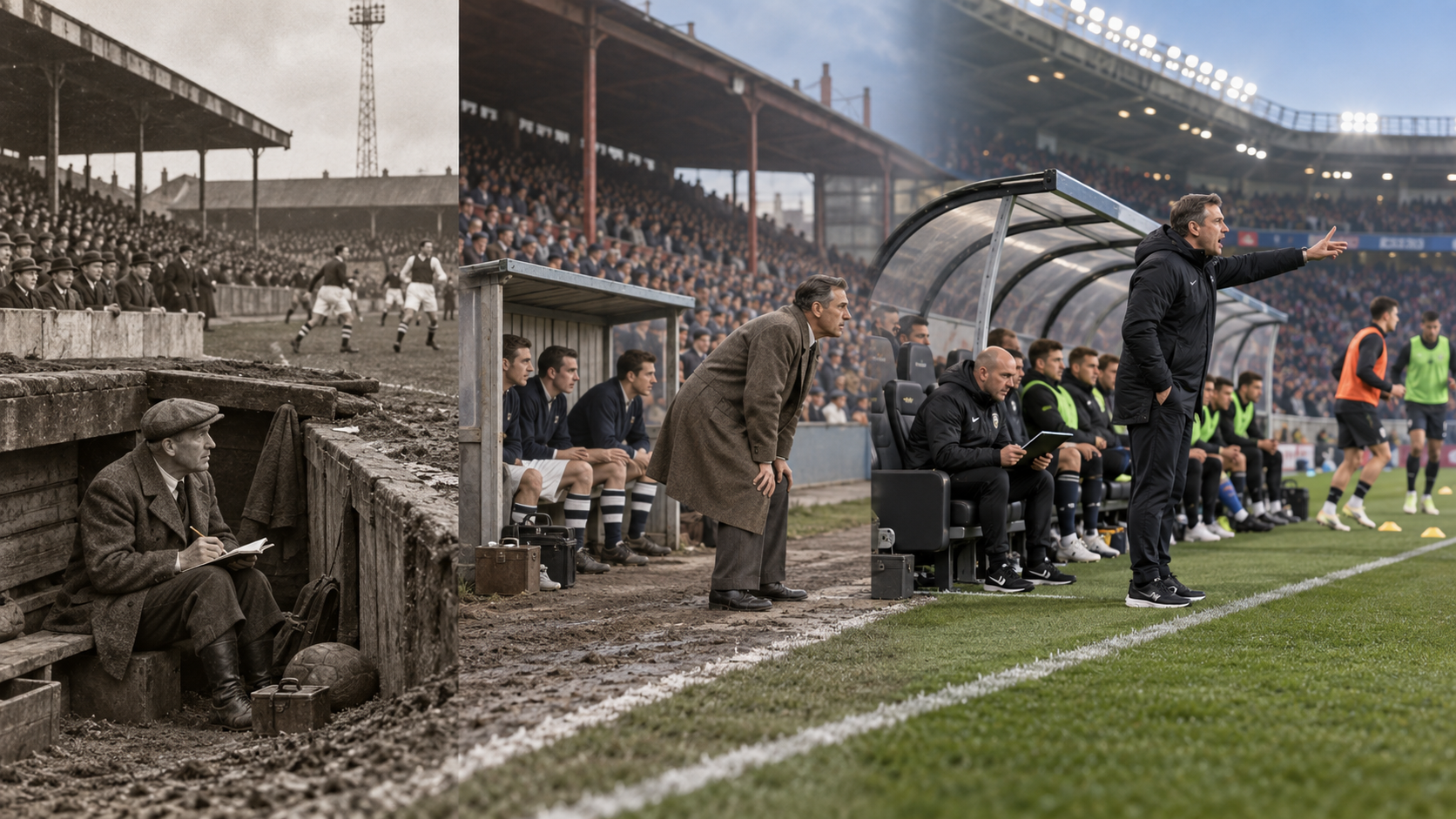
A modern football touchline can be almost as busy as the pitch. The head coach stands close to the white line giving instructions. Assistants discuss tactical changes. Substitutes wait on padded seats, analysts look at screens, medical staff prepare equipment, and players warm up only a few metres away.
That organised strip beside the field looks completely normal today, but football did not always give coaches such a clearly defined place from which to influence a match. For much of the game’s early history, trainers and managers could spend matches seated on simple benches or watching from the stands, with far less opportunity to communicate directly with players.
The transformation from bench to dugout and eventually to the modern technical area reflects several changes happening at once: coaching became more important during matches, substitutions expanded, medical and specialist staff grew in number, stadiums changed, and football’s Laws had to define exactly where all these people were allowed to work.
Early Football Did Not Need a Modern Technical Area
In nineteenth-century football, the touchline did not contain the organised coaching environment familiar today. The game itself was still developing, and the role of the manager or trainer was very different from that of a modern head coach.
Many tactical decisions were understood as the responsibility of players on the field. A trainer could prepare the team before the match, but the idea of a coach constantly directing pressing positions, substitutions and changes of shape from a marked zone beside the pitch belonged to a later version of football.
The Laws also had little reason to define a technical area if there was no large group of substitutes, analysts, assistant coaches and medical personnel occupying one.
As football became more organised, however, the people responsible for preparing teams needed a better way to observe matches and remain close to the action.
Before the Dugout, Trainers Often Used Simple Benches
The early solution was uncomplicated: a bench near the pitch.
It provided somewhere for trainers and other team personnel to sit, but it offered limited protection from rain, wind and cold. Depending on the design of the ground, sitting at pitch level could also provide a poor view of players’ movement and technique.
In larger stadiums, a manager positioned farther back in the stand might gain a broader tactical view but lose the ability to communicate easily with players.
The touchline therefore presented an awkward problem: how could a trainer remain close enough to observe and instruct without blocking spectators or spending an entire match exposed to the weather?
Donald Colman and the Pittodrie Dugout
One of football’s most influential touchline innovations is associated with Donald Colman, a former Scotland international who later became a trainer at Aberdeen.
Colman was interested in studying players’ footwork. A sheltered position set slightly below the level of the playing surface allowed him to remain close to the pitch while observing players without obstructing the view of spectators behind him.
The solution became known as the dugout.
Pittodrie Stadium is widely identified as the birthplace of the football dugout. Older accounts often dated the innovation to the 1920s, but research by the Aberdeen FC Heritage Trust has challenged that chronology.
Colman did not return to Aberdeen as trainer until 1931. By examining photographs and newspaper material, the Heritage Trust concluded that the dugouts were most likely installed during the summer of 1934, ready for the 1934–35 season. Photographs from April 1934 still show trainers using benches, while images later that year indicate the new structure had appeared.
This is a useful example of why football history sometimes needs more than repeating a familiar origin story. The association between Colman, Pittodrie and the dugout is well established, but the precise date becomes clearer when contemporary evidence is examined.
Why Was It Dug Into the Ground?
The early dugout was not simply a roof placed above an ordinary bench.
Part of its usefulness came from positioning the occupants below normal pitch level. Colman could remain close to the field and watch players’ feet while the lowered structure reduced the obstruction for people sitting or standing behind it.
The design also offered shelter. Scottish football grounds could provide difficult weather conditions, and a covered space beside the pitch was an obvious improvement over an exposed bench.
What began as a practical solution eventually produced one of football’s most familiar pieces of stadium architecture.
The Idea Spread Beyond Aberdeen
Once the usefulness of the structure became obvious, similar arrangements began appearing elsewhere.
Aberdeen’s historical research shows that the idea was already attracting attention in Scotland during the mid-1930s. A Dundee newspaper discussing ground improvements in 1935 referred specifically to the Pittodrie arrangement and its advantages for trainers.
Accounts also connect the spread of dugouts into English football with Everton after contact with Aberdeen later in the decade, although the precise route by which the idea travelled is less certain than the basic story of Colman’s innovation.
The design did not need complicated technology to spread. It solved a universal problem faced by clubs: team staff needed a sheltered position near the field without interfering with spectators.
The Dugout Changed the Relationship Between Coach and Match
A seat close to the pitch does more than improve comfort. It changes what a coach can do during the match.
From the touchline, instructions can be delivered immediately. A player can receive a message without waiting for half-time. A trainer can observe an injury at close range. A coach can respond to the opponent’s positioning while the game is still unfolding.
Modern supporters take this influence for granted, but football spent decades working out how much freedom a coach should have beside the pitch.
The wider development of the Laws followed a similarly gradual process. SwiftPeakX examines that history in How the Laws of Football Changed From 1863 to the Modern Game.
Substitutes Made the Bench More Important
The meaning of the bench changed significantly as substitution became a normal part of competitive football.
A touchline seating area no longer existed only for trainers and medical staff. It now held players who might enter the match and change its outcome.
At FIFA World Cups, substitutions were first permitted at Mexico 1970, when teams could use two substitutes. Later tournaments increased the number available, and modern football allows considerably deeper matchday benches than those early competitions.
This changed the touchline tactically as well as physically. The coach was no longer merely watching the starting eleven. Decisions made beside the pitch could introduce fresh players, change a formation or respond to an injury.
The Bench Became Part of Match Strategy
As the number and tactical importance of substitutes increased, the expression “strength in depth” acquired a literal touchline presence.
A coach could look along the bench and see several different solutions: an extra defender to protect a lead, a quick attacker for a counterattack, a midfielder capable of controlling possession or a specialist prepared for a particular set piece.
The bench therefore became more than a waiting area. It became part of the available tactical resources of a team.
Modern five-substitution rules have strengthened this relationship further. UEFA technical analysis has noted how larger substitution possibilities increase the importance of squad management and the influence players can have after beginning a match on the bench.
Coaches Did Not Always Have Freedom to Stand
Modern television regularly shows managers spending almost an entire match on their feet. Historically, that freedom was much less obvious.
UEFA’s technical director Andy Roxburgh recalled that even during the late 1980s, some competitions relied on informal understandings allowing coaches to stand beside the bench and give instructions.
The lack of a universal framework created problems. One official might tolerate a coach remaining beside the pitch, while another could interpret the existing rules more strictly and require the coach to sit down.
A professional activity that had become tactically important was therefore operating without an equally clear legal space.
The Technical Area Gave the Coach a Defined Workplace
The solution was to formalise the space.
By 1994, the International Football Association Board had incorporated the technical area into the framework of the Laws of the Game. The concept transformed an informal touchline environment into a clearly regulated zone.
The difference between a dugout and a technical area is important. The dugout is primarily the physical shelter or seating. The technical area includes that seating but also defines the space around it in which authorised team personnel may operate.
The white lines beside modern benches therefore have a legal purpose. They are not decorative markings. They show where the team’s touchline workplace begins and ends.
Law 1 Defines the Modern Technical Area
Under the current Laws of the Game, the technical area normally extends one metre on either side of the designated seated area and forward to a point one metre from the touchline.
Its occupants must be identified before the match according to competition rules and are expected to behave responsibly.
Only one person at a time is authorised to convey tactical instructions from the technical area, while people normally must remain within its boundaries except for permitted situations such as medical staff entering the field to assess an injured player.
The modern touchline is therefore both a working environment and a regulated part of the field’s surroundings.
The Coach Eventually Gained More Freedom to Remain Standing
Formalising the technical area did not end arguments over what coaches were allowed to do inside it.
For a period, the accepted procedure required a coach to stand to give instructions and then return to the bench. This could look artificial once managers had become increasingly active participants in the match.
In 2009, UEFA highlighted an IFAB change allowing one authorised person to remain standing within the technical area, provided behaviour remained responsible.
The change acknowledged something football practice had already made obvious: coaching from the touchline had become an established part of the professional game.
The Fourth Official Became Part of Touchline Management
A modern technical area also requires someone to manage the boundary between team staff and the officiating crew.
The fourth official became increasingly important in this environment. Alongside administrative duties such as managing substitutions, the fourth official communicates with coaches and helps deal with behaviour around the benches.
This role can be difficult because the technical area is emotionally close to the match. Coaches react to fouls, decisions and tactical events only metres from an official responsible for maintaining order.
The touchline therefore became a place where tactical communication and match discipline constantly overlap.
Football Eventually Introduced Cards for Team Officials
For many years, disciplinary action against managers and other team staff looked different from discipline applied to players.
That changed significantly in 2019. IFAB introduced the formal use of yellow and red cards for misconduct by team officials.
The change made touchline discipline much clearer for players, spectators and television audiences. Persistent failure to respect the technical area’s boundaries, dissent and other irresponsible behaviour can lead to a caution, while more serious conduct can result in a sending-off.
If an offence is committed by someone from the technical area and the individual cannot be identified, the senior coach can receive the sanction under the conditions specified by the Laws.
The manager had become visible enough within the match that football eventually gave officials an equally visible way of disciplining them.
The Dugout Grew Into a Multi-Department Workplace
Colman’s early dugout was designed around the needs of a trainer. A modern elite bench can accommodate an entire group of specialists.
The head coach may sit alongside assistant coaches, goalkeeping staff, medical personnel, fitness staff and substitutes. Competition regulations determine exactly how many people may be present.
At the highest levels the numbers can be striking. UEFA regulations for some current competitions allow more than twenty substitutes and officials combined to occupy the team bench area.
The physical growth of the bench mirrors the increasing complexity of professional football, but this article’s key point is spatial: all those people now require an organised, regulated place from which to work.
Technology Arrived in the Technical Area
The modern bench does not only contain people. It contains information.
Coaching staff can use permitted handheld electronic equipment for tactical, coaching, player-welfare and safety purposes. Current Laws allow items such as headsets, smartphones, tablets and laptops within defined limits.
Performance-tracking systems can also transmit reliable data to the technical area during official competitions when approved under the relevant regulations.
This represents a remarkable distance from the original idea of a trainer sitting below pitch level with a notebook. The purpose remains observation and decision-making, but the information available has changed dramatically.
The Best View Is Not Always at Pitch Level
The closeness of the technical area creates one disadvantage: perspective.
A coach only metres from the pitch can communicate quickly but may find it harder to see the spacing between entire lines of players than an analyst sitting much higher in the stadium.
This is one reason elite coaching teams often divide observation. Some staff remain on the touchline while others watch from elevated positions and communicate information downward.
Donald Colman’s problem has therefore not disappeared; it has simply changed. Football still tries to balance proximity with perspective.
Stadium Design Changed the Look of the Dugout
Dugouts themselves have changed as stadiums developed.
Traditional sunken shelters remain visually associated with older football grounds, while modern stadiums frequently use transparent structures, integrated bench seating and premium padded chairs positioned within highly engineered touchline areas.
Some benches sit almost level with spectators; others are incorporated into the main stand. Sightlines, television cameras, advertising positions and access to dressing rooms all influence their location.
The wider relationship between physical stadium design and the experience of football is explored in How Stadium Architecture Shapes the Matchday Experience.
All-Seater Stadiums Changed the Environment Around the Touchline
The surroundings of the technical area changed along with the rest of the stadium.
Older grounds could place coaches beside densely packed standing spectators, perimeter tracks or simple enclosures. Modern all-seater stadiums generally produce more structured circulation routes, controlled access and clearer separation between the competition area and the crowd.
The technical area became one component of a stadium increasingly designed around distinct zones for players, officials, staff, media and spectators.
SwiftPeakX examines that broader physical transformation in From Terraces to All-Seater Stadiums: The Evolution of Football Grounds.
Substitutes Need Space Beyond the Seats
The bench itself is only part of a modern substitution system.
Players preparing to enter need somewhere to warm up without interfering with the assistant referee or active play. Competition organisers therefore designate particular warm-up zones around the technical area or behind the goal, depending on stadium design.
Current UEFA competition rules can also limit how many substitutes warm up simultaneously, showing how carefully the area around the touchline is now managed.
What once looked like unused grass beside the field has become operational space governed by detailed procedures.
The Touchline Became a Stage for the Manager
The television era gave the technical area another function that Donald Colman could hardly have anticipated: performance.
Cameras constantly record the manager’s reactions. A tactical gesture, argument, celebration or expression of frustration can be replayed within seconds and circulated globally before the match has finished.
This has made touchline behaviour part of football’s visual culture. Supporters recognise managers not only through interviews and results but through characteristic ways of standing, celebrating or directing players.
The technical area is therefore both a workplace and one of the most closely observed spaces inside a modern stadium.
Why Coaches Still Cannot Simply Go Wherever They Want
Giving coaches greater influence did not mean removing boundaries.
A manager stepping onto the field could interfere with players or match officials. Staff moving toward the opposition bench could create confrontation. Too many people standing beside the touchline could obstruct the assistant referee.
The technical area’s painted border therefore represents a compromise. Football accepts that coaching from the side of the pitch is part of the game, but that influence must operate within a controlled space.
The history of the touchline is partly the history of football deciding where coaching authority physically ends.
The Modern Technical Area Still Carries the Idea of the Dugout
A current elite technical area may look very different from Pittodrie in 1934. The seating is larger. The staff are more numerous. Tactical information may arrive digitally, and television cameras record almost every reaction.
Yet the basic purpose remains recognisable.
The team needs a place beside the field where the people responsible for preparing and supporting the players can observe the match, communicate and respond to events.
Donald Colman’s sheltered observation point provided an early answer to that problem. Football later enlarged it, regulated it and filled it with specialists and technology.
From Shelter to Command Centre
The evolution of the football touchline did not happen through one rule change.
The dugout improved observation and shelter. Substitutions increased the tactical value of the bench. Managers gained greater freedom to communicate during matches. IFAB defined the technical area. Fourth officials helped manage it. Disciplinary cards made behaviour easier to regulate. Technology turned the bench into a place where live information could influence decisions.
Each change added another layer to the narrow strip of ground beside the field.
Today, a coach standing one metre from the touchline with assistants, substitutes, medical staff and screens behind them appears completely ordinary. The scene is ordinary only because football spent decades turning an improvised bench into a formally recognised workplace.
Recommended Sources for Further Reading
- The International Football Association Board (IFAB) — Law 1: The Field of Play, including the current technical-area regulations.
- Aberdeen FC Heritage Trust — “Dating the Dugout,” examining photographic and newspaper evidence for the installation of the Pittodrie dugouts in 1934.
- Scottish Football Museum — Historical profile of Donald Colman and the development of the football dugout.
- UEFA — The Technician, Issue 42 — Andy Roxburgh’s history of the technical area and changes to coaches’ freedom on the touchline.
- The IFAB — Laws of the Game 2019/20 — Introduction of yellow and red cards for misconduct by team officials.
- FIFA — Historical material on the evolution of substitutions at the FIFA World Cup.


