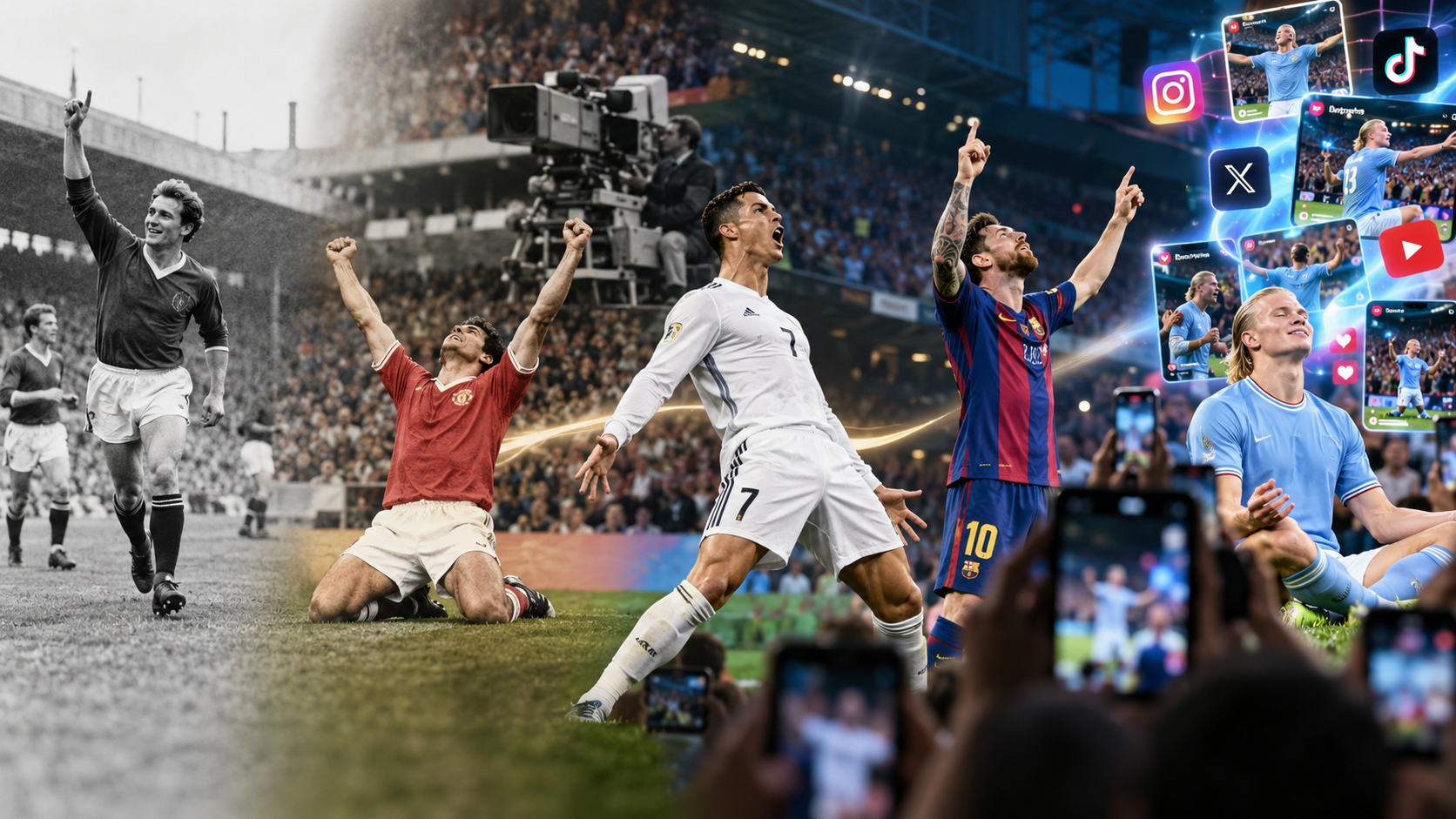
Goal celebrations turn a moment of scoring into a language of emotion, identity, and memory. Explore how celebrations evolved from spontaneous reactions into signature gestures recognized around the world.
Football rarely changes one element in isolation. The timeline moves from Early football, where photographs and reports often show comparatively restrained reactions after goals, to Social-media era, where clips and still images circulate globally within seconds. The developments between those points also changed expectations around the subject.
Written by: SwiftPeakX Editorial Team
Last editorial review: October 2026
Editorial note: This article was reviewed for topic-specific wording, historical clarity, source transparency and natural readability. References are listed at the end for verification and further reading.
Key Takeaways
Celebrations became more visible and individualized as television and global media brought player emotion closer to audiences.
Signature gestures can become part of a player’s identity, while team celebrations can express collective culture.
The Laws allow celebration but place limits on excessive delay, safety risks and actions such as removing the shirt.
Social media transformed celebrations into instantly shareable images that can outlive the match itself.
Historical Foundations
A goal lasts only a moment, but the celebration can become the image people remember. Early football photography often shows relatively restrained reactions compared with the choreographed routines of modern players. As television brought emotion closer to audiences, celebrations became increasingly visible, personal, and symbolic.
Players celebrate for many reasons: release of pressure, connection with supporters, tribute to family, expression of faith, inside jokes, political or social messages, and the simple joy of scoring. Some gestures become signatures that supporters imitate in playgrounds and video games. Others create controversy when they provoke opponents or cross disciplinary boundaries.
The celebration has also become commercial media. A distinctive pose can circulate globally within seconds, appear in advertising, and become part of a player’s brand. Yet the strongest celebrations often remain spontaneous because they capture an emotion that cannot be manufactured.
Football is not consumed as a spreadsheet. Supporters remember how a goal felt, who ran toward which stand, what gesture followed, and what the moment meant in the story of a season. Celebrations turn scoring into social communication. They allow players and fans to recognize each other in a brief shared ritual, which is why attempts to regulate excessive celebration always sit beside an equally powerful desire to let emotion breathe.
Why scoring invites ritual
A goal compresses tension, uncertainty and reward into a few seconds, so celebration gives players and supporters a way to release emotion. The reaction also confirms social belonging: team-mates converge, crowds mirror the gesture and broadcasters replay the moment.
Because goals are relatively rare compared with scoring events in many sports, each one carries enough weight to generate ritual. The celebration is therefore part psychological release and part public communication.
Television changed what a celebration could be
Once cameras routinely captured faces and gestures, players gained a global audience for what happened after the ball crossed the line. A private reaction became a repeatable media image shown in highlights, title sequences and advertising.
That visibility encouraged recognizable routines without eliminating spontaneity. The most memorable celebrations usually work because they feel connected to a real moment rather than designed only for the camera.
Celebrations can carry identity
Players use gestures to reference family, faith, hometowns, friendships or personal stories, while teams may adopt shared routines that express group chemistry. Supporters interpret these signs quickly because repeated images build a shared vocabulary. That makes celebrations can carry identity a genuine turning point in the wider story of Goal Celebrations rather than a minor historical detail.
The same gesture can mean different things in different cultural settings, which makes context important. A celebration can be joyful, defiant, humorous or commemorative without changing the scoreline at all.
Why the law still regulates joy
Celebration is allowed, but football also has to protect safety, respect opponents and restart the match. Climbing perimeter fences, entering crowds, provocative behavior or excessive delay can create risks beyond simple enthusiasm.
The caution for removing a shirt is a familiar example of how regulation can sit alongside emotional freedom. The balance is deliberately imperfect: the game wants emotion without allowing the post-goal moment to become uncontrolled.
The social-media afterlife
A celebration now has a life beyond the stadium because clips, screenshots and remixes spread through global fan networks instantly. Players and clubs can intentionally reuse a gesture in content, while supporters turn it into GIFs or memes.
That visibility can strengthen a player’s brand but also magnify misunderstandings or accusations of disrespect. The celebration has become both part of the match and part of the digital conversation that follows it.
Timeline: Key Turning Points
Period Development Why It Mattered
Early football Photographs and reports often show comparatively restrained reactions after goals. Celebration existed, but it was less mediatized and less personalized.
Television era Close-up cameras made emotion and crowd interaction part of the broadcast. Celebrations became a recognizable visual language.
Global superstar era Signature poses, dances and gestures became associated with individual players. Celebration started to overlap with personal branding.
Regulatory era Lawmakers clarified sanctions for excessive, provocative or time-wasting celebration behavior. Expression remained permitted but bounded by safety and match flow.
Social-media era Clips and still images circulate globally within seconds. A celebration can become a meme, marketing asset or political controversy almost immediately.
Why This Still Matters
Goal celebrations are one of the few moments when a highly structured sport briefly gives players room for unscripted expression. That freedom is not unlimited: time wasting, provocative conduct, removing clothing and crowd interaction can bring sanctions or safety concerns. The interesting cultural question is where football draws the line. A memorable celebration can become part of a player’s identity and a supporter’s memory, while an excessive one can be read as disrespectful or disruptive. The ritual survives because emotion is not an accidental by-product of scoring; it is part of why goals matter.
Broadcasting has made celebrations more durable than they once were. A gesture can be replayed, copied by children, turned into a graphic or remembered as part of a tournament’s visual identity. That visibility also increases scrutiny: behavior that might once have disappeared after the final whistle can now circulate for years. Players are therefore performing for several audiences at once—the stadium, opponents, team-mates and a global digital crowd—which helps explain why celebrations carry more cultural weight than a few seconds of movement might suggest.
The reaction of opponents also matters. A celebration that feels joyful to one group can look provocative to another, especially in emotionally charged fixtures. Context, proximity and timing influence how the same gesture is interpreted, which is why written rules can never capture every social boundary around celebration.
Common Misconceptions
Players can celebrate in any way because the ball is out of play.
No. The Laws allow celebration but still permit sanctions for excessive, provocative, dangerous or delaying behavior.
Signature celebrations are purely a modern invention.
Distinctive reactions existed earlier, but television and social media made them more visible, repeatable and commercially powerful.
Removing the shirt is only punished if it delays the restart.
Removing the shirt during a goal celebration is itself a cautionable act under Law 12.
Related SwiftPeakX Reading
The Offside Rule: How Football’s Most Debated Law Evolved
Kick-Off: How Football Standardized the Start and Restart of Play
Frequently Asked Questions
Why are players booked for taking off their shirts?
Law 12 specifically lists removing the shirt or covering the head with it as a cautionable form of excessive celebration.
Can a player celebrate with supporters?
Players may approach supporters, but entering the crowd or creating a safety issue can lead to disciplinary action.
Why do some celebrations become iconic?
They combine a memorable sporting moment with a simple visual gesture that fans can recognize and repeat.
Do referees add time for celebrations?
Time lost through goal celebrations can be included when the referee calculates additional time.
Celebrations Sit Between Spontaneity and Regulation
The timeline opens with Early football. Photographs and reports often show comparatively restrained reactions after goals. Celebration existed, but it was less mediatized and less personalized.
The next entry is Television era. Close-up cameras made emotion and crowd interaction part of the broadcast. Celebrations became a recognizable visual language.
The middle of the timeline reaches Global superstar era. Signature poses, dances and gestures became associated with individual players. Celebration started to overlap with personal branding.
A later entry, Regulatory era, shows another change. Lawmakers clarified sanctions for excessive, provocative or time-wasting celebration behavior. Expression remained permitted but bounded by safety and match flow.
The sequence ends with Social-media era. Clips and still images circulate globally within seconds. A celebration can become a meme, marketing asset or political controversy almost immediately.
The Bottom Line
Taken as a whole, the story of Goal Celebrations shows why historical context matters. The subject moved from the conditions represented by Early football to those represented by Social-media era through a series of practical decisions rather than one clean break. That balance between continuity and change remains central.
Sources & Further Reading
IFAB — Law 12: Fouls and Misconduct
IFAB — Law 7: Allowance for time lost
FIFA — Football culture and tournament stories