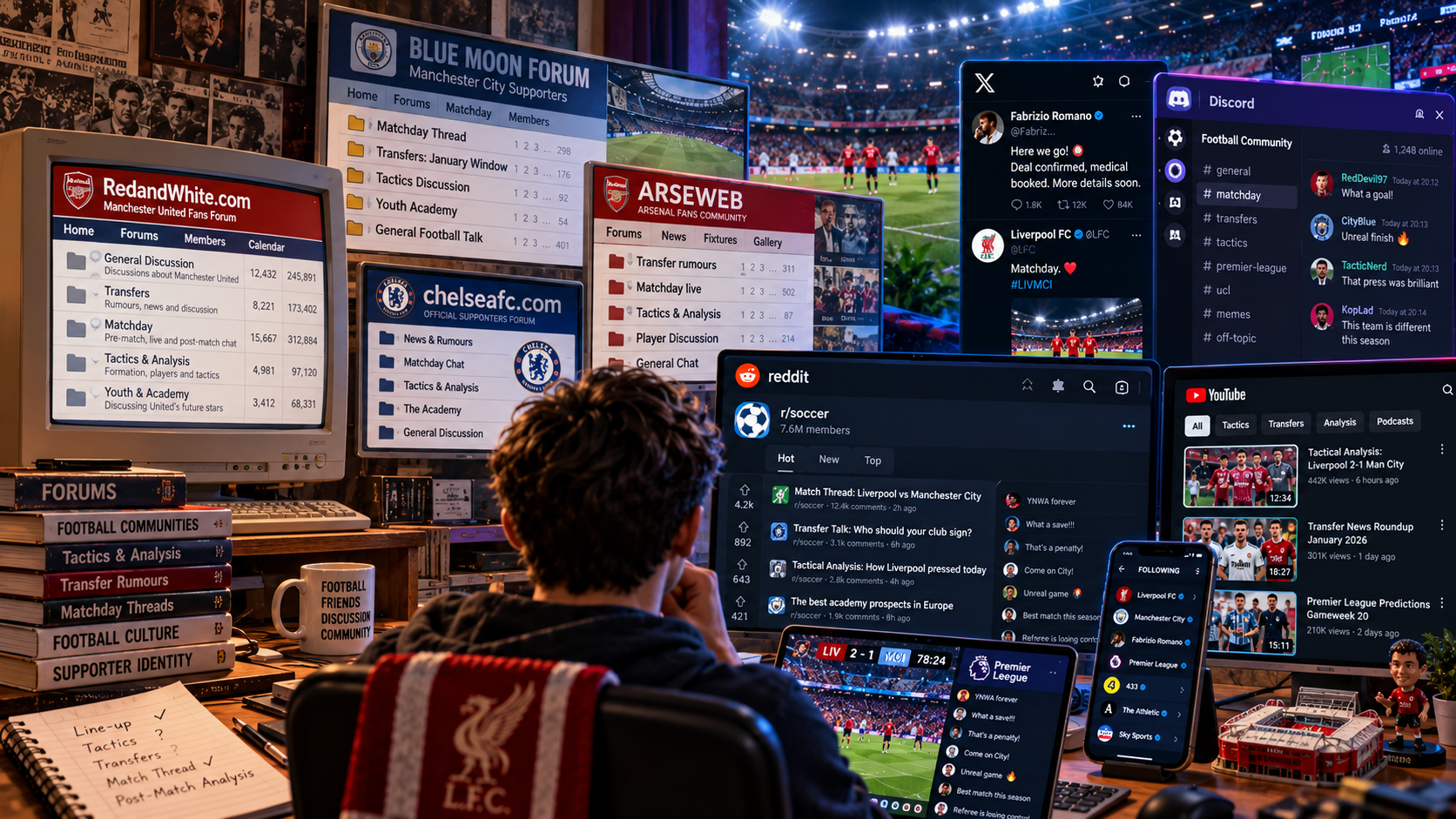
Online communities changed football fandom long before social media became dominant. Explore how forums, message boards, matchday threads, and digital communities expanded the conversation around the game.
The timeline opens with Early internet: independent websites and bulletin boards let supporters communicate beyond local geography. It closes with Platform-fragmented era: forums, group chats, Reddit-like communities and social feeds coexist. For online football communities, that span shows how a familiar part of football changed as the sport became faster, more organized and more closely scrutinized.
Written by: SwiftPeakX Editorial Team
Last editorial review: October 2026
Editorial note: This article was reviewed for topic-specific wording, historical clarity, source transparency and natural readability. References are listed at the end for verification and further reading.
Key Takeaways
Football forums created long-running communities organized around clubs, tactics, transfers and supporter identity.
Message boards preserved conversations over time in a way that fast social feeds often do not.
Matchday threads turned remote viewing into a synchronized communal experience.
Online communities can produce expertise and belonging, but they can also intensify rumor, hostility and group polarization.
Historical Foundations
Before social media, football supporters already gathered online through forums, mailing lists, fan sites, and message boards. These spaces allowed people separated by geography to debate lineups, transfers, tactics, ownership, and memories. For international fans in particular, online communities could provide a sense of belonging that distance from the stadium made difficult.
Social platforms accelerated the conversation. Matchday threads now update second by second, clips circulate almost instantly, and opinions form before the final whistle. Supporters can interact with journalists, analysts, former players, and sometimes current players in the same digital environment.
The speed has costs. Rumors spread quickly, anger can become performative, and harassment can be amplified by anonymity or large audiences. Yet online communities also organize charity drives, ticket help, travel advice, supporter campaigns, and historical archiving.
A modern match can generate hours of pre-game speculation and days of post-game analysis. The final whistle simply changes the type of conversation. Supporters clip tactical moments, argue about refereeing, share memes, and revisit statistics. Online fandom therefore stretches the temporal boundaries of matchday. Football becomes an ongoing conversation rather than an event limited to the stadium and ninety minutes.
Why forums felt different from social feeds
A traditional message board was organized around topics and recurring usernames, so discussion accumulated over months and years. That persistence helped reputations form: some users became trusted for tactics, youth football or local knowledge.
Modern feeds often prioritize novelty and reach instead of continuity. The difference affects not only interface design but the kind of football knowledge a community can build.
Matchday threads create synchronized emotion
Supporters watching from different cities can react to the same chance, substitution or refereeing decision within seconds. The thread becomes a shared timeline of anxiety and celebration.
Because emotion is immediate, analysis can be irrational or extreme, but that volatility is also part of the attraction. The digital space reproduces some social functions of watching in a pub or stand without reproducing the physical environment.
Online communities widen access
A supporter who lives far from the club can still learn local traditions, discuss tickets and follow academy news through community spaces. Diaspora fans and disabled supporters may find participation easier online than through constant travel.
This can make a club feel less geographically exclusive while still preserving local voices. The challenge is avoiding a situation where the loudest online users are mistaken for the entire supporter base.
Rumor travels differently online
Transfer speculation thrives because uncertain information can be shared, updated and debated continuously. Communities often develop informal credibility systems around journalists, insiders and repeat rumor accounts. That makes rumor travels differently online a genuine turning point in the wider story of From Message Boards to Matchday Threads rather than a minor historical detail.
Those systems can work surprisingly well, but they are vulnerable to confirmation bias and deliberate misinformation. A responsible reader distinguishes “someone posted it” from evidence.
Belonging can become polarization
Strong group identity can produce generosity and friendship inside a community while increasing hostility toward rivals or outsiders. Research on football fandom shows that loyalty and out-group hostility are related but not identical; context matters.
Moderation, norms and platform incentives influence whether discussion becomes playful rivalry or abuse. Online football culture is therefore not inherently toxic or healthy—it amplifies the social rules a community rewards.
Timeline: Key Turning Points
Period Development Why It Mattered
Early internet Independent websites and bulletin boards let supporters communicate beyond local geography. Fan discussion no longer depended on physical proximity.
Forum era Dedicated club boards developed archives, moderators and long-term user identities. Communities became persistent rather than episodic.
Broadband era Live match threads and rapid posting made simultaneous discussion easier. Remote supporters could experience a digital terrace.
Social-media era Conversation shifted partly to larger platforms with faster discovery. Attention broadened but community boundaries became less stable.
Platform-fragmented era Forums, group chats, Reddit-like communities and social feeds coexist. Fans choose between depth, speed, privacy and reach.
Why This Still Matters
Online communities changed the rhythm of fandom by removing the old boundary between matchday and the rest of the week. Tactical clips, transfer rumours, jokes and arguments circulate continuously, while supporters separated by geography can participate in the same conversation. The gain is access; the risk is acceleration. False claims, abuse and group polarization can spread with the same speed as useful analysis or community support. Understanding digital fandom therefore requires attention to both participation and the incentives of the platforms on which it occurs.
Moderation has become part of the infrastructure of online fandom. Forums and social platforms have to decide how to handle abuse, misinformation, discriminatory language and coordinated harassment without flattening the rivalry and humour that make supporter spaces distinctive. Those decisions shape who feels able to participate. A community that is technically open to everyone can still become socially narrow if the loudest users drive others away, which makes governance relevant even in spaces created informally by fans.
The archive created by online conversation is another important change. Matchday reactions that once disappeared after a pub conversation can now be searched years later, preserving jokes, arguments and immediate emotional responses. That record is valuable for understanding fan culture, but it also means impulsive posts can outlast the moment that produced them. Digital fandom therefore changes memory as well as communication.
Common Misconceptions
Online fandom began with modern social media.
Club forums, mailing lists and message boards were active football spaces long before today’s major platforms.
Online supporters are less “real” than stadium supporters.
Many fans combine digital participation with attendance, while distance, disability and cost shape who can be physically present.
A forum consensus represents all supporters.
Online communities are self-selecting and can overrepresent the views of highly active users.
Related SwiftPeakX Reading
From Console Classics to Online Play: How Football Video Games Shaped Fan Culture
Fantasy Football: How Supporters Became Data-Driven Armchair Managers
Goal Celebrations: How Scoring Became a Language of Emotion and Identity
Frequently Asked Questions
Why did football forums become so influential?
They gave supporters persistent spaces to exchange local knowledge, tactics, transfer discussion and identity across geographic boundaries.
What is a matchday thread?
It is a live online discussion that runs alongside a match, allowing supporters to react in real time.
Why do rumors spread quickly in fan communities?
Football transfers contain uncertainty and secrecy, creating strong demand for any new information even when reliability is unclear.
Are online communities replacing stadium culture?
They are better understood as an additional layer; physical and digital forms of fandom influence each other.
Online Fandom Made Matchday Continuous
The timeline opens with Early internet. Independent websites and bulletin boards let supporters communicate beyond local geography. Fan discussion no longer depended on physical proximity.
The next entry is Forum era. Dedicated club boards developed archives, moderators and long-term user identities. Communities became persistent rather than episodic.
The middle of the timeline reaches Broadband era. Live match threads and rapid posting made simultaneous discussion easier. Remote supporters could experience a digital terrace.
A later entry, Social-media era, shows another change. Conversation shifted partly to larger platforms with faster discovery. Attention broadened but community boundaries became less stable.
The sequence ends with Platform-fragmented era. Forums, group chats, Reddit-like communities and social feeds coexist. Fans choose between depth, speed, privacy and reach.
The Bottom Line
From Message Boards to Matchday Threads is easier to understand as an evolving solution than as a fixed tradition. The timeline moves from Early internet to Platform-fragmented era. At the first stage, independent websites and bulletin boards let supporters communicate beyond local geography. At the later stage, forums, group chats, Reddit-like communities and social feeds coexist. For online football communities, the distance between those points shows why future changes should be judged by the purpose they serve, not simply by whether they look more modern.
Sources & Further Reading
Abertay University — Football fandom in virtual spaces
Taylor & Francis — Ingroup cohesion and outgroup hostility among soccer fans
FIFA Museum — Football culture