Fantasy football changed the way supporters follow leagues, players, and statistics. Discover how the game turned fans into data-driven armchair managers balancing loyalty, fixtures, form, and probability.
The history is best read as a chain of responses to changing needs. It opens with Pre-internet fantasy, when newspapers and manual scoring allowed fans to build imaginary squads from real players, and closes with Content era, when podcasts, creators and live deadline shows turned fantasy decisions into media.
Written by: SwiftPeakX Editorial Team
Last editorial review: October 2026
Editorial note: This article was reviewed for topic-specific wording, historical clarity, source transparency and natural readability. References are listed at the end for verification and further reading.
Key Takeaways
Fantasy football changes the unit of attention from clubs alone to individual players across an entire league.
The game rewards decisions about fixtures, minutes, roles, injuries and probability rather than pure supporter loyalty.
Mini-leagues make fantasy a social competition layered on top of the real season.
Data tools can improve decisions, but uncertainty remains because football outcomes are noisy and line-ups change.
Historical Foundations
Fantasy football turned spectators into selectors. Instead of simply supporting a club, participants build squads under a budget, earn points from real performances, and compete with friends or strangers. The format existed in newspaper and mail-based forms before the internet made updates faster and participation vastly easier.
Digital fantasy games changed weekly football habits. A supporter might care about a defender’s clean sheet, a midfielder’s bonus points, or whether a rival player starts—even when those details have little to do with the supporter’s favorite club. Fixtures become a portfolio of small interests distributed across the league.
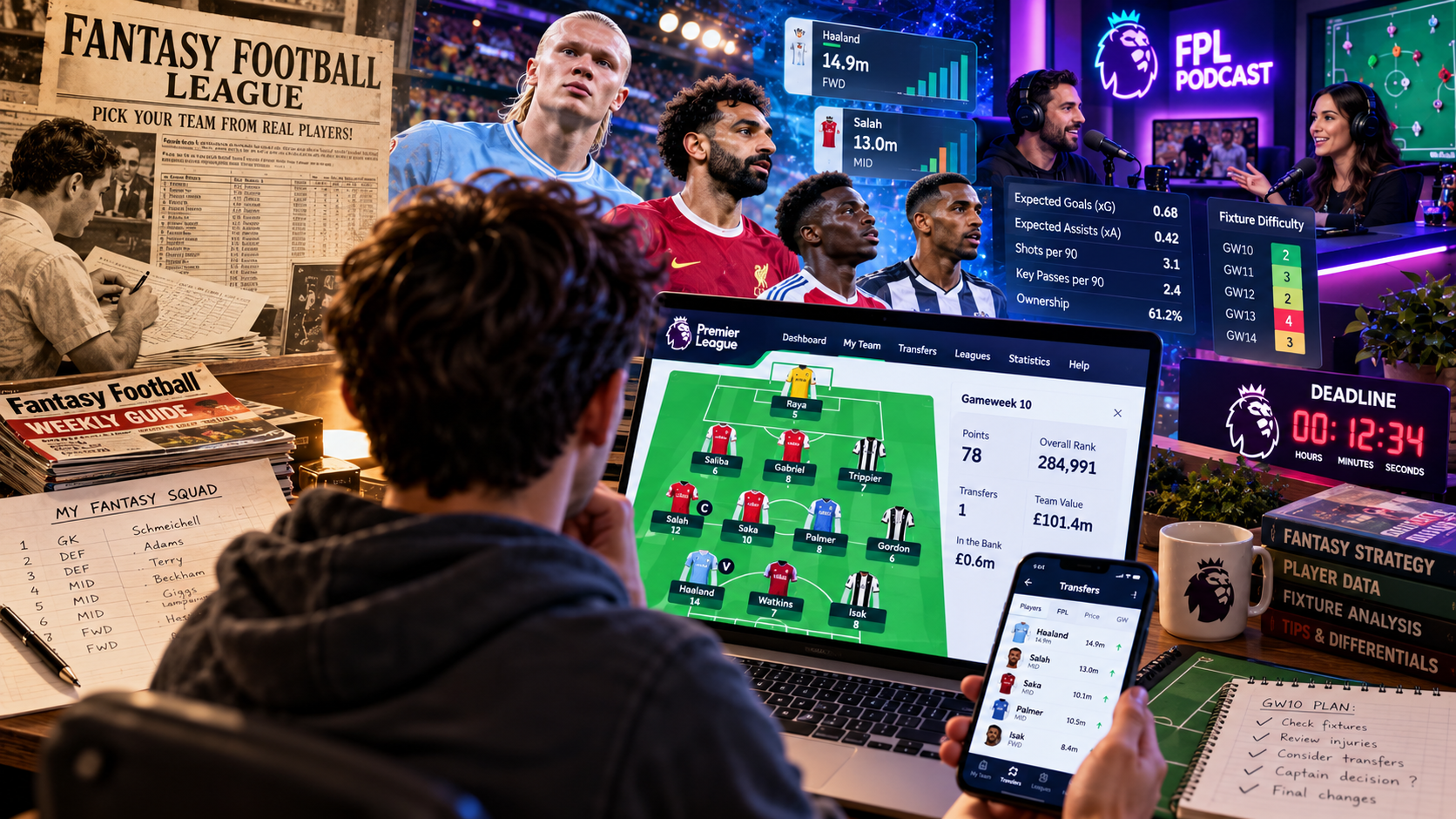
Data culture grew around the game. Participants analyze expected goals, expected assists, minutes risk, fixture difficulty, set-piece responsibility, ownership percentage, and price changes. Podcasts, newsletters, social accounts, and statistical websites now support an ecosystem of fantasy analysis.
Fantasy football creates a productive tension between loyalty and optimization. A supporter may own a player from a rival club because the points are too attractive to ignore. That does not necessarily weaken club identity; it adds another layer of engagement. The armchair manager learns to think probabilistically, balancing short-term fixtures against long-term value. In that sense, fantasy football helped popularize analytical language that once belonged mostly to scouts, bookmakers, and professional analysts.
Why fantasy changes who you watch
A supporter may care about a defender in a mid-table match because that player is in the fantasy team, even when the club itself has no emotional significance. This widens attention across a league and creates reasons to follow line-ups, injuries and minutes closely.
The result can enrich knowledge while producing strange conflicts when a fantasy player faces the supporter’s real club. Fantasy adds a second layer of allegiance rather than replacing the first.
The game teaches probability
Good decisions are made before the outcome is known, so one week of points cannot prove whether a choice was intelligent. Managers learn to think in ranges: expected minutes, chance of a clean sheet, set-piece role and likelihood of returns.
That mindset resembles decision-making under uncertainty more than simple prediction. Fantasy becomes frustrating when users judge every process only by the final score.
Data changed the community
Public statistics and specialist models let managers compare fixtures, shot volume, expected goals and other indicators. The barrier between casual and analytical play widened because highly engaged users can spend hours optimizing.
Yet no model controls rotation, injury or random finishing variance. The enduring appeal comes from a mix of analysis and unpredictability rather than perfect calculation.
Mini-leagues make it social
Private leagues turn a global game into competition among friends, families and workplaces. Conversation often matters as much as rank: screenshots, missed captaincies and lucky bench points create shared stories.
This social layer keeps users engaged even when overall rank is poor. Fantasy succeeds partly because it converts a long season into repeated small contests.
The risk of over-optimization
Because new data arrive constantly, fantasy can turn leisure into compulsive checking if every injury rumor or price change feels urgent. The best experience usually comes from setting boundaries around time and recognizing that uncertainty cannot be eliminated. That makes the risk of over-optimization a genuine turning point in the wider story of Fantasy Football rather than a minor historical detail.
This matters because fantasy is designed to extend attention between real matches. Enjoyment falls when the game becomes a demand to monitor football continuously rather than a voluntary way to engage with it.
Timeline: Key Turning Points
Period Development Why It Mattered
Pre-internet fantasy Newspapers and manual scoring allowed fans to build imaginary squads from real players. The concept existed before live digital platforms.
Web era Online scoring automated points and transfers. Fantasy became easier to enter and maintain.
Official league games Competitions such as Fantasy Premier League tied fantasy directly to a major league brand. Participation became a mainstream part of season-long fandom.
Analytics era Expected goals, fixture models and price-change tools became common among engaged managers. Fantasy communities developed their own analytical ecosystem.
Content era Podcasts, creators and live deadline shows turned fantasy decisions into media. The game became a parallel weekly conversation around football.
Why This Still Matters
Fantasy football turns spectatorship into a sequence of small management decisions. Fixtures, injuries, minutes, price changes and underlying statistics become personally relevant because they affect a user’s squad. This can deepen attention to teams and players outside a supporter’s normal interests, but it can also distort how a match is experienced when individual returns matter more than the result. Its cultural significance lies in that extra layer: fantasy does not replace club loyalty, yet it gives millions of supporters another reason to interpret football through data.
Common Misconceptions
The best fantasy manager predicts every haul.
Strong play is about making good decisions under uncertainty, not forecasting every match correctly.
Club loyalty should determine fantasy choices.
Fantasy rewards individual expected output, which can conflict with real-world allegiance.
More statistics always produce better decisions.
Useful metrics help, but excessive data can add noise and false confidence.
Related SwiftPeakX Reading
From Console Classics to Online Play: How Football Video Games Shaped Fan Culture
Goal Celebrations: How Scoring Became a Language of Emotion and Identity
Frequently Asked Questions
Why is captaincy so important in fantasy games?
Captain rules often multiply one player’s score, making that choice a major source of weekly variance.
What is a fixture swing?
It is a run in which a team’s upcoming opponents become noticeably easier or harder, affecting expected opportunities.
Why do fantasy managers care about minutes so much?
A great player cannot score fantasy points from the bench, so expected playing time is a core part of value.
Can fantasy football improve real football knowledge?
It often increases attention to players, line-ups and underlying statistics across the league, although fantasy value is not identical to real football quality.
Fantasy Football Turned Statistics Into Weekly Fandom
The first entry, Pre-internet fantasy, establishes the baseline. Newspapers and manual scoring allowed fans to build imaginary squads from real players. The concept existed before live digital platforms.
A second stage appears under Web era. Online scoring automated points and transfers. Fantasy became easier to enter and maintain.
A further turning point appears at Official league games. Competitions such as Fantasy Premier League tied fantasy directly to a major league brand. Participation became a mainstream part of season-long fandom.
Another shift is visible in Analytics era. Expected goals, fixture models and price-change tools became common among engaged managers. Fantasy communities developed their own analytical ecosystem.
The chronology closes under Content era. Podcasts, creators and live deadline shows turned fantasy decisions into media. The game became a parallel weekly conversation around football.
What Changed—and What Stayed Recognizable
Comparing Pre-internet fantasy with Content era makes the scale of change in Fantasy Football easier to judge. Early in the story, newspapers and manual scoring allowed fans to build imaginary squads from real players. The concept existed before live digital platforms. By the later stage, podcasts, creators and live deadline shows turned fantasy decisions into media. The game became a parallel weekly conversation around football. For Fantasy Football, that contrast matters because the modern practice inherited an older purpose even though the tools, expectations or institutions around it had changed.
One way to test that continuity is to revisit the misconception that the best fantasy manager predicts every haul. Strong play is about making good decisions under uncertainty, not forecasting every match correctly. For Fantasy Football, correcting that misconception matters because it separates the enduring purpose from details that changed over time. For Fantasy Football,
The Bottom Line
Understanding Fantasy Football means looking beyond the latest version. The Pre-internet fantasy and Content era entries belong to the same story, but they answer different problems. That contrast gives supporters a clearer basis for judging future reform: purpose, consequences and fit with the wider game.
Sources & Further Reading
Fantasy Premier League — Official game
Premier League — Fantasy content
Premier League — Statistics