
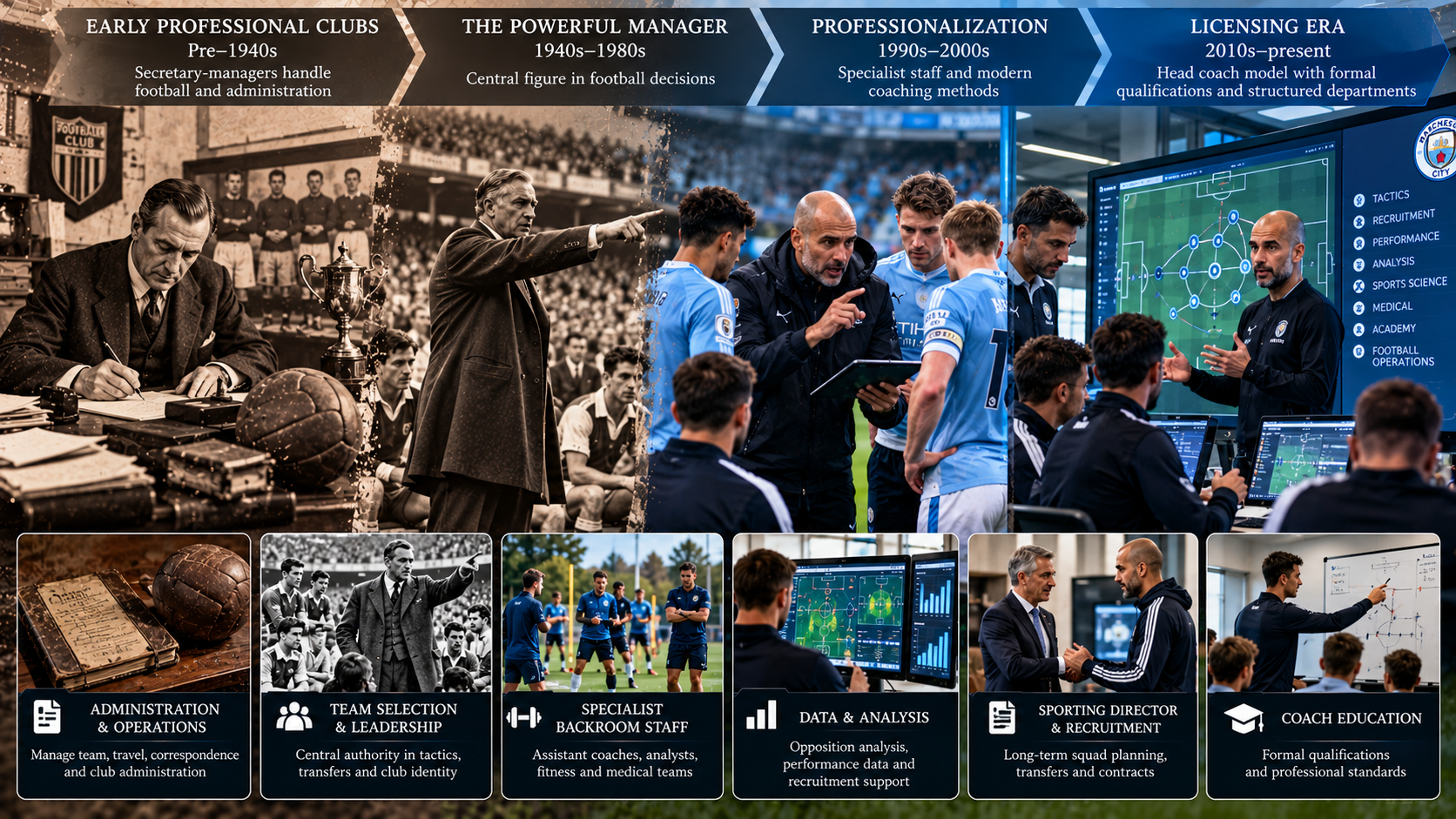
Football management once revolved around the all-powerful secretary-manager. Discover how the role evolved into today’s head coach model, supported by sporting directors, analysts, scientists, and specialist staff.
The history is best read as a chain of responses to changing needs. It opens with Early professional clubs, when secretary-managers combined administration, logistics and football responsibilities, and closes with Licensing era, when formal coaching qualifications became standard requirements in elite competitions.
Written by: SwiftPeakX Editorial Team
Last editorial review: October 2026
Editorial note: This article was reviewed for topic-specific wording, historical clarity, source transparency and natural readability. References are listed at the end for verification and further reading.
Key Takeaways
Early club managers often combined team selection with administrative duties that are now spread across several executives and specialists.
Professional coach education helped establish management as a recognized technical profession.
Modern clubs may separate the head coach from sporting-director, recruitment and football-operations responsibilities.
The title matters less than the decision rights: successful structures make clear who controls tactics, transfers, staffing and long-term strategy.
Historical Foundations
Early football clubs often placed enormous responsibility in the hands of a secretary-manager. The role could include selecting the team, organizing travel, handling correspondence, recruiting players, negotiating contracts, and managing administrative tasks. As clubs grew, those duties became too complex for one person.
The modern head coach typically works within a wider football department. Sporting directors, technical directors, recruitment teams, analysts, academy leaders, performance staff, and executives divide responsibilities that once sat under the manager’s umbrella. Different countries developed these structures at different speeds, which is why “manager” and “head coach” can still imply different levels of authority.
Coaching itself became professionalized through licensing, formal education, tactical specialization, and large backroom staffs. Video analysts prepare opposition reports; set-piece coaches focus on restarts; performance teams manage training load; assistant coaches may lead specific phases. Leadership now requires coordinating experts as much as issuing instructions.
Modern clubs operate year-round global businesses with enormous financial and regulatory complexity. Transfer strategy, contract planning, academy development, sports science, media duties, and match preparation cannot realistically depend on one individual. Specialization can create continuity when a coach leaves, but it also requires clear lines of authority. The profession has therefore evolved from a powerful all-purpose manager toward a networked leadership model in which success depends on collaboration.
Why the secretary-manager made sense
Early professional clubs were smaller organizations, so the same person could handle correspondence, travel, player administration and team affairs. As revenues, staffing and regulation expanded, that concentration became harder to sustain.
The modern club contains departments that did not exist in comparable form a century ago. The evolution of the job therefore mirrors the evolution of the organization around it.
The rise of the powerful manager
In many football cultures the manager became the central sporting authority, shaping recruitment, tactics, discipline and club identity. Long tenures made it possible for one individual to redesign a squad over several cycles.
That model produced iconic figures but also created succession risk when too much knowledge and authority sat in one office. Shorter modern tenures encouraged clubs to build structures that can survive coaching changes.
Head coach versus sporting director
A head coach usually concentrates on training, selection and match preparation, while a sporting director may oversee recruitment strategy, contracts and long-term squad planning. The division can reduce the burden on the coach and preserve continuity across appointments. That makes head coach versus sporting director a genuine turning point in the wider story of From Secretary-Manager to Head Coach rather than a minor historical detail.
It can also create conflict if the coach wants immediate solutions while the club prioritizes long-term value. Clear governance matters more than fashionable job titles.
Coach education professionalized the role
UEFA’s coaching pathway and similar systems set minimum expectations around technical, tactical and leadership competence. Elite club regulations increasingly require recognized qualifications
Licensing cannot guarantee a great coach, just as a degree cannot guarantee a great executive. Its value lies in establishing a common professional baseline and a culture of continuing education.
The manager is now an integrator
Modern head coaches receive information from analysts, medical staff, sports scientists, set-piece specialists and recruitment departments. The leadership challenge is to turn specialist input into a coherent football message without overwhelming players.
That requires communication and prioritization as much as tactical knowledge. The job became more professional not because the coach knows everything, but because the coach must coordinate people who know different things deeply.
Timeline: Key Turning Points
Period Development Why It Mattered
Early professional clubs Secretary-managers combined administration, logistics and football responsibilities. The job reflected smaller club organizations.
Managerial era The manager became a powerful sporting authority in many leagues. Team selection, transfers and coaching could sit with one dominant figure.
Specialist staffing Assistant coaches, analysts, fitness coaches and medical departments expanded. The manager increasingly led a staff rather than operating alone.
Sporting-director model Many clubs separated long-term squad planning from day-to-day coaching. Continuity became less dependent on one manager.
Licensing era Formal coaching qualifications became standard requirements in elite competitions. Technical leadership gained a recognized professional pathway.
Why This Still Matters
The modern head coach usually works inside a network of sporting directors, analysts, recruitment staff, medical teams, academy leaders and executives. That division of labor can make a club more resilient, because knowledge and planning do not disappear with one manager. It can also create blurred authority when responsibilities are poorly defined. The historical shift away from the all-purpose secretary-manager therefore explains a recurring modern question: which decisions should belong to the coach, and which should remain part of the club’s longer-term structure? That remains true today.
One reason this structure matters to supporters is continuity. A club may change head coaches frequently while keeping recruitment principles, academy planning and performance departments relatively stable. That separation can protect long-term strategy, but only if the coach’s authority is clear enough to build a coherent team. The most successful arrangements are therefore not defined by one job title. They depend on whether the people around the first team understand who decides squad construction, training priorities, recruitment profiles and matchday tactics.
This also explains why the same title can mean different things at different clubs. One head coach may control recruitment and staffing, while another focuses mainly on training and matches under a sporting director. Comparing titles without comparing responsibilities can therefore be misleading. The professionalization of coaching created more specialist roles, but it did not produce one universal organizational chart.
Common Misconceptions
A head coach and a manager are always different jobs.
Clubs use titles differently; the important distinction is which responsibilities the role actually controls.
Sporting directors make coaches irrelevant.
The head coach remains central to training, selection and the playing model even in highly structured clubs.
Great former players automatically become great coaches.
Playing experience can help, but coaching requires separate skills in teaching, planning, leadership and decision-making.
Related SwiftPeakX Reading
From Training Runs to Sports Science: How Football Preparation Evolved
The Rise of Youth Academies: How Clubs Built Pathways From Childhood to the First Team
The Evolution of Football Scouting: From Local Talent Spotters to Global Recruitment Networks
Frequently Asked Questions
Why do elite coaches need licences?
Competition and club-licensing rules often require recognized qualifications, while the courses create common standards for professional preparation.
What does a sporting director do?
The exact role varies, but it often includes squad strategy, recruitment structures, contracts and coordination between football departments.
Why are coaching staffs so large now?
The game has specialized in analysis, fitness, medicine, set pieces, goalkeeping and individual development, creating more expert roles around the head coach.
Which model is better: powerful manager or head coach plus director?
Neither is automatically superior; success depends on clear authority, aligned recruitment and a structure suited to the club’s culture and resources.
Why the Head Coach Became One Specialist Among Many
The first entry, Early professional clubs, establishes the baseline. Secretary-managers combined administration, logistics and football responsibilities. The job reflected smaller club organizations.
A second stage appears under Managerial era. The manager became a powerful sporting authority in many leagues. Team selection, transfers and coaching could sit with one dominant figure.
A further turning point appears at Specialist staffing. Assistant coaches, analysts, fitness coaches and medical departments expanded. The manager increasingly led a staff rather than operating alone.
Another shift is visible in Sporting-director model. Many clubs separated long-term squad planning from day-to-day coaching. Continuity became less dependent on one manager.
The chronology closes under Licensing era. Formal coaching qualifications became standard requirements in elite competitions. Technical leadership gained a recognized professional pathway.
The Bottom Line
Understanding From Secretary-Manager to Head Coach means looking beyond the latest version. The Early professional clubs and Licensing era entries belong to the same story, but they answer different problems. That contrast gives supporters a clearer basis for judging future reform: purpose, consequences and fit with the wider game.
Sources & Further Reading
UEFA — Coach education overview
UEFA — Coaching licences
UEFA Club Licensing 2026 — Head coach


