
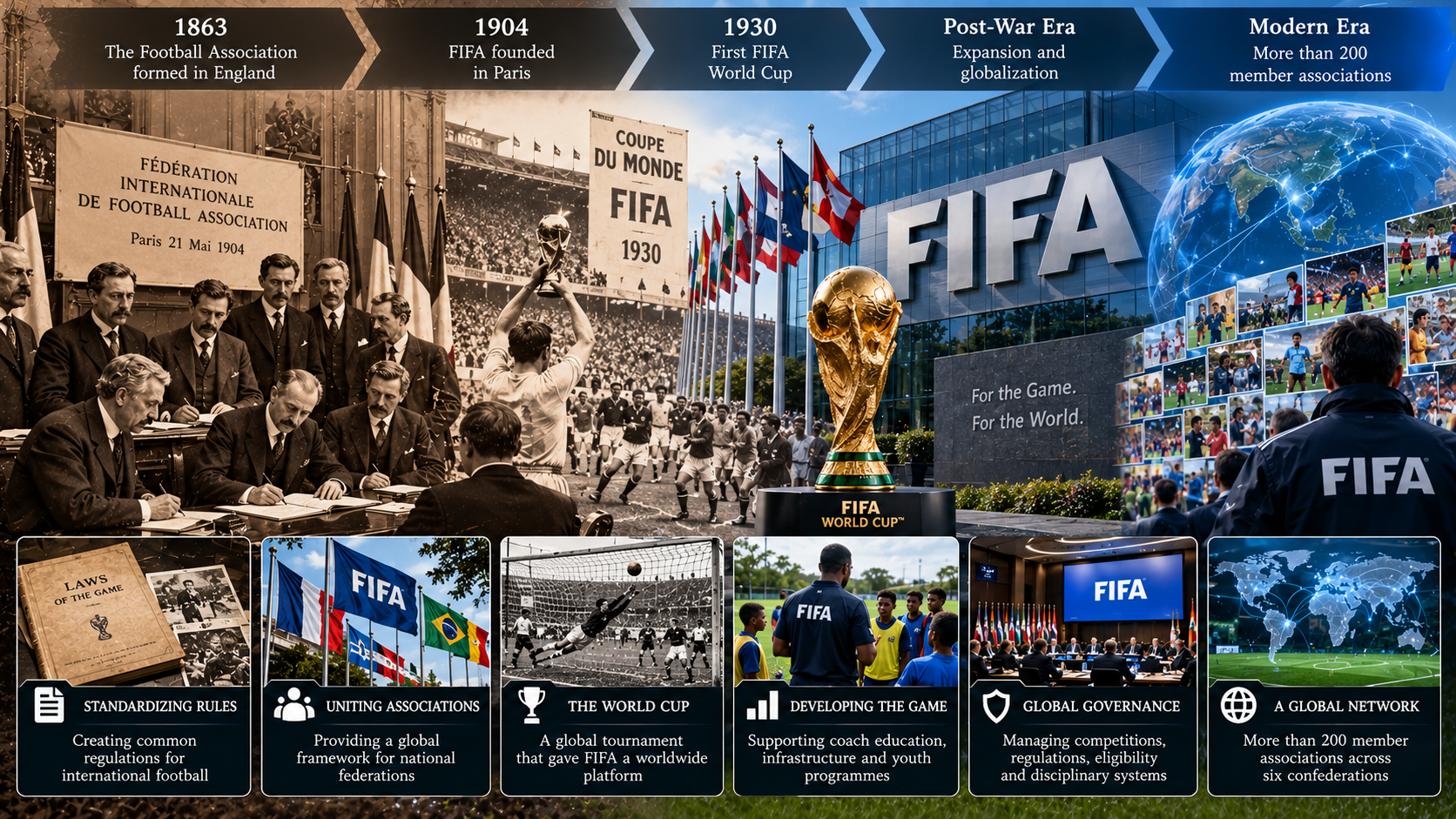
FIFA was created to give international football a common governing structure. Explore why national associations needed a global authority and how that institution became central to the worldwide game.
The timeline opens with 1863: the Football Association was formed in England and codified association rules. It closes with Modern era: fIFA expanded to more than 200 member associations. That span shows how a familiar part of football changed as the sport became faster, more organized and more closely scrutinized.
Written by: SwiftPeakX Editorial Team
Last editorial review: October 2026
Editorial note: This article was reviewed for topic-specific wording, historical clarity, source transparency and natural readability. References are listed at the end for verification and further reading.
Key Takeaways
FIFA was founded in Paris on 21 May 1904 by representatives of European football associations.
International matches created problems that no single national association could solve alone, including common rules, eligibility and competition organization.
FIFA’s growth followed football’s globalization and eventually produced a worldwide network of member associations and competitions.
Global governance remains a balancing act between universal standards and the autonomy of confederations and national associations.
Historical Foundations
By the start of the twentieth century, international football was growing faster than the structures designed to govern it. National associations could organize domestic competitions and international matches, but there was no single global body capable of coordinating the game across borders. FIFA was founded in Paris in 1904 by representatives of several European associations to provide that international framework.
The organization’s early ambitions included standardizing relations between associations, recognizing national bodies, and facilitating international competition. Its importance expanded as football spread and more associations joined. The creation of the FIFA World Cup in 1930 gave the governing body a tournament that could embody its global role.
Global governance brought benefits and recurring tensions. Football needed common rules, eligibility systems, transfer regulations, disciplinary processes, and competition structures. At the same time, questions of representation, commercial power, transparency, and political influence have followed FIFA throughout its history. Governance became more complex as the sport grew into a vast international industry.
International matches require mutual recognition. Teams must agree on player eligibility, refereeing, disciplinary consequences, calendars, and the authority of results. Without a coordinating institution, disputes can multiply and competitions become difficult to administer. FIFA’s creation was therefore less about inventing football than about creating a political and administrative layer above national associations. The continuing debate is not whether global coordination is necessary, but how it should be governed.
Why national associations were not enough
A national body can regulate clubs and matches inside its own territory, but international football creates questions about recognition, eligibility and scheduling across borders. As cross-border matches increased, bilateral arrangements became inefficient.
A federation could create procedures that everyone accepted before a dispute arose. FIFA’s creation was therefore a response to the practical costs of a sport becoming international.
FIFA and IFAB solve different problems
The organizations are connected but not identical: IFAB is the guardian of the Laws of the Game, while FIFA governs global football across many broader areas. That distinction is historically important because rule-making existed before FIFA. That makes fifa and ifab solve different problems a genuine turning point in the wider story of Why FIFA Was Created rather than a minor historical detail.
Modern supporters sometimes treat “FIFA” as shorthand for every football rule, even though law changes belong to the IFAB process. Understanding the institutional map makes debates about authority much clearer.
The World Cup changed FIFA’s scale
A permanent world championship gave the federation a recurring event around which sporting, commercial and national interest could gather. The tournament also created demands
Success increased FIFA’s influence far beyond the administrative role of its founders. Global competitions turned governance into a major economic and political responsibility.
Development became part of governance
A world federation does more than organize elite tournaments; it also redistributes expertise and funding through member associations. Coach education, infrastructure, women’s football, youth development and technical programmes now sit within FIFA’s development role.
That breadth creates opportunities to grow the game in under-resourced regions. It also raises expectations about accountability because a governing body handling large resources must explain how priorities are set.
Why global governance remains contested
Football’s worldwide appeal means FIFA must reconcile different legal systems, sporting cultures, commercial markets and political environments. Central standards can protect competition integrity, but too much centralization can clash with national autonomy.
Major controversies often arise where sporting governance meets money, hosting, ethics or political pressure. The institution exists because coordination is necessary; the continuing debate is about how that power should be exercised.
Timeline: Key Turning Points
Period Development Why It Mattered
1863 The Football Association was formed in England and codified association rules. National organization preceded global organization.
1886 The International Football Association Board was established to oversee the Laws of the Game. Rule-making already required cooperation across British associations.
1904 FIFA was founded in Paris. A permanent international federation could coordinate football beyond national borders.
1930 The first FIFA World Cup was staged in Uruguay. FIFA gained a flagship competition with global ambitions.
Modern era FIFA expanded to more than 200 member associations. Governance now covers competitions, development, regulation, integrity and international coordination.
Why This Still Matters
FIFA emerged from a practical problem: international football was growing faster than any one national association could coordinate. A global governing body could organize recognition, competition and common administration across borders, but greater scale also created questions about representation, commercial power and accountability. Those tensions are not separate from FIFA’s history; they are consequences of the role it came to occupy. Understanding its founding purpose helps explain why debates about governance are ultimately debates about how a worldwide sport should distribute authority.
Global governance also involves a constant tension between universality and local autonomy. FIFA can provide common competition structures and regulations, yet football is still administered day to day by confederations and national associations operating in very different legal and cultural environments. That layered system explains why reform can be slow: a change that appears simple at global level may affect hundreds of competitions and institutions. The scale that gives FIFA influence is also what makes transparency, consultation and implementation so important.
The World Cup later gave global governance a highly visible purpose, but FIFA’s influence extends beyond one tournament. Regulations, development programs, disciplinary structures and relationships with confederations all depend on the idea that international football needs coordination beyond national borders. That breadth is why governance debates can become so consequential: changes at the center can affect competitions, associations and players far from FIFA’s headquarters.
Common Misconceptions
FIFA created the Laws of the Game.
The Laws are governed through IFAB, whose history predates FIFA.
FIFA began with today’s global membership.
It started with a small group of European associations and expanded as football internationalized.
FIFA’s only job is running the World Cup.
Its responsibilities also include development, regulations, international competitions, integrity and coordination with member associations.
Related SwiftPeakX Reading
The Offside Rule: How Football’s Most Debated Law Evolved
Why Football Has Extra Time: The History of Playing Beyond 90 Minutes
The History of the Throw-In: How Football Settled the Restart From Touch
Frequently Asked Questions
When was FIFA founded?
FIFA was founded in Paris on 21 May 1904.
Why was a global football federation needed?
International matches required common administration, recognition and coordination that individual national associations could not provide alone.
Does FIFA control every national league?
National associations and leagues retain substantial domestic authority, while FIFA sets global frameworks and international regulations.
What is the difference between FIFA and a confederation?
FIFA is the global federation; confederations such as UEFA, AFC and CONMEBOL organize and coordinate football within their regions.
Governance Grew Because Football Crossed Borders
The timeline opens with 1863. The Football Association was formed in England and codified association rules. National organization preceded global organization.
The next entry is 1886. The International Football Association Board was established to oversee the Laws of the Game. Rule-making already required cooperation across British associations.
The middle of the timeline reaches 1904. FIFA was founded in Paris. A permanent international federation could coordinate football beyond national borders.
A later entry, 1930, shows another change. The first FIFA World Cup was staged in Uruguay. FIFA gained a flagship competition with global ambitions.
The sequence ends with Modern era. FIFA expanded to more than 200 member associations. Governance now covers competitions, development, regulation, integrity and international coordination.
The Bottom Line
Why FIFA Was Created is easier to understand as an evolving solution than as a fixed tradition. The timeline moves from 1863 to Modern era. At the first stage, the Football Association was formed in England and codified association rules. At the later stage, fIFA expanded to more than 200 member associations. The distance between those points shows why future changes should be judged by the purpose they serve, not simply by whether they look more modern.
Sources & Further Reading
FIFA — FIFA celebrates its founding anniversary
FIFA — Organisation
IFAB — About the Laws and governance


