
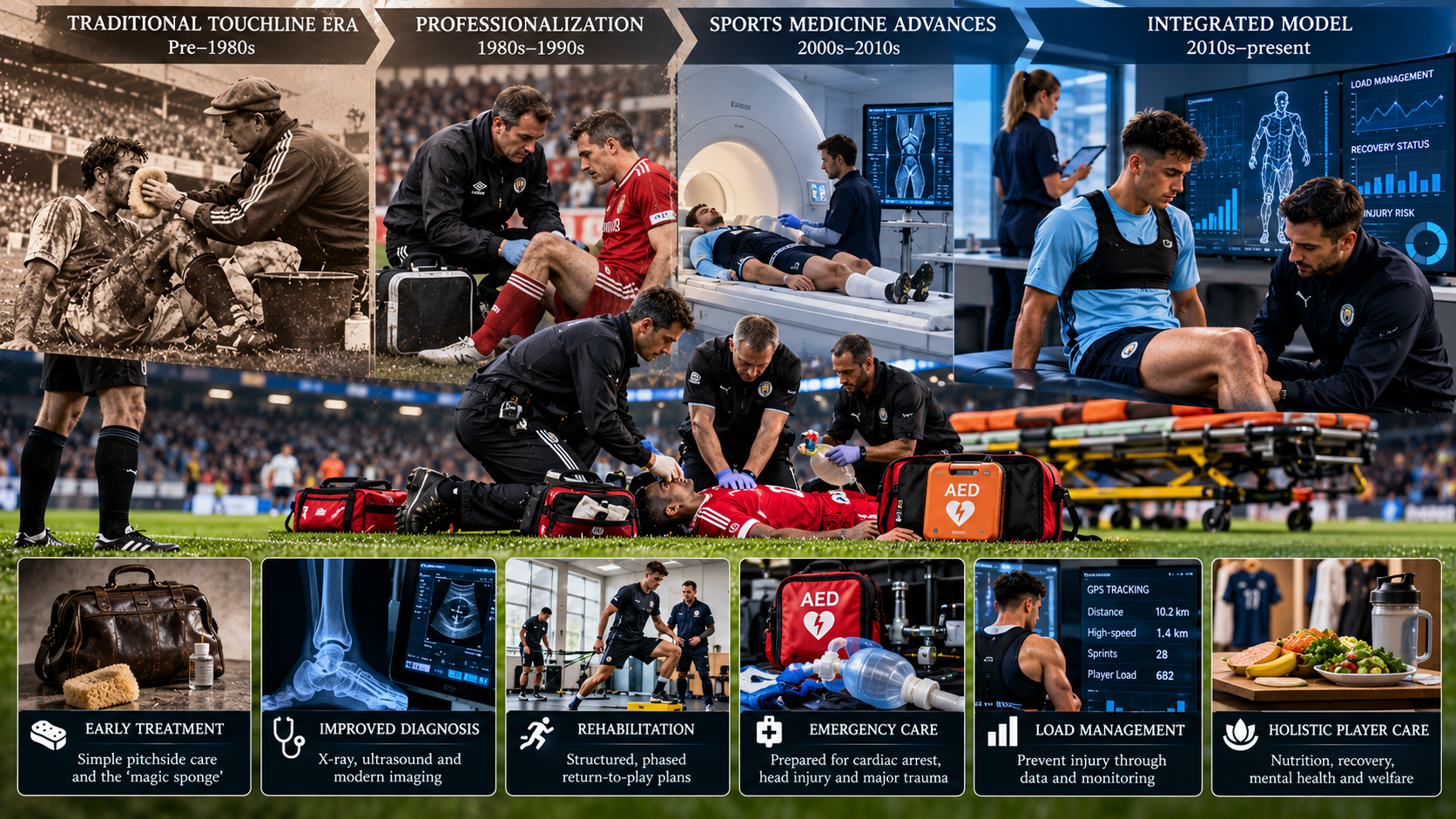
Player care has evolved from the famous ‘magic sponge’ to multidisciplinary medical departments. Explore how diagnosis, rehabilitation, emergency care, and player welfare became central to modern football.
What looks settled today was shaped by experimentation. The Traditional touchline era entry shows that treatment was often immediate, simple and based heavily on experience; the Integrated model entry shows that medical, performance and coaching departments now coordinate load and return-to-play plans. The contrast makes the intermediate choices easier to understand.
Written by: SwiftPeakX Editorial Team
Last editorial review: October 2026
Editorial note: This article was reviewed for topic-specific wording, historical clarity, source transparency and natural readability. References are listed at the end for verification and further reading.
Key Takeaways
The old “magic sponge” image reflects an era when pitchside treatment was far less specialized than it is today.
Modern clubs use doctors, physiotherapists, sports scientists and rehabilitation staff with distinct responsibilities.
Emergency planning for cardiac arrest, head injury and major trauma is now treated as a rehearsed team process.
Player care extends beyond returning someone quickly; it includes diagnosis, graded rehabilitation, prevention and informed return-to-play decisions.
Historical Foundations
The old image of football treatment is almost comic: a player goes down, a trainer runs on with a bucket and sponge, and the match continues. That image reflected an era when medical staffing was limited and playing through pain was often celebrated. Professional football now operates very differently, with doctors, physiotherapists, rehabilitation specialists, sports scientists, and emergency protocols integrated into club life.
Advances in imaging, surgery, rehabilitation, and concussion awareness have changed how injuries are diagnosed and managed. Return-to-play decisions can involve strength testing, movement analysis, staged running, football-specific drills, and psychological readiness. Clubs also pay more attention to prevention through workload management, screening, sleep, nutrition, and recovery.
Emergency care has become particularly important. Cardiac incidents and serious head injuries have shown that football medical teams must be prepared for rare but life-threatening events. Stadiums increasingly use emergency action plans, defibrillators, trained personnel, and clear communication procedures.
Better medicine is only part of the story. Football had to reconsider the idea that toughness always means staying on the pitch. A player who reports dizziness, muscle pain, or mental strain may be protecting a career rather than avoiding responsibility. This shift is uneven and debates remain, especially around concussion and fixture load, but the direction is clear: player availability is no longer judged only by whether someone can physically stand up and continue.
Why the “magic sponge” became a symbol
The phrase survives because it captures an older football culture in which many knocks were treated quickly on the sideline and players were expected to continue. That culture sometimes blurred the line between minor discomfort and injuries needing proper assessment.
Modern medicine is more cautious about problems such as concussion, cardiac symptoms and significant muscle or joint injury. The change reflects better knowledge as well as a different understanding of duty of care.
Multidisciplinary care changed the workflow
A team doctor may handle diagnosis and medical decisions while physiotherapists, rehabilitation specialists and strength staff guide the return of function and load. Analysts and sports scientists can add information about the physical demands the player must tolerate before competition.
Clear roles reduce the risk that one person is expected to manage every stage from acute injury to match readiness. Coordination matters because medical clearance and performance readiness are related but not identical questions.
Emergency medicine must be rehearsed
Sudden cardiac arrest is rare but demands action within minutes, which means equipment and role allocation cannot be improvised after a collapse. FIFA promotes emergency action planning, CPR, AED access and rehearsed responsibilities for pitchside teams.
The same principle applies to serious head, neck and airway emergencies. A medical department is judged not only by daily treatment quality but by whether it can respond efficiently when the worst-case event occurs.
Return to play became a progression
Modern rehabilitation typically rebuilds strength, range of motion, running exposure, sport-specific movement and confidence in stages. A player who is pain-free in the treatment room may still be unprepared for repeated sprinting, contact or chaotic decision-making. That makes return to play became a progression a genuine turning point in the wider story of From the Magic Sponge to Medical Teams rather than a minor historical detail.
That is why clubs use field rehabilitation and objective benchmarks alongside clinical assessment. The final step is often a risk-managed decision rather than proof that reinjury is impossible.
Player welfare widened beyond injury
Elite football medicine now intersects with sleep, travel, illness, mental health and the effects of congested calendars. Medical staff may need to protect long-term health even when competitive pressure favors a faster return.
This creates an ethical tension because the player, coach and club can value risk differently. Professional standards are important precisely because football decisions can carry financial and emotional pressure.
Timeline: Key Turning Points
Period Development Why It Mattered
Traditional touchline era Treatment was often immediate, simple and based heavily on experience. Medical infrastructure varied widely between clubs.
Professionalization Full-time physiotherapy and club medical roles became more common. Diagnosis and rehabilitation became specialist functions.
Research era Injury surveillance and prevention research expanded through organizations such as FIFA’s medical programmes. Clubs gained better evidence about common injury patterns.
Emergency-care era AED access, cardiac-arrest protocols and structured pitchside response became core safety priorities. Preparation focused on rare but life-threatening events as well as routine injuries.
Integrated model Medical, performance and coaching departments now coordinate load and return-to-play plans. The objective is safe availability, not merely rapid availability.
Why This Still Matters
The change in player care is visible not only in treatment rooms but in the responsibilities clubs accept before an injury occurs. Emergency action plans, cardiac screening, concussion protocols, rehabilitation criteria and return-to-play decisions all require specialists, communication and documentation. That can create disagreement because the interests of player, coach, medical staff and competition schedule are not always identical. The professionalization of medicine matters precisely because it gives those decisions a framework that extends beyond whether someone feels able to continue in the moment.
Return-to-play decisions show why medical progress is not simply a story of better equipment. A scan, strength test or monitoring score can inform the process, but recovery also depends on symptoms, position, workload and the demands a player will face in competition. The safest systems use staged exposure and clear communication rather than one dramatic pass-or-fail moment. That approach reflects the broader shift from treating injuries after they happen toward managing risk across the entire recovery process.
Common Misconceptions
A player who can jog is ready to play.
Match readiness requires far more than pain-free low-speed movement; the player must tolerate the demands of the sport and position.
Medical teams can prevent every injury.
They can reduce risk and improve response, but football remains a high-intensity contact sport with unavoidable uncertainty.
An AED is useful only for medical specialists.
Rapid access matters because early defibrillation is time-critical; trained responders across football environments can save lives.
Related SwiftPeakX Reading
From Training Runs to Sports Science: How Football Preparation Evolved
The Rise of Youth Academies: How Clubs Built Pathways From Childhood to the First Team
Frequently Asked Questions
What does a football physiotherapist do?
Roles vary, but physiotherapists commonly assess musculoskeletal problems, deliver treatment and rehabilitation, and help progress players back toward training.
Why do teams rehearse emergency scenarios?
Clear rehearsal reduces confusion during rare, high-stakes events when seconds matter.
What is return-to-play testing?
It is a set of clinical and performance checks used to judge whether a player has recovered enough capacity for the next stage of football exposure.
Why are medical decisions sometimes controversial?
Competitive pressure, incomplete information and different tolerances for risk can make return decisions difficult even with good expertise.
Player Welfare Became an Organizational Responsibility
The opening phase is labeled Traditional touchline era. Treatment was often immediate, simple and based heavily on experience. Medical infrastructure varied widely between clubs.
The sequence moves next to Professionalization. Full-time physiotherapy and club medical roles became more common. Diagnosis and rehabilitation became specialist functions.
The sequence continues with Research era. Injury surveillance and prevention research expanded through organizations such as FIFA’s medical programmes. Clubs gained better evidence about common injury patterns.
The chronology then reaches Emergency-care era. AED access, cardiac-arrest protocols and structured pitchside response became core safety priorities. Preparation focused on rare but life-threatening events as well as routine injuries.
The last stage shown here is Integrated model. Medical, performance and coaching departments now coordinate load and return-to-play plans. The objective is safe availability, not merely rapid availability.
The Bottom Line
The modern version of From the Magic Sponge to Medical Teams is best seen as one point on a longer continuum. From the Traditional touchline era stage through Integrated model, the subject changed whenever football needed a better fit between rules, institutions, technology and experience. That history leaves room for further evolution without assuming every innovation is progress.
Sources & Further Reading
FIFA — Pitchside emergency care
FIFA — Sudden cardiac arrest
British Journal of Sports Medicine — Twenty years of F-MARC


