
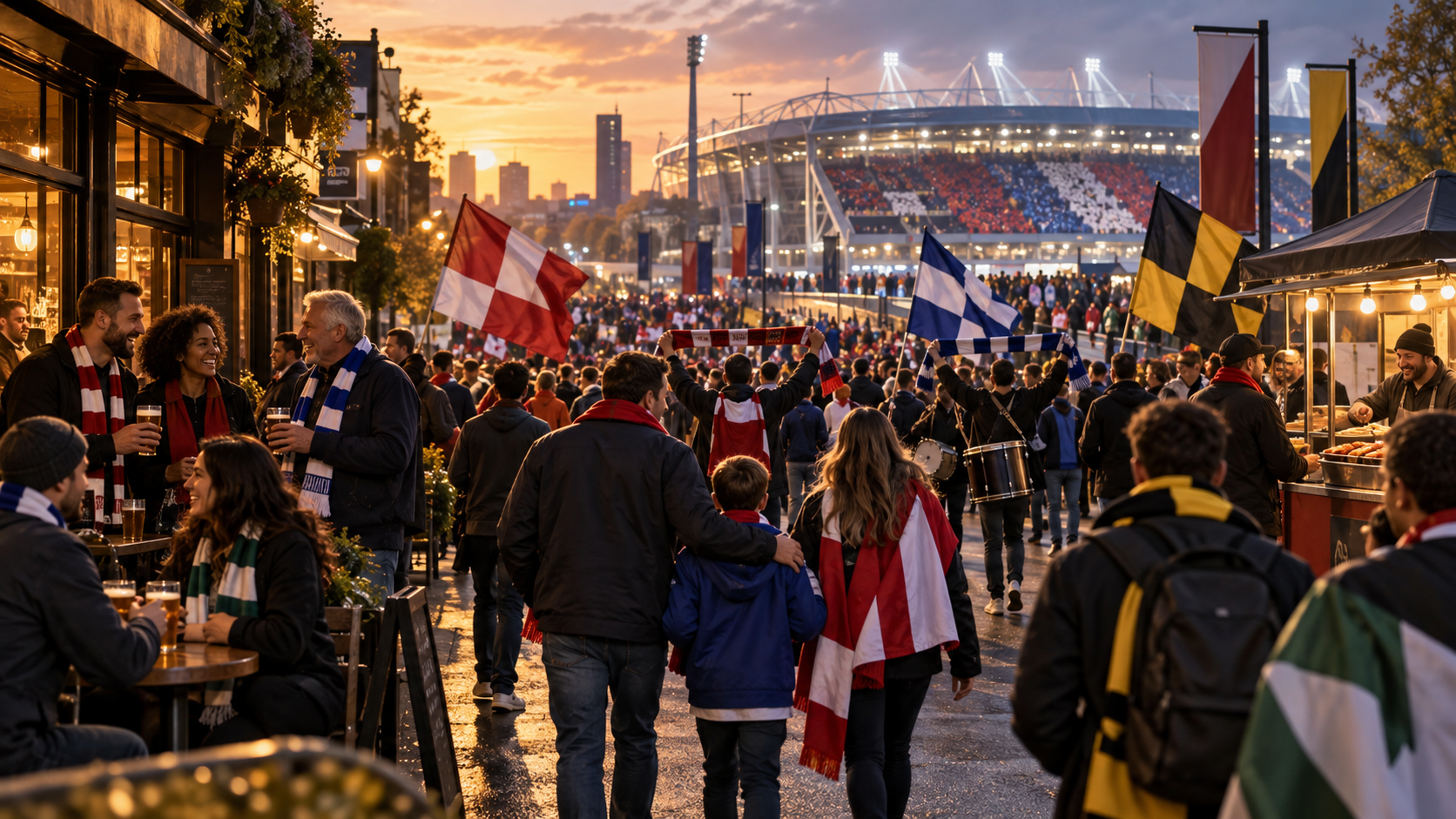
A football match officially begins when the referee starts play, but for supporters the experience often begins much earlier. The first familiar road toward the stadium, a meeting in the same café, a scarf wrapped in the usual way, a song outside the ground or the moment the team appears for the warm-up can all become part of matchday.
These routines vary enormously from one football culture to another. Some involve thousands of people marching through city streets. Others are as small as one supporter entering through the same gate every week. National teams add anthems and ceremonial traditions, while players develop their own routines involving music, prayer, clothing, movement or quiet concentration.
What connects them is timing. They happen before the uncertainty of the match begins. Football supporters cannot control the result, but they can repeat the journey that leads toward it. Over time, repetition gives ordinary actions cultural meaning.
The Matchday Ritual Begins Before the Stadium
For many supporters, arriving at the stadium is only one stage of the day. The ritual may begin at home with a particular shirt or scarf, continue on the same train or bus, and include familiar stops before the turnstiles appear.
This is one reason football culture extends far beyond ninety minutes. Roads, stations, pubs, cafés, food stalls and public squares become connected with the match because supporters repeatedly use them at approximately the same time for the same purpose.
The location itself can become part of the tradition. A meeting place does not need to be famous. Its importance may come simply from the fact that several generations of friends or relatives have gathered there before matches.
SwiftPeakX explores one particularly important version of this social space in The Football Pub: How Matchday Drinking Places Became Social Institutions.
Ritual Creates a Boundary Between Ordinary Life and Football Time
A pre-match routine can be understood as a transition. Someone may spend the morning working, studying, shopping or looking after a family. Several hours later, the same person is standing in a crowd singing for a football club.
The journey between those two states is not purely geographical. Familiar actions help create the feeling that matchday has begun.
Meeting the same people, putting on club colours, approaching the stadium and hearing the crowd grow louder all help separate the football experience from the rest of the week.
That transition is one reason seemingly minor habits can become important. Missing a usual train or arriving too late for a normal meeting place may feel wrong even though neither event can influence what happens on the pitch.
Seattle Turned the Walk to the Stadium Into a Collective Ritual
Seattle provides a clear example of an ordinary journey becoming a formalised supporter tradition.
The Seattle Sounders’ March to the Match developed from a procession organised by supporters in 2005, before the current MLS version of the club had even begun playing. Supporters gathered around Pioneer Square and travelled together toward the stadium.
The tradition later became a major part of Sounders matchday. Today the march begins around an hour before kick-off at Occidental Park and moves toward the stadium with scarves, songs, conversation and organised supporter participation.
Its importance comes partly from transforming travel into performance. Instead of thousands of individuals entering separately, supporters temporarily become one moving crowd.
The stadium atmosphere therefore begins on surrounding streets. By the time the march reaches the ground, participants have already been singing together and reinforcing the identity they will carry into the stands.
Away Supporters Build Ritual Around the Journey Itself
Pre-match routines become even more noticeable when supporters travel away from home.
An away match can require an early train, a coach journey, a meeting point in an unfamiliar city and a carefully timed movement toward the visiting entrance. Food stops, songs, railway stations and temporary gathering places become part of the story.
The routine may change from city to city, but travelling together gives the day its own structure. Long before the match begins, supporters are already performing their loyalty simply by making the journey.
This wider travel culture is explored in The Culture of Away Days: Travel, Loyalty, and Life on the Road.
In Japan, Arriving Early Can Become Part of Supporter Preparation
Pre-match culture does not always depend on spontaneous street gatherings. Stadium routines themselves can structure the hours before kick-off.
Urawa Red Diamonds provide a useful example. Saitama Stadium can open around three hours before a home match, giving supporters time to enter, eat, visit merchandise areas and settle into the ground well before the players appear.
The club’s matchday guidance places the players’ warm-up roughly 45 minutes before kick-off and the starting-line-up announcement around 15 minutes before the match. Each stage changes the atmosphere.
A largely social crowd gradually becomes a football crowd. Conversations become chants, attention moves toward the pitch and the approaching match becomes increasingly difficult to ignore.
This progression demonstrates that ritual does not require one spectacular event. A sequence repeated every home game can create its own rhythm.
Songs Can Mark the Final Minutes Before Kick-Off
Some pre-match rituals become powerful because thousands of individual voices perform the same action at the same moment.
At Anfield, Liverpool supporters singing You’ll Never Walk Alone is one of football’s most recognisable examples. The song became associated with the club in the early 1960s after Gerry and the Pacemakers’ version entered the British charts and was played as part of the popular music heard before matches.
Supporters continued singing it even after it was no longer simply another current hit. It gradually became part of the club’s identity and is now heard before Liverpool home games.
The power of the ritual comes from repetition. A song recorded for a completely different context becomes attached to a particular stadium because generations perform it at the same stage of matchday.
Football singing has a much broader history than this one example. SwiftPeakX examines why collective songs matter in Why Football Fans Sing: The History and Meaning of Stadium Chants.
Holding a Scarf Can Become Part of the Performance
Pre-match singing is often visual as well as audible. Supporters raise scarves, flags or coloured cards while singing, turning individual objects into part of a larger stadium image.
The significance changes when thousands of people perform the movement together. A scarf normally worn around one person’s neck becomes one small line in a wall of colour.
This helps explain why the final minutes before kick-off can look carefully choreographed even when supporters are following a tradition rather than detailed instructions.
Everyone already knows approximately when the action occurs and what they are expected to do.
Dortmund Shows How Choreography Can Transform an Entire Stand
Other pre-match displays require much more preparation. Large supporter choreographies can turn a stand into a temporary image visible from across the stadium.
Borussia Dortmund’s South Stand is famous for this form of visual support. Before matches, thousands of supporters can participate in choreographies created from coloured cards, banners and large-scale imagery.
A display documented by Borussia Dortmund in 2025 involved approximately 25,000 supporters on the South Stand changing the appearance of the terrace through coordinated colours and imagery before kick-off.
Such displays require work long before matchday. Designs have to be developed, material prepared and supporters given enough information to perform their part at the correct moment.
The final image may exist for only a few minutes, but its preparation can take far longer than the display itself.
South American Supporters Turn the Team’s Entrance Into an Event
In parts of South American football, the entrance of the teams can become a major supporter spectacle in its own right.
The Spanish word recibimiento — literally a reception or welcome — is often used when supporters prepare a coordinated display for the moment their team enters the field. Flags, paper, banners, colour and continuous singing can transform the seconds before kick-off into one of the loudest moments of the day.
Argentina provides many examples, particularly around derbies and major cup matches. The purpose is straightforward: make the players feel that the crowd is already participating before the ball moves.
The tradition also reflects the strong connection between South American football and music in the stands. CONMEBOL has described supporter songs across Argentina, Brazil, Uruguay and Chile as expressions shaped by popular music, local history and club identity.
Specific forms of display vary by stadium and are also affected by local safety rules. What remains consistent is the attempt to make the team’s arrival onto the pitch feel larger than an ordinary entrance.
Brazil Turned the National Anthem Into a Shared Performance
International football introduces a different type of pre-match ritual because club identity is temporarily replaced by national representation.
Brazil produced one particularly memorable example around the 2013 Confederations Cup and the 2014 World Cup. When the recorded portion of the Brazilian national anthem ended inside the stadium, players and supporters continued singing the remaining lines without accompaniment.
The a cappella continuation became a powerful part of Brazil’s pre-match atmosphere. FIFA has continued to recognise it as a distinctive feature associated with Seleção matches.
The effect comes from the change in sound. Stadium speakers stop, but tens of thousands of voices continue. The anthem ceases to be only part of an official ceremony and becomes something the crowd temporarily controls.
AFCON Shows How Football Ritual Can Blend With Wider Culture
Pre-match culture is especially visible at international tournaments because supporters bring different national traditions into the same host country.
At African football tournaments, the build-up can combine supporter songs with clothing, dance, percussion, national colours and food. Fan parks extend this atmosphere beyond the stadium by creating spaces where supporters gather hours before matches.
CAF described fan zones around the 2025 Africa Cup of Nations in Morocco as places where local music, cultural displays and football activity mixed before matches. Supporters from different countries could encounter one another before moving toward stadiums or watching together.
Former Togo international Emmanuel Adebayor has also recalled songs and prayers among the pre-match rituals associated with AFCON.
This demonstrates how football rituals can borrow from wider cultural practices rather than existing in a separate sporting world. The match provides the occasion, but the forms of expression may come from traditions much older than football.
Prayer Can Be Both Collective and Private
Not every pre-match ritual is designed for spectators.
Players may pray individually, gather briefly with team-mates or follow private routines inside the dressing room. The meaning varies greatly between individuals and cultures, so these actions should not be treated as one universal football practice.
What they share with supporter rituals is repetition. A player may repeat the same preparation because it creates familiarity at a moment when the result remains completely uncertain.
For some, the routine is religious. For others, it may involve music, stretching, visualisation or simply sitting quietly in the same place before every match.
Players Create Rituals to Make Pressure Feel Familiar
Elite players face a strange problem before important matches. They need to treat an extraordinary occasion as something familiar enough to perform normally.
Psychologists working around football have described personal rituals as a form of psychological structure. Familiar actions can help players organise attention and create a sense of continuity even when the match itself carries enormous pressure.
FIFA’s discussion of preparation for major World Cup matches has highlighted examples involving familiar music, repeated routines and other habits beginning even several days before kick-off.
The behaviour does not magically improve technique. Its value lies in helping an unpredictable situation feel less unfamiliar.
Warm-Ups Have Their Own Supporter Rituals
The players’ warm-up is technically preparation, but for supporters it often forms another stage of the ceremony.
An almost empty stadium can become noticeably louder when the goalkeeper first runs onto the pitch. The rest of the team follows, songs begin and supporters react when individual players approach their section.
For regular matchgoers, this sequence becomes predictable. They know roughly when the players will emerge, which end the goalkeeper will use and how much time remains before the teams disappear briefly into the tunnel again.
The warm-up therefore connects private athletic preparation with public matchday anticipation.
Reading the Team Line-Up Can Become a Call and Response
Another modern ritual occurs when the stadium announcer reads the starting team.
At many grounds, supporters have developed responses to player names. The announcer may provide the first name and the crowd answers with the surname, or the player’s name may trigger a particular chant.
The team sheet therefore becomes more than information. It provides one of the final opportunities for the stadium to rehearse collective noise before kick-off.
A new signing hearing thousands of people answer their name for the first time is participating in a ritual that existed before their arrival and may continue long after they leave.
International Matches Add Formal Ceremony
Some pre-match rituals are created by supporters. Others are written directly into competition procedure.
International matches commonly include team entrances, national flags, anthems, photographs, captain introductions and the coin toss. Major competitions carefully schedule these actions because broadcasters, officials, teams and stadium operations all need to reach kick-off at the same moment.
For the 2026 World Cup, FIFA introduced an expanded pre-match ceremony in which starting players and substitutes gather around the centre circle during the national anthems. The ceremony also includes large national flags and visual elements designed for supporters throughout the stadium.
After the anthems, more familiar procedures remain: team photographs, greetings and the captains’ coin toss.
The contrast is revealing. A supporter song may develop organically over decades, while an international tournament ceremony can be planned to the second. Both can eventually feel inseparable from the moment before football begins.
Food Can Become Ritual Without Being Unique to One Club
Not every tradition requires thousands of people acting together. Eating the same food before football can become just as repetitive.
The specific food differs dramatically between countries and even between stadiums in the same league. What matters culturally is often the routine rather than the menu.
A supporter buys from the same stall, meets the same people and eats at approximately the same time every home match. The meal becomes part of the sequence leading toward kick-off.
Because these habits are ordinary, they can be overlooked when football culture is represented through dramatic tifos or enormous crowds. Yet much of matchday identity is built from precisely these repeated small actions.
Families Pass Rituals Between Generations
A child attending football for the first time usually does not invent the day from scratch. Someone else teaches them how matchday works.
They learn which route to take, when to arrive, where to meet, what song is sung before kick-off and when to hold a scarf above their head. Those instructions are rarely written down.
Years later, the same supporter may repeat the sequence with another generation.
This is how small customs acquire durability. A behaviour does not need official recognition to survive if enough people continue teaching it through participation.
Ritual Makes an Uncertain Game Feel Temporarily Predictable
Football’s attraction depends heavily on uncertainty. Supporters can analyse form and predict results, but nobody knows exactly what will happen after kick-off.
The pre-match period is different. Much of it can be repeated.
The train leaves at the same time. The group meets in the same place. The stadium appears at the end of the same street. The players warm up. The teams are announced. The anthem or club song begins.
Then the whistle sounds and predictability disappears.
This contrast helps explain why rituals can matter even to supporters who do not consider themselves superstitious. They provide structure around an event whose outcome cannot be structured.
Commercial Football Can Adopt Traditions It Did Not Create
Successful supporter traditions often attract institutional attention.
A march begun informally can become supported by a club. A fan gathering can develop into an official fan zone. Music that supporters adopted independently can become part of the stadium’s carefully timed entertainment programme.
This does not automatically destroy the tradition, but it can change who controls it.
Football organisations increasingly design the entire period before kick-off as part of the product supporters experience. Large screens, light shows, entertainment, sponsors and official ceremonies compete for time with supporter-created practices.
The most durable football cultures often contain both: organised presentation from the club and traditions that still feel as though they belong to the crowd.
Safety Rules Also Change Pre-Match Traditions
Rituals are not frozen. Stadium regulations, policing, redevelopment and safety standards can alter how supporters gather and what materials they are allowed to bring.
Large flags and choreographies may require approval. Certain objects once common around football grounds may be prohibited. Marches through streets can require coordination with local authorities.
Supporter culture adapts. A tradition may disappear, move location or develop a safer replacement while retaining the same basic purpose: gathering people and building anticipation before the game.
There Is No Single Global Pre-Match Ritual
Football is often described as a global language, but its matchday culture is interesting precisely because it is not identical everywhere.
A Seattle procession, an Anfield anthem, a Dortmund choreography, a Brazilian national anthem sung beyond the recorded music and an African tournament gathering shaped by music and dance all belong to the same sport without becoming the same tradition.
Even supporters of neighbouring clubs can prepare for football differently.
The global game therefore produces local rituals. They reveal how communities take a standardised sport — the same pitch, the same basic Laws and the same ninety-minute structure — and surround it with their own ways of gathering.
Why the Hours Before Kick-Off Matter
If football culture consisted only of the action after the referee’s whistle, many of its most important experiences would disappear.
The anticipation belongs to the match too. Supporters travel, eat, talk, march, sing, raise flags and wait together. Players prepare through routines of their own. Stadiums gradually change from buildings into crowds.
The result may eventually dominate memory, but the ritual makes the occasion recognisable before anyone knows the result.
That is why supporters can repeat the same pre-match actions through victories, defeats, relegations, championships and generations of different players. The ritual does not guarantee what football will give them. It marks the moment when they are ready to receive whatever happens next.
Recommended Sources for Further Reading
- Liverpool FC — Historical material on You’ll Never Walk Alone and its development as the club’s pre-match anthem.
- Seattle Sounders FC / Major League Soccer — History and current matchday guidance for the March to the Match tradition.
- Borussia Dortmund — Club documentation of supporter choreographies on the South Stand before kick-off.
- Urawa Red Diamonds — Official matchday guidance describing supporter entry, warm-ups and pre-kick-off activities at Saitama Stadium.
- FIFA — Material on national anthems, player preparation and pre-match ceremony at international tournaments.
- Confederation of African Football — Reporting on supporter culture, fan parks, music and pre-match traditions surrounding AFCON.
- CONMEBOL Libertadores — Cultural material on songs and supporter traditions in South American stadiums.


