
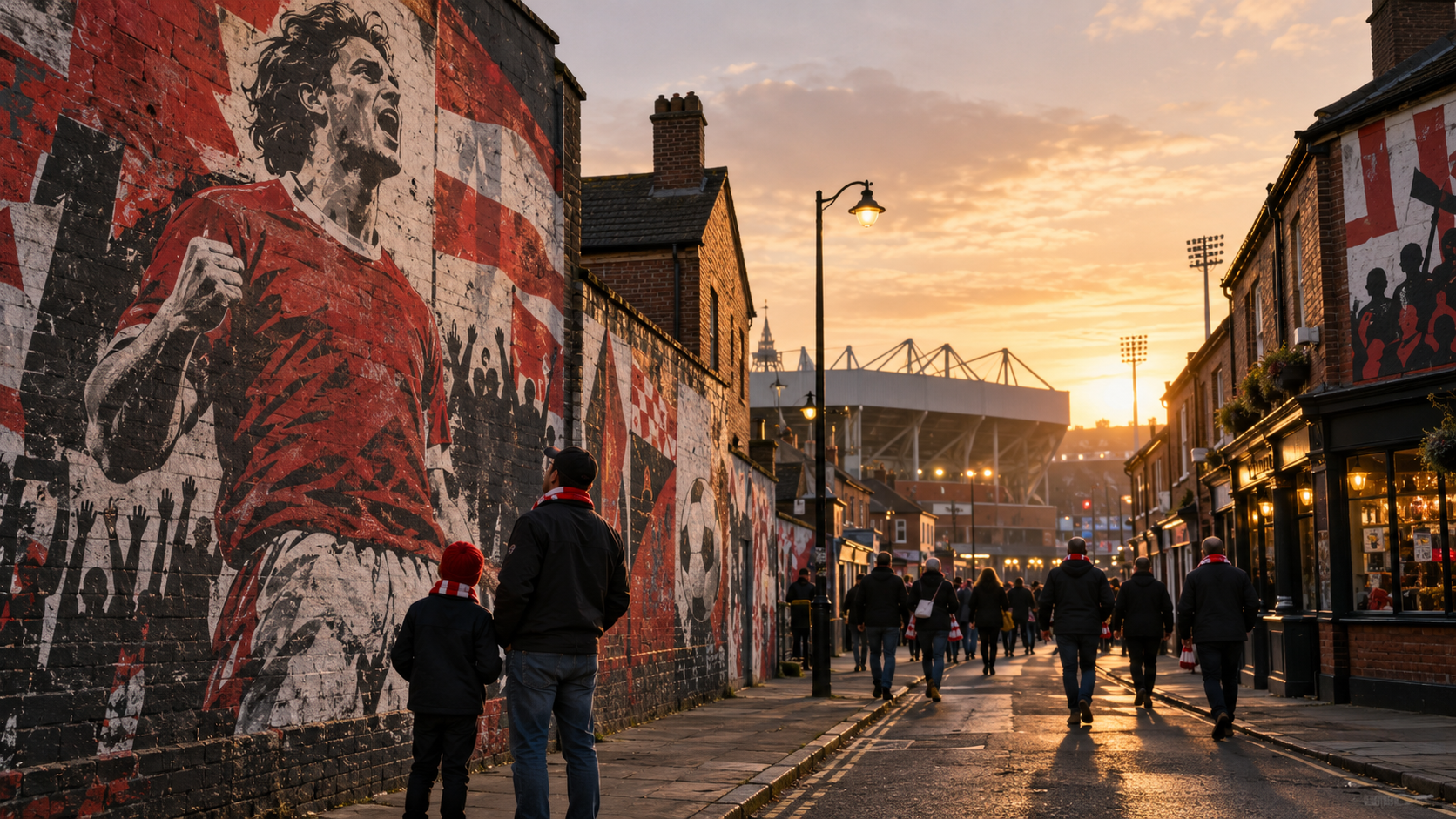
You can sometimes identify a football neighbourhood before seeing the stadium. A club colour appears across a railway bridge. A former player looks down from the side of a terraced house. A supporter-group name covers a wall beneath an overpass. Around the next corner, a mural remembers a local hero, a championship season or a supporter who never came home.
These images occupy a different part of football culture from shirts, scarves or banners. They are not carried into the stadium and taken home afterward. They remain in streets used by residents, commuters, schoolchildren, visitors and people who may never attend a match.
That permanence changes their meaning. Football street art can mark territory, preserve memory, celebrate players, communicate supporter identity and turn ordinary buildings into landmarks. In some cities it is unofficial and confrontational; elsewhere clubs, councils and community organisations commission murals deliberately. Either way, football moves beyond the stadium wall and becomes part of how the city looks.
Football Identity Does Not Stop at the Stadium Gate
A football club may play inside one ground, but its cultural geography is usually much larger. Supporters travel along familiar roads, gather in pubs, pass through railway stations and cross neighbourhoods associated with generations of matchgoing.
Club colours and symbols naturally appear within those spaces. Stickers are attached to lamp posts, graffiti identifies supporter groups, flags hang from windows and walls become surfaces for larger images.
This creates a visible connection between football and place. Someone who knows nothing about a neighbourhood’s history can still understand that a particular club matters there because its colours and figures repeatedly appear in public space.
That relationship connects with the broader way football clubs can become symbols of neighbourhood and city identity, explored by SwiftPeakX in Football and Local Identity: Why Clubs Represent Their Communities. Street art gives that relationship a physical surface.
Not All Football Street Art Is the Same
The phrase “football mural” can describe very different objects. A large portrait painted by a professional artist with permission from a building owner is not the same thing as a quickly sprayed supporter-group name on a concrete wall.
Between those extremes are countless variations: memorial paintings, political graffiti, neighbourhood emblems, championship celebrations, club-funded artwork, independent supporter murals and collaborative community projects.
The distinction matters because the person who creates the image affects its meaning. A club marketing department, a local artist, a supporter group and an anonymous graffiti writer can use similar colours while communicating very different relationships with football.
Supporters Use Walls to Mark Belonging
One of the simplest functions of football graffiti is territorial. A painted club abbreviation, supporter-group name or local branch can announce that a particular area has a football identity.
This does not necessarily mean formal ownership of the neighbourhood. The message is symbolic: people connected with this club live here, gather here or consider the area part of their cultural territory.
Academic research on Indonesian supporter culture has documented this relationship clearly. Research on ultras in Yogyakarta described streets and smaller neighbourhood roads decorated with football murals and graffiti associated with supporter groups. These markings helped connect supporter organisations with particular areas of the city.
The wall therefore works almost like a permanent banner. A stadium banner communicates identity during a match; street art continues communicating it on an ordinary Tuesday morning when no football is being played.
Surabaya Shows How Murals Can Express Supporter Identity
The relationship between football murals and urban identity has been studied directly in Surabaya. Research examining murals associated with Bonek, supporters of Persebaya, found that the paintings could communicate much more than encouragement for a football team.
The murals were interpreted in relation to supporter identity, social position and the pressures of urban life. In this context, football street art became a way for supporters to make themselves visible within the city and communicate ideas about who they were.
This is an important reminder that the meaning of a mural cannot always be understood by identifying the badge or player in the image. The surrounding neighbourhood, the people who created it and the social circumstances in which it appeared can be equally important.
A football mural may celebrate a club, but it can also communicate pride in a district, frustration with authorities, working-class identity or the belief that supporters themselves deserve recognition within the city.
Street Art Can Carry Messages That Do Not Fit Inside the Stadium
Supporter culture has often used visual material to express opinions. Inside stadiums, banners and choreographies can criticise owners, football authorities, policing, ticket prices or decisions affecting the club.
On the street, similar messages can survive for much longer. A banner may be displayed for ninety minutes; graffiti can remain for months or years.
Recent sociological research on ultras graffiti in Tetouan, Morocco, illustrates how football-related street art can extend into political and social commentary. The researchers treated the graffiti not simply as decoration but as a form of public communication connected with supporters’ experiences, frustrations and relationships with institutions.
This makes football street art difficult to reduce to a single category. Some paintings are affectionate portraits. Others are arguments written onto the city itself.
A Player Can Become Part of the Neighbourhood Landscape
Player portraits are among the most visible forms of football mural. Their scale gives them an unusual relationship with the streets around them. A footballer whose image normally appears on television or a small photograph can suddenly occupy the entire side of a building.
The choice of location can be as significant as the portrait. Around Liverpool’s Anfield district, murals of players and former players have appeared on houses and other buildings only a short walk from the stadium.
In 2022, for example, a large Mohamed Salah mural was unveiled on Anfield Road after supporters selected him through a poll organised by supporter group Spion Kop 1906. Liverpool FC has subsequently documented murals honouring figures including John Barnes, Robbie Fowler, Virgil van Dijk and Andy Robertson.
These works create a kind of outdoor football gallery, but unlike a formal museum, the surrounding neighbourhood remains active. People live beside the artwork, traffic passes it and supporters encounter it as part of the walk to the ground.
Why the Side of a House Can Matter More Than a Gallery Wall
When Liverpool legend John Barnes visited a mural created in his honour near Anfield in 2023, he emphasised the significance of its location on housing close to the stadium rather than on a distant prestige building.
That idea helps explain much of football street art’s appeal. The image belongs within the ordinary geography of supporters.
A mural beside the route to a stadium becomes part of repeated matchday experience. Supporters may pass it dozens of times each season. Children grow up seeing it. Visiting fans photograph it. Eventually, the image can become associated with the neighbourhood almost as strongly as the wall underneath it.
Murals Can Turn Football Memory Into Public Memory
Football clubs remember their history in trophy rooms, museums, books and anniversary ceremonies. Murals perform a similar function in public.
A retired player painted on a wall remains visually present long after the end of a career. A championship mural can preserve a particular season. Images of managers, captains and local heroes can create a sequence of club history across several streets.
The difference is accessibility. A passer-by does not need a museum ticket or match ticket to encounter a mural. It enters the everyday visual environment of the area.
This also means the audience is broader than committed supporters. Residents who do not follow football still live with the images, making club history one element within the neighbourhood’s wider public memory.
Memorial Murals Give Grief a Physical Place
Street art can become especially powerful after a death. Supporters often need physical places where collective grief can be expressed, and football stadiums frequently attract flowers, shirts and written messages.
Murals can make that remembrance longer-lasting. In July 2025, following the deaths of Liverpool player Diogo Jota and his brother André Silva in a road accident, artist John Culshaw completed a mural near Anfield as one of several fan-led tributes.
The artwork transformed an exterior wall near the stadium into a memorial connected with both the player and the surrounding supporter community.
This function is different from ordinary player celebration. The wall becomes somewhere people can visit, photograph and use as a focal point for remembering someone whose absence is shared by thousands of strangers.
Naples Shows How a Football Mural Can Become a City Landmark
Few examples demonstrate the relationship between football, street art and urban identity more clearly than Diego Maradona in Naples.
Images of Maradona appear throughout the city, but one of the best-known murals is in the Quartieri Spagnoli. Painted by Mario Filardi in 1990, it became so strongly associated with the area that the surrounding space developed into a destination for supporters and visitors.
The City of Naples now lists Maradona murals within its street-art material, while municipal plans have addressed the public space around the famous Quartieri Spagnoli image because of the number of people who visit it.
Another enormous Maradona portrait, created by artist Jorit in San Giovanni a Teduccio in 2017, covers the side of a residential building. Municipal tourism material presents the work not merely as football decoration but as part of a wider urban and cultural setting.
At this point the distinction between football landmark and city landmark begins to disappear.
Murals Can Create Informal Football Pilgrimage Routes
Once several murals appear around the same club or neighbourhood, supporters can begin treating them as destinations.
A matchday visit may expand beyond the stadium. Someone arrives early to photograph a famous wall, walks past another tribute, visits a pub associated with supporters and only then continues toward the turnstiles.
Social media strengthens this process because photographs circulate far beyond the neighbourhood. A mural created for local supporters can become internationally recognisable, encouraging visiting fans to search for its location.
The visual geography of the club therefore expands. The stadium remains the centre, but surrounding streets acquire secondary landmarks that help define the supporter experience.
Some Murals Begin With Supporters, Others With Clubs
The growth of football murals has created an important distinction between bottom-up supporter art and officially commissioned work.
A fan painting a wall independently may be motivated by affection, territorial identity or remembrance. A club commissioning public art may have broader objectives involving community engagement, branding or the appearance of the stadium district.
Neither form is automatically more authentic. Official projects can involve extensive consultation with supporters, while unofficial paintings can also reproduce familiar commercial imagery.
The important question is who participates in deciding what the wall should represent.
Community Murals Can Represent More Than Famous Players
Some clubs have used murals deliberately as community projects. Arsenal’s No More Red initiative, for example, included a mural at Rosemary Gardens in Islington developed with local young people and artist Stazzy.
Community staff discussed what the area meant to young participants before the artwork was produced. Footballers appeared in the finished mural, but the purpose extended beyond simply advertising the team.
The project shows how a club’s visual presence in the city can be collaborative. The mural can represent football, local young people, social programmes and neighbourhood identity at the same time.
Stadium Walls Have Become Canvases Too
Street art does not always sit several blocks away from the ground. Clubs increasingly use the stadium exterior itself as a storytelling surface.
Large-scale artworks can display historic players, supporters and moments from club history on areas that might otherwise be blank concrete or cladding. The result changes the relationship between stadium and street.
A stadium is no longer experienced only when supporters pass through the turnstile. Its exterior can communicate identity throughout the week, even when the stands are empty.
The physical design of a ground already affects how supporters experience matchday. SwiftPeakX examines that wider relationship in How Stadium Architecture Shapes the Matchday Experience.
Football Art Can Also Become Contested Territory
A wall visible to one group is visible to its rivals as well. That creates possibilities for conflict.
Graffiti can be painted over, club colours replaced and supporter symbols altered. In areas where rival fan identities overlap, visual markings can become claims about who belongs where.
This makes public football imagery different from memorabilia inside someone’s home. A private scarf can remain untouched for decades; a mural exists in a shared environment where other people may disagree with its message or simply object to its presence.
Street art is therefore partly about visibility and partly about control of space.
The Line Between Mural and Advertising Can Become Blurred
As murals became popular, clubs and commercial partners recognised their visual power. A large painted wall photographs well, circulates easily online and can make a campaign appear connected to local street culture.
This creates tension. Supporter art usually gains value from appearing rooted in place, while branded campaigns may attempt to reproduce the same appearance for commercial purposes.
The distinction is not always obvious. A professional artist may be commissioned by supporters, a club, a sponsor, a local business or several partners together.
For residents, the question may be less about who paid for the paint and more about whether the finished work feels connected with the people and history represented on the wall.
Street Art Changes as Football Heroes Change
A mural can appear permanent because of its size, but public walls are never completely fixed. Weather damages paint. Buildings are renovated. Players transfer. New heroes emerge.
That impermanence gives football street art an unusual historical quality. A mural photographed today may not exist a decade later, while another image may appear beside it after a championship or famous performance.
The city’s football imagery can therefore function like a constantly edited archive. New layers are added while others disappear.
Social Media Gave Local Walls a Global Audience
Historically, the audience for a supporter mural was largely determined by geography. People had to pass the wall to see it.
Smartphones changed that. A mural beside one stadium can now be photographed immediately, shared by supporters and eventually seen by millions of people who have never visited the city.
This has encouraged a curious reversal. The artwork may become internationally famous precisely because it appears intensely local. Brick walls, narrow streets, neighbourhood pubs and ordinary houses provide the sense of place that makes the image different from a standard promotional photograph.
Local identity becomes part of what makes the mural globally shareable.
Murals Extend the Visual Language of Supporter Culture
Football supporters have always communicated visually. Scarves show colour. Banners carry messages. Flags identify groups. Shirts turn bodies into moving displays of allegiance.
Murals use many of the same elements but remove them from the timetable of the match. The colours remain after everyone has gone home.
This is why street art belongs within the same cultural family as other supporter symbols while producing a different effect. SwiftPeakX explores those more portable forms of visual identity in From Scarves to Banners: The Symbols That Unite Football Supporters.
When Football Becomes Part of the City’s Face
A football club can be represented by league tables, trophies and famous players, but none of those things fully explains its place within a city.
Street art reveals another layer. A wall can show which figures a neighbourhood chooses to remember, which colours residents want to display, which supporter groups claim visibility and which moments deserve to remain after the match has finished.
Sometimes the image is officially approved. Sometimes it begins with supporters. Sometimes it celebrates and sometimes it protests. Its meaning can change as the neighbourhood around it changes.
What remains constant is the use of public space. The stadium may be where the team plays, but murals demonstrate how football can occupy a much larger territory. When a player’s face covers a house, a supporter symbol stretches across an underpass or a memorial becomes a place of pilgrimage, the club is no longer represented only by a building or a badge. It has become part of the visual language of the city itself.
Recommended Sources for Further Reading
- Liverpool FC — A Tribute to Mo: New Salah Mural Unveiled Near Anfield
- Liverpool FC — John Barnes on His Anfield Mural and Community
- Arsenal — A Mural for the Community, by the Community
- Sport in Society — Ultras in Indonesia: Conflict, Diversification, Activism
- Nirmana — Mural Bonek: Identitas dan Kuasa Fan Sepak Bola
- International Review for the Sociology of Sport — From Stadium to Street: Political Graffiti of Football Fan Groups
- Comune di Napoli — Diego Armando Maradona Mural and Naples Street Art


