
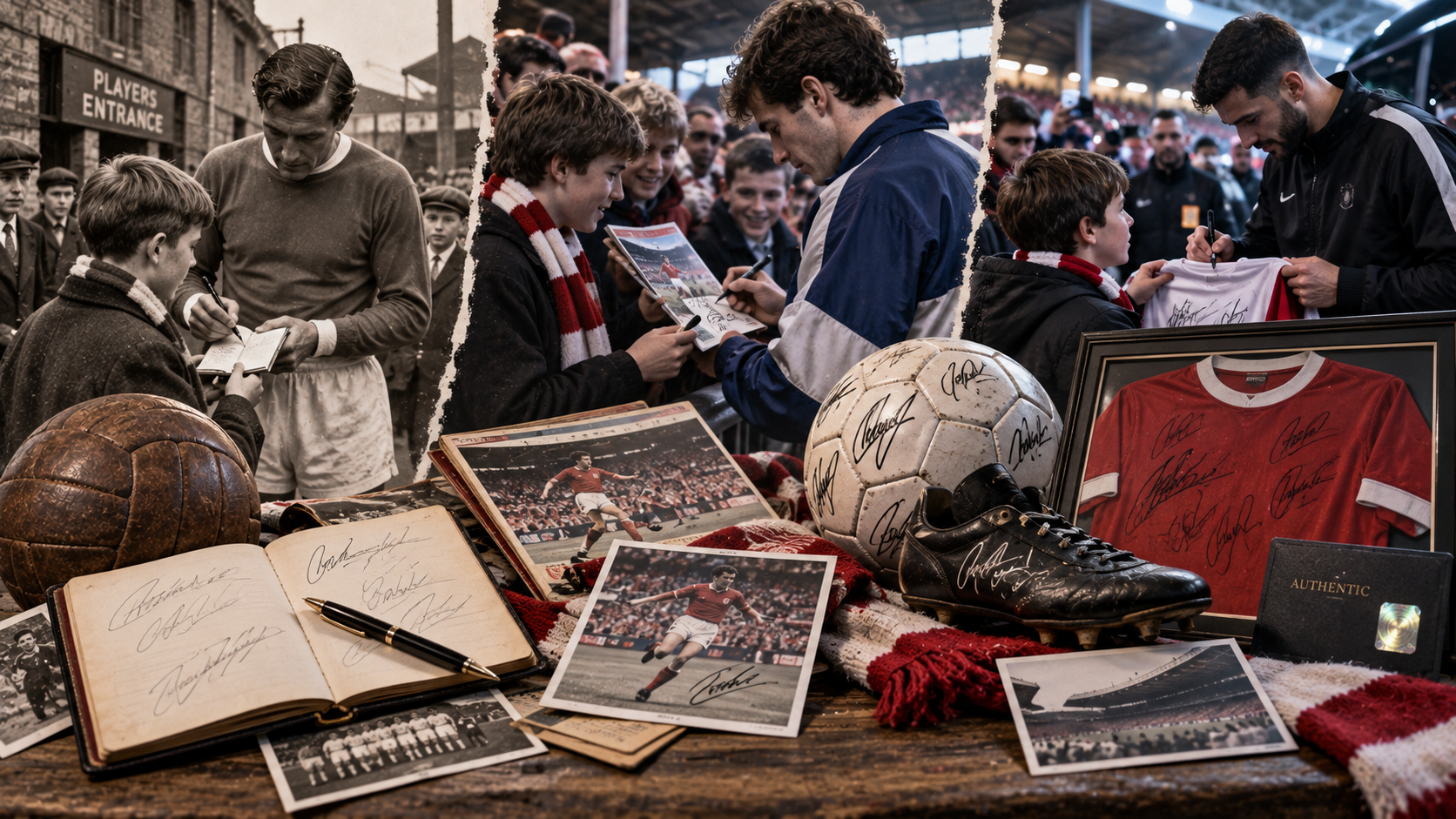
A football autograph can take only a few seconds to create. A player takes a pen, writes a name or signature across a programme, photograph, shirt, boot, card, or notebook, hands the object back, and continues walking. Yet the supporter who receives it may preserve that brief interaction for decades.
This is what makes football autographs culturally interesting. The handwriting itself may be difficult to read and may contain no information beyond a name, but its value comes from contact. The supporter possesses something physically marked by a player they watched, admired, or travelled to see. Long before supporters could collect selfies, digital messages, and instant video clips, an autograph offered a small but tangible connection between football celebrity and the people watching from the stands.
An Autograph Is More Than a Name on Paper
A signature performs an ordinary practical function in everyday life: it can confirm identity, agreement, or authorization. In supporter culture, however, its purpose changes completely. Nobody needs a striker’s signature on a match programme for legal reasons. The autograph matters because of who produced it and the circumstances in which it was obtained.
The same handwriting can therefore carry very different meanings. A signature obtained personally outside a stadium may remind somebody of a childhood afternoon. The same signature purchased years later from a memorabilia dealer may instead represent admiration for a player or an attempt to build a historical collection. The ink looks similar, but the story around it is different.
Football Autographs Belong to a Wider Collecting Tradition
People collected signatures long before modern professional football. Autograph collecting developed around politicians, writers, actors, musicians, military figures, and other notable personalities because handwriting appeared to provide a direct physical trace of somebody who might otherwise remain distant.
Football fitted naturally into that tradition as players became public figures. Supporters could collect photographs, cigarette cards, programmes, newspaper cuttings, and eventually signatures. The autograph gave an otherwise mass-produced object one unique feature: direct contact with the person represented on it.
The Autograph Book Became a Childhood Football Object
For generations of young supporters, a small autograph book could become an important piece of football equipment even though it was never taken onto the pitch. Blank pages waited for players, managers, coaches, or other football personalities encountered at grounds, training facilities, hotels, public appearances, or local events.
The book turned collecting into an ongoing project. Each new signature occupied another page and preserved another encounter. Unlike a commercially produced album, there was no official checklist determining when the collection was complete. The contents depended entirely on where the supporter went and whom they happened to meet.
A 1958 Brazil Autograph Book Shows How Personal These Collections Could Be
One surviving example demonstrates the historical value of what may initially look like an ordinary childhood collection. Before the 1958 World Cup, eleven-year-old Marcos Nastrini collected signatures from members of the Brazil squad while the team was preparing in Poços de Caldas.
The notebook later became historically fascinating because it contains names from the team that would win Brazil’s first World Cup. Among them was a young Pelé, still signing “Edson Arantes.” What began as a child’s attempt to meet footballers eventually became a document connected to one of the most important teams in international football history.
Supporters Often Remember How the Signature Was Obtained
For personally collected autographs, the story of acquisition can matter as much as the signature. A supporter may remember waiting beside a stadium entrance in the rain, approaching a player after training, seeing a team arrive at a railway station, or nervously asking a childhood hero for a signature.
These encounters are usually brief, but their brevity can make them memorable. The footballer who appears distant on television suddenly exists within arm’s reach. A few seconds of conversation and a mark of ink transform a famous public figure into somebody the supporter can remember having met.
Autographs Once Offered a Rare Form of Direct Access
Before social media, supporters had fewer ways to interact directly with players. Newspapers and television could show footballers to millions of people, but communication largely travelled in one direction. The autograph encounter was different because it required a moment of physical proximity.
This helped make waiting for players part of supporter routine. Children might gather near players’ entrances or wait after matches holding programmes and pens. The object being signed was important, but the possibility of being acknowledged by the player was often equally valuable.
Match Programmes Were Natural Autograph Material
The match programme became an especially suitable place for signatures because it was already connected with a specific fixture. A player could sign beside a photograph, team list, profile, or simply across the cover.
That changed the programme from a mass-produced publication into a personal object. Thousands of supporters might own the same edition, but only some copies would contain signatures obtained before or after the match. The autograph added a second history on top of the printed one.
Photographs Allowed the Player and Signature to Exist Together
Signed photographs offered another obvious attraction. Instead of asking somebody to recognize a name written on a blank page, the image showed the footballer directly, with the signature confirming the connection.
Club portraits, press photographs, postcards, and later glossy promotional images became common autograph surfaces. For supporters, the combination of image and handwriting created something that could be framed or displayed rather than hidden inside a book.
Football Shirts Changed the Scale of the Autograph
Replica shirts created a much larger and more visible surface for signatures. One player might sign beside a shirt number, while entire squads could cover the fabric with names. A shirt already carrying club colours and identity could become even more personal once players physically marked it.
This also increased the commercial appeal of signed memorabilia. A framed shirt bearing the signature of a famous player can function simultaneously as supporter decoration, a collectible, a gift, and in some cases an expensive market object.
Signed Boots and Footballs Connect the Signature to the Game Itself
Supporters also collect signatures on footballs, boots, goalkeeper gloves, captain’s armbands, and other equipment. These objects have an additional attraction because they are physically associated with playing football rather than simply representing it.
A signed boot immediately suggests the player who wore or used that type of equipment. A football covered in signatures can represent an entire squad. The signature does not change what the object is, but it changes why somebody wants to preserve it.
SwiftPeakX explores how football equipment itself developed in The History of Football Boots: From Heavy Leather to Modern Technology.
The Same Autograph Can Mean Different Things to Different Supporters
One supporter may treasure an autograph from a global superstar. Another may care far more about the signature of a lower-league captain who scored an important goal for their local club. Market fame and emotional value are not necessarily the same.
This is similar to many forms of football memorabilia. Objects become important because of personal relationships with clubs, players, places, and moments. The wider football world may consider one signature ordinary while one family sees it as irreplaceable.
Club Identity Gives the Signature Context
An autograph rarely exists in isolation from football identity. A signature written across a club shirt, photograph, scarf, or programme connects the individual player with the colours and symbols surrounding them.
This is one reason supporters often seek signatures from players associated with a particular era rather than simply from the most famous names available. The collection can become a history of the club as experienced by one supporter.
For more on how objects become part of supporter identity, see Scarves and Banners: Why Symbols Matter to Football Supporters.
Team-Signed Objects Create a Collective Memory
A single signature focuses attention on one player. A shirt, football, programme, or photograph signed by an entire squad tells a different story. The object represents a group connected with one season, tournament, promotion, cup run, or championship.
These objects can become especially significant once teams separate. Players transfer, managers leave, careers end, and clubs rebuild squads. The collection of signatures preserves a group that existed together only temporarily.
The Imperfect Signature Can Feel More Authentic
Personally obtained autographs are not always beautiful. A player may be walking, surrounded by supporters, signing rapidly, or holding an awkward object. The result can be rushed, incomplete, or almost impossible to read.
Paradoxically, those imperfections can strengthen the personal value. The crooked line or fading ink reminds the owner of the circumstances in which the signature was obtained. It looks less like a designed product and more like evidence of a real encounter.
Some Players Develop Recognizable Signatures
Footballers who sign frequently often develop shortened or highly stylized autographs. Writing a full legal signature hundreds or thousands of times would be slow, particularly when crowds are waiting.
As a result, the autograph can become almost a personal logo. Collectors learn its general shape, while experienced authenticators compare letter forms, movement, placement, and examples from known signing periods when assessing whether an item appears genuine.
Authenticity Became Crucial Once Autographs Acquired Financial Value
A signature obtained personally has a simple form of provenance: the supporter knows where it came from because they watched the player sign it. The problem becomes more difficult when memorabilia is bought and sold between people who were not present.
Once signed shirts, photographs, boots, and footballs became commercial products, buyers needed evidence that the handwriting genuinely belonged to the claimed player. Provenance, photographs from signing sessions, certificates, holograms, and documented chains of ownership became ways of supporting authenticity.
A Certificate Is Only as Trustworthy as the Organisation Behind It
The words “Certificate of Authenticity” can sound definitive, but a certificate does not magically prove a signature. Anyone selling a questionable object could theoretically print a piece of paper making the same claim.
What matters is provenance and the credibility of the organisation providing the authentication. Established memorabilia businesses increasingly document controlled signing sessions with photographs, unique codes, tamper-resistant holograms, or other records connecting a particular object with the event at which it was signed.
Forgeries Followed the Growth of the Memorabilia Market
Whenever an autograph becomes valuable, there is an incentive to imitate it. A famous signature can be copied onto an ordinary photograph or replica shirt and presented as genuine to a buyer who has no direct knowledge of its origin.
This is why experienced collectors are cautious about unusually cheap items, vague provenance, generic certificates, or sellers unable to explain where a signature came from. The emotional appeal of owning something connected with a favourite player can make supporters vulnerable precisely because they want the story to be true.
The Autograph Market Changed the Behaviour of Collectors
Once signed objects could be sold for significant sums, collecting developed a professional side. Some people began seeking autographs not primarily as personal souvenirs but as inventory. A player might be approached with several photographs or shirts rather than one childhood autograph book.
This distinction matters because it changes the interaction. A supporter asking a player to sign one programme may be hoping to preserve a personal moment. A professional hunter carrying stacks of merchandise may be attempting to obtain as many saleable signatures as possible before the player leaves.
Modern Autograph Hunters Can Follow Players Far Beyond the Stadium
The competition for valuable signatures has pushed some autograph hunting into more intrusive spaces. Players and managers can be approached near training grounds, hotels, airports, restaurants, traffic lights, and other places outside the traditional supporter environment of the stadium.
The cultural boundary is important. Asking politely for an autograph after a public event is different from following somebody into a private or family setting. As football celebrity has grown, the question is no longer simply whether a supporter can obtain a signature, but where and how that request remains appropriate.
Players Can Tell the Difference Between a Fan and a Seller
Professional footballers are often familiar with organized autograph hunters. Somebody carrying multiple identical photographs, several shirts, or a prepared stack of merchandise can appear very different from a child holding one programme.
This affects player behaviour. A footballer may happily sign for young supporters while refusing somebody believed to be collecting stock for online resale. What appears from the outside to be a simple refusal can therefore be shaped by repeated experiences with the commercial autograph market.
The Selfie Changed the Traditional Autograph Encounter
Smartphones created another way to record meeting a footballer. Instead of handing over an object and pen, a supporter can ask for a photograph. The result provides immediate visual evidence that both people were together at the same moment.
For some younger supporters, a selfie may feel more personal than a handwritten signature because their own face appears beside the player. It can also be shared instantly with friends or on social media rather than remaining inside a private autograph book.
Yet the Selfie Has Not Completely Replaced the Signature
The two forms of memory perform different functions. A photograph records the encounter visually. An autograph leaves the player’s physical mark on an object that the supporter can keep, display, frame, or pass to somebody else.
This helps explain why signed memorabilia remains popular despite smartphones. Digital photography made meetings easier to document, but it did not eliminate the appeal of owning something physically touched and marked by the player.
Social Media Made Autograph Collecting More Visible
Collectors once shared new signatures mainly with friends or other enthusiasts. Social media allows a rare autograph or newly signed shirt to reach thousands of viewers almost immediately.
This visibility can strengthen collecting communities because people compare examples, discuss authenticity, trade memorabilia, and identify unusual items. It can also increase competition because collectors can see exactly which players, appearances, hotels, or events are producing signatures.
Official Signing Sessions Created a Controlled Alternative
The commercial memorabilia industry increasingly uses scheduled private signing sessions. Players sit in a controlled environment and sign agreed quantities of shirts, photographs, boots, footballs, or cards while the process is documented.
This model removes some uncertainty for buyers because the seller can record when and where an item was signed. It also removes the unpredictability that makes personally obtained autographs meaningful. One is primarily a documented commercial transaction; the other may be a spontaneous supporter memory.
Signed Memorabilia Can Become Display Culture
Autographs are not always hidden in albums. Framed shirts, signed boots, photographs, and footballs appear in homes, pubs, club lounges, museums, offices, and supporter spaces.
The presentation changes the object. A shirt designed to be worn becomes something viewed through glass. Boots designed to become dirty on a pitch are protected from handling. Memorabilia moves from football equipment into domestic or museum display.
Museums Treat Signatures as Part of an Object’s Story
Professional museums preserve football objects for reasons that go beyond celebrity. A signature can reveal when an item changed hands, how later generations understood it, or what happened after its original sporting use.
The National Football Museum provides an unusual example through the ball used in the 1966 World Cup final. According to the museum, signatures reportedly added by players after the tournament had rubbed away over time, while a later signature became another chapter in the object’s history. The story demonstrates that autographs can themselves change, fade, disappear, or alter how an artefact is interpreted.
Ink and Fabric Do Not Last Forever
Supporters sometimes assume that obtaining a signature permanently fixes it onto the object. In reality, ink can fade, transfer, crack, or rub away. Light, moisture, handling, heat, and unsuitable storage can damage both the autograph and the object underneath it.
This is why serious collectors think about preservation. Signed shirts may be framed away from direct sunlight, photographs placed behind protective materials, and older paper stored carefully rather than repeatedly handled. Collecting eventually becomes a responsibility to preserve what was collected.
Personalisation Can Make an Autograph Less Marketable but More Personal
A player sometimes adds a supporter’s name: “To James,” “Best wishes, Sarah,” or another personal dedication. From a resale perspective, this may make the object less desirable to somebody with no connection to that name.
For the original recipient, however, the opposite may be true. Personalisation confirms that the player was responding to a particular person rather than rapidly signing anonymous stock. The market may prefer a clean signature, while memory may prefer evidence of a genuine interaction.
Children Remain Central to Autograph Culture
Despite the commercial market, the classic image of autograph collecting remains a young supporter waiting with a pen and something to sign. For children especially, meeting a player can collapse the enormous distance between the pitch and the stand.
A player who stops for a few seconds can create a memory far larger than the effort required. That is one reason stories about players staying late to sign for young supporters circulate so positively within fan communities. The gesture can reinforce the idea that a club and its players remain connected to the people who watch them.
Autograph Culture Reveals the Distance Between Players and Supporters
The desire for a signature exists partly because players occupy an unusual social position. Supporters may watch them every week, know their statistics, discuss their performances, own shirts bearing their names, and yet never speak to them personally.
An autograph temporarily reduces that distance. The player acknowledges the individual supporter, even if only for a moment. In an era when elite footballers can have millions of followers online, that brief personal recognition can still feel unusually direct.
Smaller Clubs Can Offer a Different Autograph Experience
The relationship between supporters and players is not identical at every level of football. At smaller clubs, players may walk through the same entrances as spectators, spend time in clubhouses, or interact regularly with supporters after matches.
Autographs in these environments may feel less like encounters with remote celebrities and more like interactions within a local football community. The signature can still be treasured, but the social distance between player and supporter is often smaller.
Away Travel Can Produce Unexpected Autograph Memories
Some signatures are collected through journeys rather than planned signing events. Supporters travelling away may encounter players at stations, hotels, airports, stadium entrances, or after matches.
The autograph then becomes attached to the wider journey. Years later, the owner may remember the train, the result, the stadium, and the conversation as one connected story rather than treating the signed object as something separate.
SwiftPeakX explores the importance of these journeys in The Culture of Away Days: Why Football Fans Travel for Their Team.
Autographs Can Connect Different Generations of Supporters
A signed programme collected by a grandparent can eventually pass to somebody who never saw the player perform. The younger supporter may know the name through stories, old footage, club history, or family memory rather than personal experience.
This transfer gives the autograph another role. It no longer records only a meeting between player and original collector. It becomes a family object connecting different generations through their relationship with the same club.
Famous Signatures Can Become Part of Football Heritage
When autographs survive for decades, their meaning changes. A player who was active when the item was signed may later become part of football history. The ordinary notebook or photograph can become a historical source because it preserves a physical trace from that person’s career.
This is how personal collections sometimes enter museums and archives. What one supporter preserved out of affection can later help historians document players, teams, tournaments, and the wider culture in which football was experienced.
Not Every Valuable Autograph Needs to Be Expensive
Commercial markets naturally focus on scarcity, fame, condition, provenance, and demand. Supporter culture uses another measure. The most meaningful signature may belong to a player whose memorabilia has very little resale value.
An autograph obtained at a first match, from a local favourite, or during a memorable promotion season can remain priceless to its owner precisely because its importance cannot be reproduced by purchasing another example online.
Buying and Collecting Are Not the Same Experience
Purchasing authenticated memorabilia allows supporters to own signatures from players they could never realistically meet. This can be especially valuable for collecting football figures from previous generations or other countries.
Obtaining a signature personally offers something the commercial market cannot sell separately: the memory of the encounter. Neither form is automatically more legitimate, but they satisfy different reasons for collecting.
Digital Technology May Make Physical Signatures More Distinctive
Modern supporters accumulate enormous digital archives. Thousands of photographs, videos, social-media posts, match notifications, and online conversations can document a single season.
Against that background, handwriting on a physical object becomes unusually analogue. It cannot be copied perfectly through a simple screen capture, and the object carries signs of handling, age, and ownership. What once seemed ordinary may become more distinctive precisely because so much football memory now exists digitally.
The Ethics of Autograph Hunting Matter
The culture survives only if access is balanced with personal boundaries. Players are public figures when performing their work, but that does not make every location or moment an appropriate opportunity for a signature.
A respectful supporter can accept that a player may be tired, travelling with family, preparing for a match, or simply unwilling to stop. The existence of a valuable resale market makes this especially important because persistent commercial hunting can make players less willing to interact even with genuine fans.
A Signature Can Preserve a Relationship With a Club
Football support is built through repetition: matches attended, players remembered, seasons endured, journeys made, and stories retold. Autographs fit naturally into that pattern because they turn particular moments into objects that can survive long after the team has changed.
SwiftPeakX explores the deeper relationship between football institutions and the communities around them in Football and Local Identity: Why Clubs Mean More Than the Game.
From Autograph Books to Authentication Codes
The culture of football autographs has changed significantly. A child once needed little more than a notebook and a pen. Modern collectors can encounter professionally framed shirts, controlled signing sessions, digital authentication records, holograms, online marketplaces, and specialists attempting to distinguish genuine handwriting from forgery.
Yet the central attraction has changed surprisingly little. The supporter still wants a physical trace of the footballer. Technology can verify it, preserve it, sell it, photograph it, and catalogue it, but the essential object remains a mark made by one person and valued by another.
Why Supporters Still Ask for Autographs
A signature cannot reproduce a goal, recreate a stadium atmosphere, or explain why a particular player mattered. Its importance depends on everything surrounding it. It can represent childhood admiration, a chance encounter, club loyalty, a family story, a historic team, or simply the excitement of having been noticed for a few seconds by somebody usually seen from far away.
That is why football autographs continue to survive alongside selfies and social media. The signature combines celebrity with touch, memory with material, and football history with individual experience. The ink may eventually fade, but the reason somebody asked for it often lasts much longer.
Continue Exploring SwiftPeakX
Football autographs belong to a wider culture in which ordinary objects acquire meaning through clubs, players, journeys, and memory. Continue with Scarves and Banners: Why Symbols Matter to Football Supporters, Football and Local Identity: Why Clubs Mean More Than the Game, and The Culture of Away Days: Why Football Fans Travel for Their Team.
Recommended Sources for Further Reading
- Museu do Futebol / Google Arts & Culture — Paper Football and Historic Autograph Collections
- National Football Museum — The 1966 World Cup Final Ball and Its Signatures
- BBC Sport — Football Autograph Hunters, Fans and Professional Resellers
- Icons.com — Signed Football Memorabilia, Provenance and Authentication


