
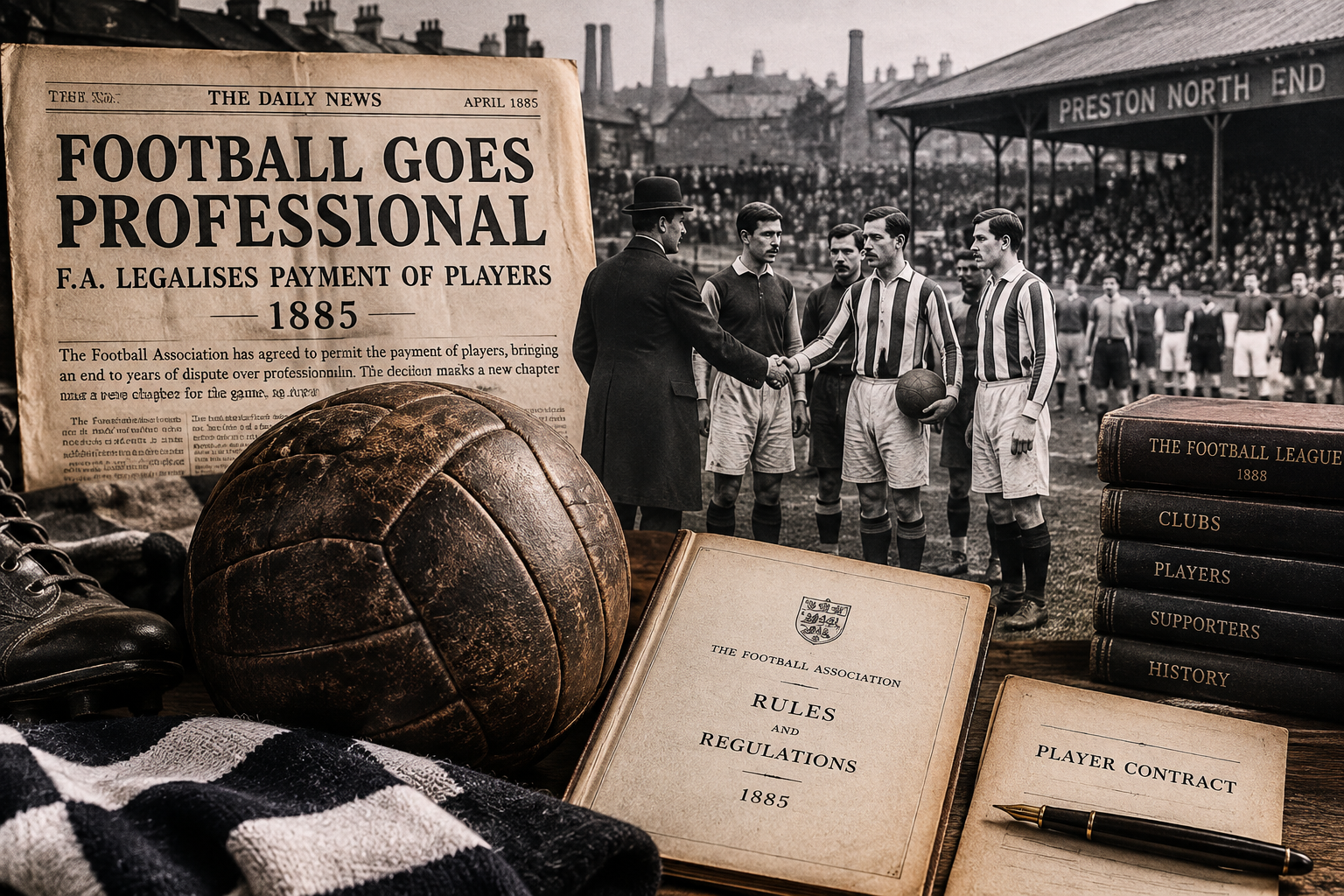
Professional football was not born simply because clubs decided that talented players deserved to be paid. It emerged from a deeper conflict over who could realistically afford to play the game at a high level. During the nineteenth century, amateurism was often presented as a sporting ideal, particularly by administrators and players who had enough money and leisure to participate without wages. For working men, however, regular training, travel, and matches could mean losing income from their ordinary employment. As football became more competitive and attracted larger crowds, pretending that elite players could remain entirely unpaid became increasingly difficult.
The decision to legalize professionalism in England in 1885 therefore represented much more than a change to an administrative rule. It altered who could build a career in football, how clubs recruited players, how teams organized themselves, and how money circulated through the sport. Professionalism helped football grow into a regular occupation and eventually into a major entertainment industry, but it also created new questions about contracts, wages, transfers, and the balance of power between players and clubs. Many of the arguments surrounding modern football economics can be traced back to this Victorian transformation.
Amateurism Was More Than a Sporting Rule
In nineteenth-century Britain, amateurism carried strong social meaning. Playing without payment was frequently associated with the idea that sport should be pursued for enjoyment, character, and honor rather than financial reward. That philosophy was especially influential among public schools, universities, and socially established clubs whose members could afford to give time to sport without depending on it for income. To many administrators, money appeared capable of corrupting competition by replacing gentlemanly participation with employment and commercial ambition.
The difficulty was that the amateur ideal did not affect every player equally. A wealthy player could travel to a match, miss work, and train regularly without worrying about lost wages. A factory worker, tradesman, or laborer could not necessarily do the same. As football expanded through industrial towns, increasingly talented working-class players became central to successful clubs. The question of payment therefore became connected to access. Keeping football officially amateur could protect an ideal, but it could also favor people whose economic circumstances allowed them to participate without compensation.
Northern Clubs Challenged the Amateur Ideal
The tension became particularly visible in the north and Midlands, where ambitious clubs were developing strong connections with industrial communities and increasingly large paying crowds. These clubs wanted talented players and were prepared to help them financially. Some recruited footballers from Scotland or other parts of Britain, found them employment, covered expenses, or provided payments that technically violated Football Association rules. The practice created an obvious contradiction: officially the game remained amateur, but in reality money was already influencing who played and where.
Preston North End became one of the best-known examples of this conflict. The club recruited players from outside Lancashire and became associated with payments and employment arrangements that challenged the FA’s amateur regulations. In 1884, Preston were expelled from the FA Cup over the issue of professionalism. The confrontation was larger than one club because numerous northern sides were increasingly unwilling to accept rules they believed ignored the economic reality of competitive football. What had started as hidden compensation was turning into a dispute over the future structure of the sport.
Why Secret Payments Created an Impossible Situation
Banning wages did not necessarily prevent money from entering football. Instead, it encouraged payments to take less transparent forms. A talented player might receive expenses, employment connected with a club, gifts, or unofficial financial assistance. Clubs that followed the amateur rules strictly could then find themselves competing against organizations whose players were effectively being compensated. The system created uncertainty because the distinction between legitimate expenses and prohibited payment was often difficult to maintain in a sport becoming more competitive every season.
This mattered because football was no longer only a collection of occasional local matches. The FA Cup had created national competition, clubs were attracting paying spectators, and successful teams were building reputations that extended beyond their immediate communities. Better players could improve results, and better results could attract larger crowds. Financial incentives therefore existed even while official rules tried to exclude payment. Legalizing professionalism eventually became a way of bringing an already developing economic reality into a system that could be regulated openly rather than hidden behind informal arrangements.
The FA Legalized Professionalism in 1885
In 1885, The Football Association formally legalized professionalism. The decision followed years of growing disagreement and came at a moment when English football risked dividing between organizations that accepted payment and administrators committed to the amateur principle. Legalization did not mean that every club immediately became professional or that arguments disappeared. What changed was that paying a footballer was no longer automatically treated as incompatible with association football. The sport had formally accepted that playing could be employment as well as recreation.
The decision transformed the relationship between clubs and players. Professional footballers had to be registered, and their employment increasingly became governed by rules concerning eligibility, contracts, and movement between teams. Payment provided players with an opportunity to earn money from their ability, but professional status also gave governing bodies and clubs mechanisms to control that labor. The birth of professional football was therefore both an expansion of opportunity and the beginning of a long argument about how much freedom players should have within the organizations that employed them.
Professionalism Opened Football to Working-Class Careers
One of professionalism’s most important consequences was that talented players no longer needed independent wealth to justify dedicating large amounts of time to football. A wage could compensate for hours spent training, travelling, and playing instead of working elsewhere. That did not make early professional footballers wealthy by modern standards, and many still lived within the economic conditions of the communities around their clubs. Nevertheless, the principle was significant: sporting ability could now form the basis of legitimate employment rather than having to exist alongside unpaid participation.
This helped broaden football’s social foundation. Clubs in industrial towns could recruit and retain players whose backgrounds differed from many of the administrators who had first codified the game. Supporters increasingly watched footballers whose working lives and communities were closer to their own experience. Professional teams could train more consistently, develop tactical understanding, and build recognizable squads. The change contributed to football becoming not only a sport people played but also a recurring public spectacle organized around clubs representing particular towns and communities.
The Football League Made Professional Football Sustainable
Legalizing payment solved one problem but created another: clubs paying players needed reliable matches and reliable income. Friendly fixtures could be irregular, cancelled, or arranged without a predictable season-long structure. In 1888, Aston Villa director William McGregor helped establish the Football League, bringing twelve founding clubs into an organized competition with a regular programme of matches. The league format provided a framework in which professional football could become economically and competitively more stable.
The relationship between professionalism and league football was mutually reinforcing. Clubs needed gate receipts and recurring fixtures to support playing staffs, while spectators were more likely to follow a competition with standings, meaningful results, and a recognizable season. Instead of isolated matches, supporters could follow an unfolding campaign. SwiftPeak explores this institutional transformation further in How the Football League Changed the Organization of the Game. Professionalism supplied the players, but organized league competition gave their employment a more durable structure.
Regular Competition Changed the Meaning of a Football Club
A professional club required more continuity than an informal team assembled for occasional matches. It needed administrators, finances, a ground, regular opponents, playing contracts, and an audience willing to return throughout the season. These requirements strengthened the club as an institution. Supporters could organize their weekends around fixtures, newspapers could report an ongoing competition, and players could become familiar public figures rather than temporary participants. Football gradually developed the rhythms that still define the modern game: seasons, tables, transfers, contracts, and recurring local loyalties.
This continuity also strengthened the relationship between club and community. A team representing Preston, Blackburn, Aston Villa, Everton, or another town could become part of how residents understood local identity. Results accumulated over years, rivalries developed through repeated meetings, and grounds became regular social destinations. The professionalization of football therefore affected more than players’ wages. It helped create institutions capable of carrying collective memory from one generation to another, giving supporters a continuing story to inherit rather than a series of disconnected sporting events.
Contracts Gave Players Wages but Also Gave Clubs Control
Professional status did not produce the kind of labor freedom modern footballers would recognize. Registration and contract systems gave clubs considerable influence over whether players could move elsewhere. The retain-and-transfer system that developed around professional football allowed clubs to retain a player’s registration and demand compensation before he could join another team. In practical terms, a player could be earning a wage from football while still possessing limited freedom to choose where he worked.
This tension became one of the central themes in football’s labor history. Players wanted security and payment, clubs wanted to protect valuable squads and investments, and governing bodies wanted competition to operate under consistent rules. Those interests did not always align. The later history of transfer regulations, maximum wages, player unions, and freedom of contract grew from these early structures. SwiftPeak examines that longer struggle in The History of Football Transfers and the Fight for Player Freedom, where the movement of players became a continuing argument about ownership, bargaining power, and employment rights.
Professionalism Raised the Standard of Competition
When football could become a job, players had stronger reasons and greater opportunities to devote time to improving their performance. Clubs could select squads with competitive objectives in mind, organize training more systematically, and build teams intended to play together across a full season. The difference was gradual rather than immediate, but professionalism encouraged football to move away from a culture in which preparation depended heavily on the leisure available to individual participants. Performance itself became increasingly connected to an organized working environment.
Higher standards also changed spectator expectations. Paying audiences wanted meaningful competition, recognizable players, and teams capable of performing consistently. Successful clubs could attract more spectators, which generated income that could support stronger squads and better facilities. This created a cycle through which sporting ambition and commercial growth reinforced each other. The same basic relationship remains visible in modern football, even though broadcasting, sponsorship, global merchandising, and enormous transfer markets have increased its scale beyond anything Victorian administrators could have imagined.
The Amateur Ideal Did Not Disappear Overnight
Legal recognition in 1885 did not cause everyone within football to embrace professionalism. Amateur traditions remained influential, particularly among organizations that believed payment threatened the values sport was supposed to represent. Tension between professional and amateur cultures continued into the twentieth century, demonstrating that the 1885 decision was not a simple moment when one philosophy disappeared and another completely replaced it. Different ideas about what football should represent continued to coexist inside the same expanding sport.
The disagreement also reflected class differences within British sport. The ability to play without payment could be presented as evidence of purity while depending on economic privilege that was unavailable to many working players. Professionalism challenged that assumption by recognizing that compensation did not necessarily make sporting commitment less genuine. A person could love football and still expect to be paid for labor that consumed significant time and generated income for a club. That principle would become increasingly difficult to dispute as spectators, competitions, and commercial revenues continued to grow.
Players Eventually Organized to Demand Greater Rights
Once football became employment, disputes about employment conditions were inevitable. Professional players could earn wages, but regulations concerning pay and movement limited their bargaining power. Efforts to organize collectively eventually produced player associations that challenged the conditions imposed by clubs and governing bodies. The history of professional football therefore cannot be understood only as a story of clubs generously deciding to compensate athletes. It is also a history of workers attempting to influence the rules governing their careers.
Those struggles continued for decades and eventually reshaped wages, contracts, and transfer freedom. Modern players occupy a very different economic position from Victorian professionals, especially at the highest levels of the sport, but the underlying questions remain recognizable. Who controls a player’s movement? How should football income be distributed? How much protection should contracts provide to clubs and to employees? Professionalism created a career where one had previously been officially forbidden, but it simultaneously created an employment system whose balance of power would be contested for generations.
Professional Football Changed the Supporter Experience
Professionalism also changed football from the perspective of people standing around the pitch. Regular teams and organized competitions made it easier for supporters to develop long-term relationships with clubs and players. Familiar names returned week after week, league positions gave every result a wider context, and seasons created recurring narratives of expectation, disappointment, promotion, rivalry, and success. Spectatorship became less dependent on isolated occasions and more connected to following a club through a structured calendar.
This helped create many of the cultural habits SwiftPeak focuses on today. Matchday routines, club loyalties, away travel, local rivalries, football journalism, and collective memory all benefited from the continuity produced by organized professional competition. Later developments such as radio and television would expand the audience dramatically, a transformation explored in How Television Changed Football Forever. Yet before football could become a mass-media spectacle, it first had to become stable enough for clubs and players to produce a dependable competition worth following.
From Victorian Wages to a Global Football Economy
The financial scale of contemporary football can make the first professional era seem almost unrelated to the modern game. Today’s leading clubs negotiate enormous broadcasting contracts, sponsorship agreements, commercial partnerships, and international transfer fees, while elite players can become global celebrities. Early professionals operated in a much smaller economy. Nevertheless, the fundamental change made in the nineteenth century remains underneath the modern system: football accepted that playing at an elite competitive level could constitute paid work.
Once that principle was established, every later expansion of football raised new economic questions. Greater revenues produced arguments over wages, transfer values, ticket prices, ownership, competitive balance, and the distribution of money between clubs. The commercial world surrounding football has changed beyond recognition, but debates about who creates the game’s value and who should receive its rewards remain closely connected to the original conflict over professionalism. Modern football economics is therefore not a separate story from the nineteenth century; it is one of the longest consequences of the decision made in 1885.
Why 1885 Changed Football Permanently
The legalization of professionalism did not create modern football by itself. The Laws had already been codified, clubs already existed, the FA Cup was established, and supporters were already gathering around teams. What 1885 changed was the relationship between football and labor. It acknowledged that elite players could legitimately earn money from the game and allowed clubs to build organizations around paid playing staffs. The Football League soon provided those professional clubs with the regular competition necessary to sustain that model across a season.
The consequences reached far beyond wages. Professionalism broadened opportunities for working-class talent, improved the conditions for regular competition, strengthened clubs as permanent community institutions, and helped create the economic foundations of spectator football. At the same time, contracts and registration systems generated new forms of control that players would spend generations challenging. The birth of professional football was therefore neither a simple triumph of commerce nor the destruction of an amateur ideal. It was the moment football accepted that sporting talent could be work—and began negotiating everything that followed from that decision.


