
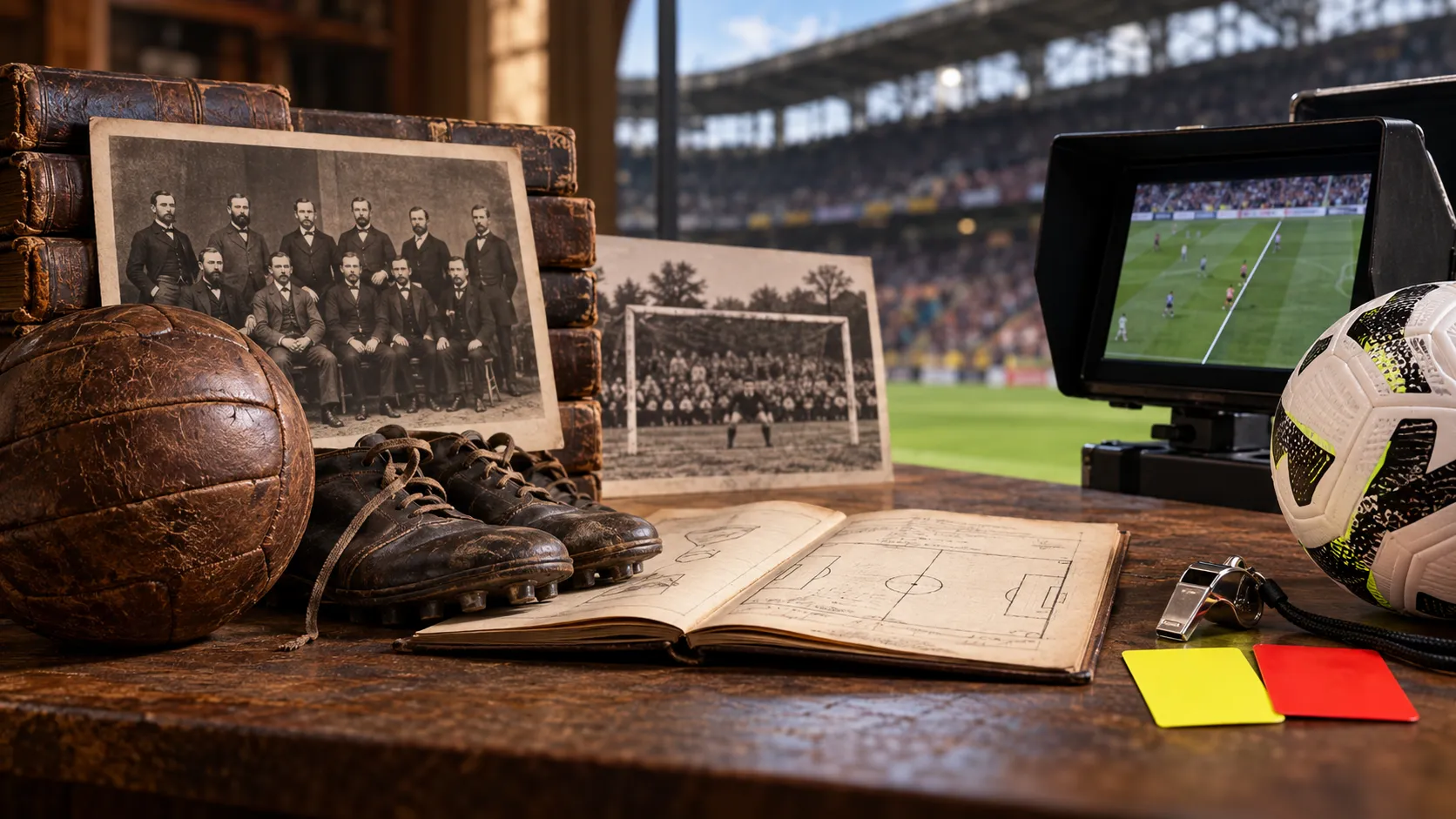
Modern football can appear to be governed by rules that have always existed in roughly the same form. The pitch has familiar markings, teams use eleven players, referees carry yellow and red cards, penalties are taken from twelve yards, and supporters instinctively understand concepts such as offside, corners, substitutions, and added time. Yet the football played today is the result of more than a century and a half of continuous rule changes. Many features that now seem inseparable from the game were introduced only after players, clubs, referees, and administrators encountered problems the original laws had never anticipated.
The history of football’s laws is therefore not simply a collection of technical amendments. Rule changes altered tactics, encouraged different kinds of players, changed the responsibilities of goalkeepers and defenders, influenced stadium behavior, and even transformed how matches could be presented on television. Some changes were intended to make the game safer, others to discourage exploitation, and others to produce clearer or more attacking football. What remained constant was the need to preserve a recognizable game while allowing that game to respond to new challenges. The football of 1863 and the football of today belong to the same tradition, but the path between them involved repeated reinvention.
Why Football Needed a Common Set of Rules
Before the Football Association was established in England in 1863, football did not operate under one universally accepted code. Schools, universities, and clubs could use different rules concerning handling, tackling, offside, and how the ball should be restarted. A team accustomed to one version of football could therefore find it difficult to arrange a match against opponents who played another. As clubs became more organized, this lack of consistency became increasingly impractical. Football needed a shared language if teams from different communities were going to compete regularly.
The Football Association was formed in London on 26 October 1863, with representatives from clubs and institutions meeting to create a definite code for the game. Ebenezer Cobb Morley played an important role in drafting the new laws, and after a series of meetings the final code was approved in December. One of the most significant debates concerned “hacking,” the practice of kicking an opponent on the leg, which some participants wanted to preserve. The final FA code rejected hacking and helped distinguish association football from forms of football that developed along different lines.
The 1863 Game Would Look Strange to Modern Supporters
The original laws established a recognizable foundation, but many details would surprise a modern audience. The goal consisted of two upright posts without the familiar crossbar structure used today, and field markings were far simpler. The offside principle was also extremely restrictive. Under the early rule, an attacking player ahead of the ball when a teammate played it could effectively be considered out of play, creating a game in which forward passing operated very differently from modern football. Tactical possibilities were therefore shaped directly by the wording of the law.
Even concepts that supporters now consider basic developed gradually. The goal area appeared later, corner kicks were introduced after the original code, and the geometry of the penalty area did not yet exist. Football fields slowly acquired more markings as administrators attempted to define exactly where particular restarts, fouls, and restrictions should apply. The modern pitch is therefore a kind of historical diagram: almost every line reflects a problem that the laws eventually needed to solve more precisely.
The International Football Association Board Created Greater Uniformity
As organized football spread across Britain, maintaining a consistent set of laws became increasingly important. England, Scotland, Wales, and Ireland did not always interpret or develop football in exactly the same way, so a permanent body was needed to coordinate changes. The International Football Association Board, commonly known as IFAB, was formed in 1886 with representatives from the four British football associations. Its purpose was to maintain a common set of Laws of the Game rather than allowing national versions to drift apart.
This structure became even more important as football expanded internationally. FIFA was founded in 1904 and later joined IFAB in 1913, creating the framework through which the Laws could be applied throughout world football. That arrangement remains significant because the laws are not simply the property of one league or country. A professional match in Europe, an international tournament, and organized football elsewhere are built around the same fundamental code. The global identity of association football depends heavily on that consistency.
New Restarts Helped Give the Pitch Its Modern Shape
During the decades after 1863, football introduced rules that gradually made the structure of the match more recognizable. The goal area appeared in the nineteenth century, while the corner kick became part of the game in the early 1870s. These additions solved practical questions about how play should restart after the ball crossed different parts of the boundary. Instead of relying on inconsistent local practices, the laws increasingly specified which team should receive possession, where the ball should be placed, and how opponents were required to position themselves.
The cumulative effect was larger than each individual change might suggest. A modern football pitch communicates rules visually. The corner arc indicates where a corner is taken, the goal area defines certain goalkeeper and restart procedures, the penalty area establishes a zone where particular fouls have extraordinary consequences, and the halfway line affects offside positioning. As football became more regulated, the field itself became increasingly standardized, allowing players and referees to understand the same visual language wherever a match was played.
The Penalty Kick Changed the Meaning of a Foul Near Goal
One of the most influential nineteenth-century changes arrived in 1891 with the introduction of the penalty kick. Before it existed, football faced a serious problem: a defender could deliberately commit an offence near goal to prevent an obvious scoring opportunity, yet the existing punishment might not adequately restore the attacking advantage. William McCrum, a goalkeeper associated with Milford Football Club in Ireland, proposed a stronger sanction that eventually moved through the Irish football authorities and into the international law-making process.
The original penalty procedure was not identical to the modern version, but its central principle survived. Football had accepted that the consequence of an offence could depend on where it occurred and what opportunity it destroyed. Over time the penalty area and fixed twelve-yard mark created the form supporters now recognize instantly. The history of this rule is explored in The History of the Penalty Kick and Why It Was Introduced. Few rule changes have had such a lasting influence on both football tactics and football drama.
Offside Became One of Football’s Most Important Experiments
No major law has been adjusted as repeatedly as offside. The original 1863 version made attacking movement extremely restrictive because players positioned ahead of the ball had far fewer opportunities to receive forward passes legally. The rule gradually became more permissive as administrators attempted to find a better balance between attacking freedom and preventing players from simply waiting beside the opponents’ goal. Each alteration changed the geometry of football because attackers and defenders immediately adapted their positioning to the new boundary between legal and illegal play.
By the twentieth century, one of the most important changes involved reducing the number of opponents required between an attacker and the goal line. The two-opponent principle helped produce a more attacking game and encouraged defensive systems to evolve in response. Modern offside continues to use the second-last opponent as a key reference point, although merely standing in an offside position is not automatically an offence. A player generally has to become involved in active play by touching the ball, interfering with an opponent, or gaining an advantage under the conditions defined by the law.
Offside Rules Changed Tactics as Much as Refereeing
Changes to offside demonstrate why football laws cannot be separated from tactics. When the legal position of an attacker changes, defenders must reconsider how high they can hold their line, goalkeepers must judge space behind the defence differently, and attackers learn new ways to time runs. Entire tactical systems have been shaped by attempts to exploit or control the offside law. A seemingly small alteration in wording can therefore influence thousands of movements across a match without the referee blowing the whistle once.
The same law has also become one of the areas most affected by modern technology. Television replays and video officiating can examine extremely narrow positional differences that were impossible for earlier generations of assistant referees to judge with comparable precision. This has created new debates about whether technology is applying the original spirit of offside or turning a tactical principle into a measurement exercise. Yet the controversy fits a much older pattern: offside has always been adjusted as football searches for the right balance between attacking possibility and defensive fairness.
The Goalkeeper’s Freedom Was Gradually Reduced
Goalkeeping also changed dramatically because of law reform. Early goalkeepers enjoyed freedoms that would be impossible in the modern game, and the boundary between goalkeeper and outfield player developed over time. One important change came in 1912, when goalkeepers were prohibited from handling the ball outside their own penalty area. That restriction helped define the goalkeeper as a specialist whose exceptional privilege to use the hands applied only within a clearly marked part of the field.
Later reforms continued to reshape the position. Goalkeepers faced restrictions on the amount of time they could control the ball, how teammates could deliberately return possession to them, and how they could behave during penalty kicks. Each change forced technical adaptation. The modern goalkeeper has consequently become far more involved with passing, positioning, and build-up play than many predecessors. That wider transformation is examined in How the Goalkeeper Evolved From Shot-Stopper to Playmaker.
Cards Created a Universal Visual Language for Discipline
For much of football history, referees could warn or dismiss players without displaying a colored card. The problem became particularly obvious in international matches where language differences could make disciplinary communication unclear. The 1966 World Cup quarter-final between England and Argentina became especially influential after Argentine captain Antonio Rattín was sent off amid confusion and dispute. English referee administrator Ken Aston later developed the idea of using traffic-light colors as a universally understandable visual system: yellow as a warning and red as the signal to stop.
Yellow and red cards were used at the World Cup for the first time in 1970 and eventually became one of football’s most recognizable officiating tools. The system did not create cautions and dismissals, but it made those decisions visible to players, spectators, broadcasters, and officials regardless of language. SwiftPeakX explores this development in Why Football Introduced Yellow and Red Cards. The cards demonstrate how a rule-related innovation can solve a communication problem while also becoming part of football’s visual culture.
Substitutions Changed the Idea of the Starting Eleven
Football originally developed around the expectation that the players who started a match would generally have to complete it. Injury could leave a team weakened, and tactical replacement was not the normal strategic tool it later became. The gradual acceptance of substitutions changed both squad construction and management. Coaches could respond to injuries, alter formations, introduce fresh attackers, protect a lead, or manage the physical demands placed on players during increasingly intense schedules.
Over subsequent decades the permitted number of substitutes increased, and competition rules developed detailed procedures governing when and how replacements could enter. Modern football now treats the substitutes’ bench as an active tactical resource rather than simply emergency cover. The law therefore helped create a new dimension of coaching. Managers do not only choose a starting team; they plan how different players may change the game after it begins, making substitutions part of the strategic narrative of almost every high-level match.
Penalty Shootouts Solved a Different Problem
The penalty kick had existed since the nineteenth century, but deciding a drawn knockout match required another solution. Earlier competitions sometimes relied on replays, drawing lots, or other methods when teams could not be separated. As international tournaments and congested schedules developed, football needed a procedure that could produce a winner within the match event itself. Kicks from the penalty mark eventually provided that solution, using the familiar penalty situation for a completely different purpose.
A shootout is therefore not simply a collection of ordinary penalties. A penalty awarded during play punishes an offence, while a shootout is a competition procedure for determining the winner after the match remains level under the required conditions. Over time the shootout became one of football’s most dramatic rituals, especially in international tournaments and cup competitions. Its separate history is explored in How the Penalty Shootout Became Football’s Most Dramatic Decider.
The Back-Pass Rule Transformed Football in 1992
By the late twentieth century, football faced another problem created by players using the existing laws efficiently but unattractively. A team protecting possession could deliberately pass the ball back to its goalkeeper, who was allowed to pick it up with the hands. The ball could then be held and returned to a teammate before the same process was repeated. This tactic could slow matches dramatically, particularly when a team wanted to protect a lead and reduce the opponent’s opportunity to regain possession.
The back-pass reform introduced in 1992 prevented goalkeepers from handling a ball deliberately kicked to them by a teammate. Its consequences were enormous. Goalkeepers suddenly needed greater confidence controlling and passing the ball with their feet, defenders had to provide safer passing options, and pressing opponents gained opportunities that had previously disappeared when the goalkeeper simply collected possession. A rule designed partly to reduce time-wasting helped accelerate the evolution of modern build-up play and contributed to the transformation of goalkeeping technique.
Rules Often Change Because Players Learn to Exploit Them
The back-pass rule illustrates a pattern visible throughout football history. Players and coaches naturally search for every legal advantage available, and once a tactic becomes widespread it can expose weaknesses in the law. Administrators then have to decide whether the behavior represents legitimate strategy or whether it undermines the kind of contest the rules are intended to create. Football’s laws therefore develop through a continuing conversation between written regulation and behavior on the pitch.
This explains why apparently minor technical changes can matter so much. Restrictions on goalkeeper possession, goalkeeper movement at penalties, deliberate handball, delaying restarts, encroachment, or misconduct may initially appear to concern only referees. In reality, players immediately incorporate those boundaries into tactical decision-making. Football is played not just with a ball and opponents, but within a constantly interpreted legal framework. Understanding that framework is part of understanding why the sport looks the way it does.
Television Changed How Supporters Judged the Laws
For most of football history, a referee made a decision and the majority of spectators had little opportunity to inspect the incident again. Television transformed that relationship. Slow-motion replay, multiple camera angles, freeze frames, and studio analysis allowed millions of viewers to examine a decision more closely than the referee who had seen it once at full speed. As broadcasting became more sophisticated, questions about handball, offside, penalties, fouls, and whether the ball crossed the line became central parts of football discussion.
This created new pressure on the laws themselves. Ambiguous wording or difficult interpretations were exposed repeatedly on television, making consistency increasingly important. Broadcasting did not merely report refereeing decisions; it changed the cultural expectation that decisions should be explainable under close examination. The wider effect of television on the sport is explored in How Television Changed Football Forever. Eventually, the availability of detailed video evidence contributed to calls for technology to move from the television studio into the officiating process itself.
Technology Entered the Laws Without Replacing the Referee
Goal-line technology represented one major step toward using machines to answer questions that human officials could sometimes struggle to resolve reliably. Whether the entire ball crossed the goal line is fundamentally a factual question, and technology could provide a rapid answer without requiring interpretation of intent or contact. Video assistant referees later extended technological assistance into more complex incidents involving goals, penalties, direct red cards, and mistaken identity under the procedures established for competitions using VAR.
Technology did not eliminate controversy because many football decisions are interpretive rather than purely factual. A camera can show where contact occurred, but a referee may still have to decide whether that contact was careless, reckless, sufficient to constitute an offence, or relevant to the phase of play being reviewed. VAR therefore became another stage in the long history of law reform rather than the final solution to refereeing. The essential challenge remained familiar: how can football improve decision-making without destroying the flow and human character of the game?
The Modern Laws Still Carry Their Nineteenth-Century Foundations
Despite all these changes, someone transported from the early decades of organized association football would still recognize the basic objective of the modern game. Two teams attempt to move a ball into the opponents’ goal while operating within rules that limit physical contact, handling, positioning, and restarts. Goals remain the central measure of success, and the contest still depends on a balance between freedom and restriction. The laws have accumulated enormous detail, but they have not replaced the identity established during football’s formative period.
This continuity explains why rule reform is often cautious. A change that solves one problem can create another, and altering a fundamental law may reshape tactics in ways administrators cannot fully predict. IFAB therefore acts not only as a body that changes the laws but also as a guardian of their consistency. Modern football may use advanced broadcasting, data analysis, communication systems, and video review, yet it remains connected institutionally to the rule-making tradition that began when clubs gathered in London to establish a shared code in 1863.
Why Football’s Laws Will Continue to Change
The idea that the Laws of the Game should eventually become completely finished misunderstands their history. Football continues to encounter new technologies, tactical behaviors, medical concerns, scheduling demands, and expectations about fairness. Lawmakers must respond while trying not to make the game unnecessarily complicated. Recent generations have already seen changes involving substitution numbers, concussion protocols, goalkeeper time limits, video review, disciplinary interpretation, and other areas that earlier supporters could not have imagined.
Future changes will almost certainly produce the same debate that accompanied earlier reforms. Some supporters will argue that football is losing something traditional, while others will see the new rule as a necessary response to an obvious problem. History suggests that both reactions are normal. The penalty kick, cards, substitutions, the back-pass rule, and video technology were all unfamiliar innovations at some point. Once absorbed into everyday football, many of them became so normal that later generations struggled to imagine the game without them.
From Thirteen Early Laws to a Global Game
The laws created in 1863 gave association football something more valuable than a perfect rulebook: they gave the sport a common foundation from which it could evolve. Subsequent generations added corner kicks, penalties, new offside interpretations, disciplinary cards, substitution systems, restrictions on goalkeepers, shootouts, technological assistance, and countless smaller adjustments. Each change responded to football as it actually existed at that moment rather than treating the original code as untouchable.
That adaptability is one reason football survived its own enormous growth. The sport moved from loosely connected nineteenth-century clubs to professional leagues, international tournaments, enormous stadiums, global broadcasting, and audiences numbering in the billions without abandoning a common legal identity. Football’s Laws of the Game are therefore both historical and living documents. They preserve the principles that made association football recognizable while continuing to change whenever the game finds a new way to test their limits.


