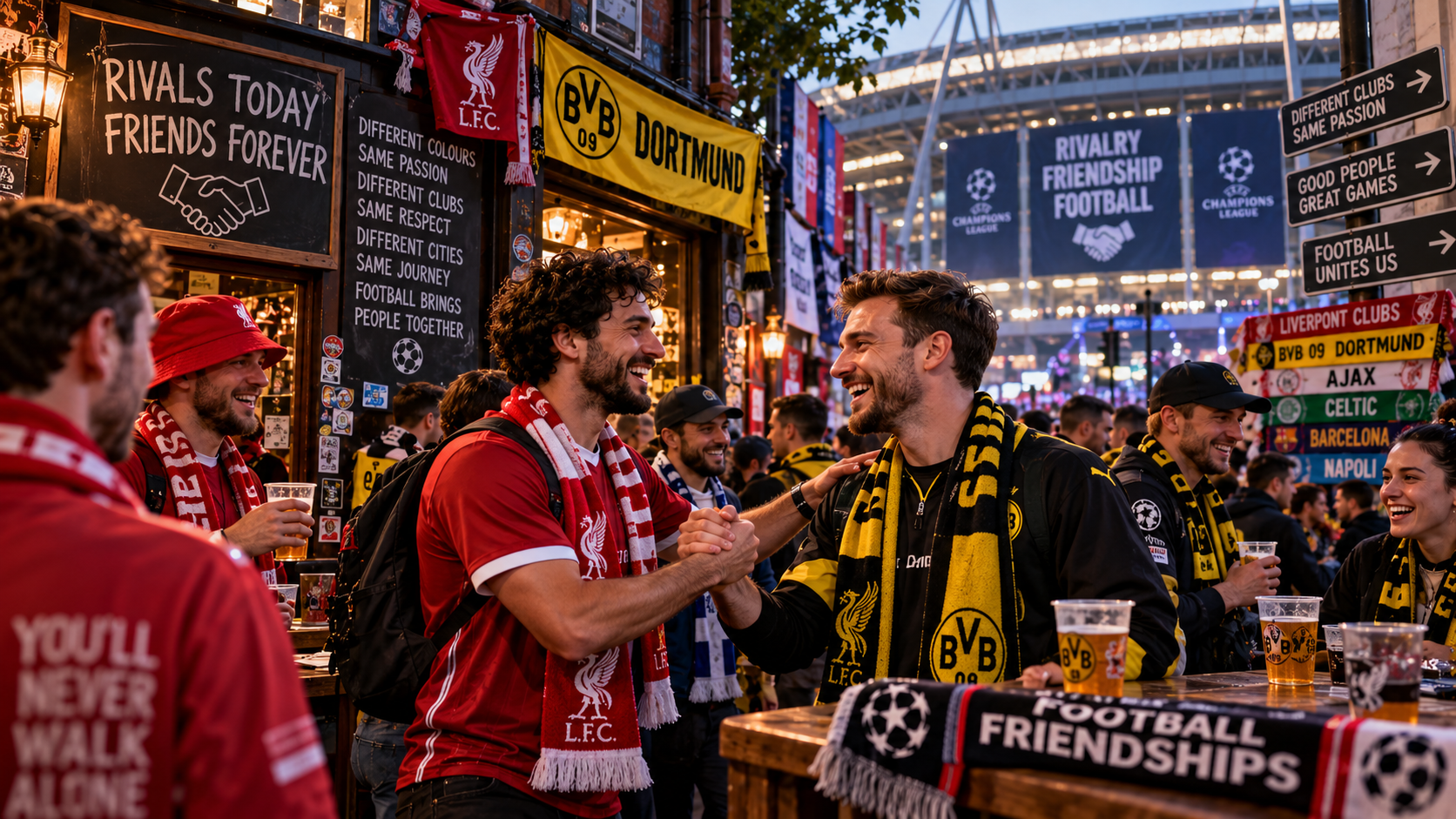
Football rivalry does not always prevent friendship. Explore why some supporter groups form lasting bonds across club lines through shared history, travel, values, and experiences beyond the match itself.
The beginning and end of the timeline show the scale of the change. Under Terrace culture, supporter identity formed strongly around club and locality. Under Modern supporter networks, formal and informal alliances coexist with traditional rivalries.
Written by: SwiftPeakX Editorial Team
Last editorial review: October 2026
Editorial note: This article was reviewed for topic-specific wording, historical clarity, source transparency and natural readability. References are listed at the end for verification and further reading.
Key Takeaways
Football identity encourages rivalry, but rivalry does not automatically produce hostility.
Supporter friendships can grow from historical encounters, political or cultural affinities, travel and mutual hospitality.
Repeated positive contact can humanize rival groups without erasing competitive identity.
Cross-club bonds remain fragile when ownership disputes, violence or online conflict change the relationship.
Historical Foundations
Football culture is famous for rivalry, yet supporter relationships are not always hostile. Some fan groups develop friendships across club lines through shared political values, historical connections, repeated European travel, common rivals, or simply years of personal contact.
These relationships can be formalized through banners, joint events, hospitality, and reciprocal visits. In other cases they remain small and personal, existing between families or supporter groups rather than entire fan bases. The meaning can also be contested because not every supporter accepts an officially celebrated friendship.
Cross-club bonds reveal that football identity is layered. A person can be fiercely loyal to one club while respecting another community. Shared experiences—travel disruption, stadium disasters, supporter campaigns, or opposition to discriminatory behavior—can create solidarity that temporarily outweighs competition.
Supporters do not need to become neutral in order to respect each other. A friendship can survive ninety minutes of intense competition because the relationship concerns more than the result. In fact, the contrast may strengthen the ritual: fans sing against one another during the match and meet afterward. These bonds show that football tribalism is flexible, shaped by history and human relationships rather than by a universal rule that opponents must be enemies.
Rivalry is not the same as hatred
Football needs opposition to create competitive meaning, but supporters can value rivalry without treating opponents as enemies outside the match. Research on fan identity shows that strong in-group bonds do not mechanically produce hostility in every setting. That makes rivalry is not the same as hatred a genuine turning point in the wider story of Football Friendships rather than a minor historical detail.
The difference depends on norms, perceived threat and social context. That distinction makes cross-club friendship possible without requiring anyone to stop caring who wins.
Travel creates social contact
Away trips put supporters in unfamiliar cities where help with directions, food, transport or local customs can turn strangers into hosts. Repeated European fixtures or shared tournament experiences may create lasting relationships between groups.
Stories of hospitality are often transmitted through supporter networks and become part of collective memory. The friendship grows because people remember how they were treated, not because club identities disappear.
Shared values can cross club lines
Supporters may cooperate on issues such as affordable tickets, anti-discrimination work, ownership concerns or policing. A fan can oppose another club on Saturday and still see its supporters as allies on a governance issue on Monday.
That coalition politics reveals a second layer of football identity: supporters as a stakeholder group with common interests. Cross-club organizations become possible when the issue is bigger than the result of one match.
Friendship does not remove boundaries
Many supporter friendships include clear rules about where affection stops and rivalry begins. Banter remains important because the relationship would feel less football-specific without competitive difference.
This balance can be delicate around high-stakes matches. The strongest friendships survive because both sides understand that respect does not require pretending the clubs are interchangeable.
Online spaces can strengthen or damage bonds
Digital communication makes it easy to keep contact between matches and countries, but it also magnifies outrage and selective clips. A single viral incident can be treated as representative of an entire fanbase.
Long-term relationships provide a counterweight because people have direct experience of individuals on the other side. That is one reason real contact can reduce simplistic stereotypes even when online rivalry remains intense.
Timeline: Key Turning Points
Period Development Why It Mattered
Terrace culture Supporter identity formed strongly around club and locality. Rivalry became a central way to define belonging.
European travel era Away trips created repeated encounters with supporters from other cities and countries. Hospitality and shared experiences could create unexpected bonds.
Supporter-organizing era Fan groups collaborated on ticketing, policing, ownership and rights issues. Common interests sometimes crossed club lines.
Digital era Friendships and antagonisms both expanded online. Fans can sustain relationships without meeting only on matchday.
Modern supporter networks Formal and informal alliances coexist with traditional rivalries. Identity is more layered than a simple friend-versus-enemy map.
Why This Still Matters
Supporter friendships across club lines complicate the idea that fandom is built only on opposition. Relationships can grow through shared travel, political causes, local history, supporter organizations or moments of solidarity after tragedy. None of this erases rivalry; it shows that identities can overlap. A fan can care intensely about competitive difference while recognizing another group as part of the same broader culture. Those connections are especially revealing because they emerge from supporters themselves rather than from official attempts to manufacture unity.
These relationships can become especially visible during campaigns around ticketing, governance or supporter rights. Groups that oppose one another on matchday may cooperate when they share an interest off the pitch. That cooperation does not make rivalry less authentic; it shows that supporters can hold multiple identities at once—as fans of a club, residents of a city and participants in a wider football culture.
Common Misconceptions
Real supporters must dislike every rival fan personally.
Competitive loyalty and personal hostility are different things, and many supporters maintain friendships across club lines.
Cross-club friendship makes rivalry meaningless.
The rivalry can remain intense precisely because both sides respect the shared culture around it.
Online abuse reflects the whole supporter base.
Highly visible accounts and viral incidents can distort how broad or typical a view actually is.
Related SwiftPeakX Reading
Goal Celebrations: How Scoring Became a Language of Emotion and Identity
Football Club Mottos: The Words That Define Identity, Ambition, and Tradition
From Message Boards to Matchday Threads: How Online Communities Changed Football Fandom
Frequently Asked Questions
Why do some supporter groups call each other “friends”?
The relationship may come from repeated travel, historical hospitality, shared values or long-running personal contacts.
Can rival fan groups cooperate politically?
Yes. Ticket prices, club ownership, policing and anti-discrimination campaigns can create common interests.
Does friendship reduce matchday atmosphere?
Not necessarily. Supporters can maintain intense sporting rivalry while treating opponents with respect.
Why are some cross-club relationships controversial?
Fans may disagree about how much closeness is compatible with rivalry, especially when history includes conflict or violence.
Supporter Friendship Complicates Rivalry
The opening phase is labeled Terrace culture. Supporter identity formed strongly around club and locality. Rivalry became a central way to define belonging.
The sequence moves next to European travel era. Away trips created repeated encounters with supporters from other cities and countries. Hospitality and shared experiences could create unexpected bonds.
The sequence continues with Supporter-organizing era. Fan groups collaborated on ticketing, policing, ownership and rights issues. Common interests sometimes crossed club lines.
The chronology then reaches Digital era. Friendships and antagonisms both expanded online. Fans can sustain relationships without meeting only on matchday.
The last stage shown here is Modern supporter networks. Formal and informal alliances coexist with traditional rivalries. Identity is more layered than a simple friend-versus-enemy map.
What Changed—and What Stayed Recognizable
Comparing Terrace culture with Modern supporter networks makes the scale of change in Football Friendships easier to judge. Early in the story, supporter identity formed strongly around club and locality. Rivalry became a central way to define belonging. By the later stage, formal and informal alliances coexist with traditional rivalries. Identity is more layered than a simple friend-versus-enemy map. For Football Friendships, that contrast matters because the modern practice inherited an older purpose even though the tools, expectations or institutions around it had changed.
One way to test that continuity is to revisit the misconception that real supporters must dislike every rival fan personally. Competitive loyalty and personal hostility are different things, and many supporters maintain friendships across club lines. For Football Friendships, correcting that misconception matters because it separates the enduring purpose from details that changed over time. For Football Friendships,
The Bottom Line
Looking across the full timeline, Football Friendships reflects football’s habit of adapting without completely severing its past. The contrast between the Terrace culture and Modern supporter networks stages explains why modern debates often combine practical questions with arguments about identity, fairness or tradition.
Sources & Further Reading
Taylor & Francis — Ingroup cohesion and outgroup hostility among soccer fans
Football Supporters Europe
FIFA Museum — Football culture