
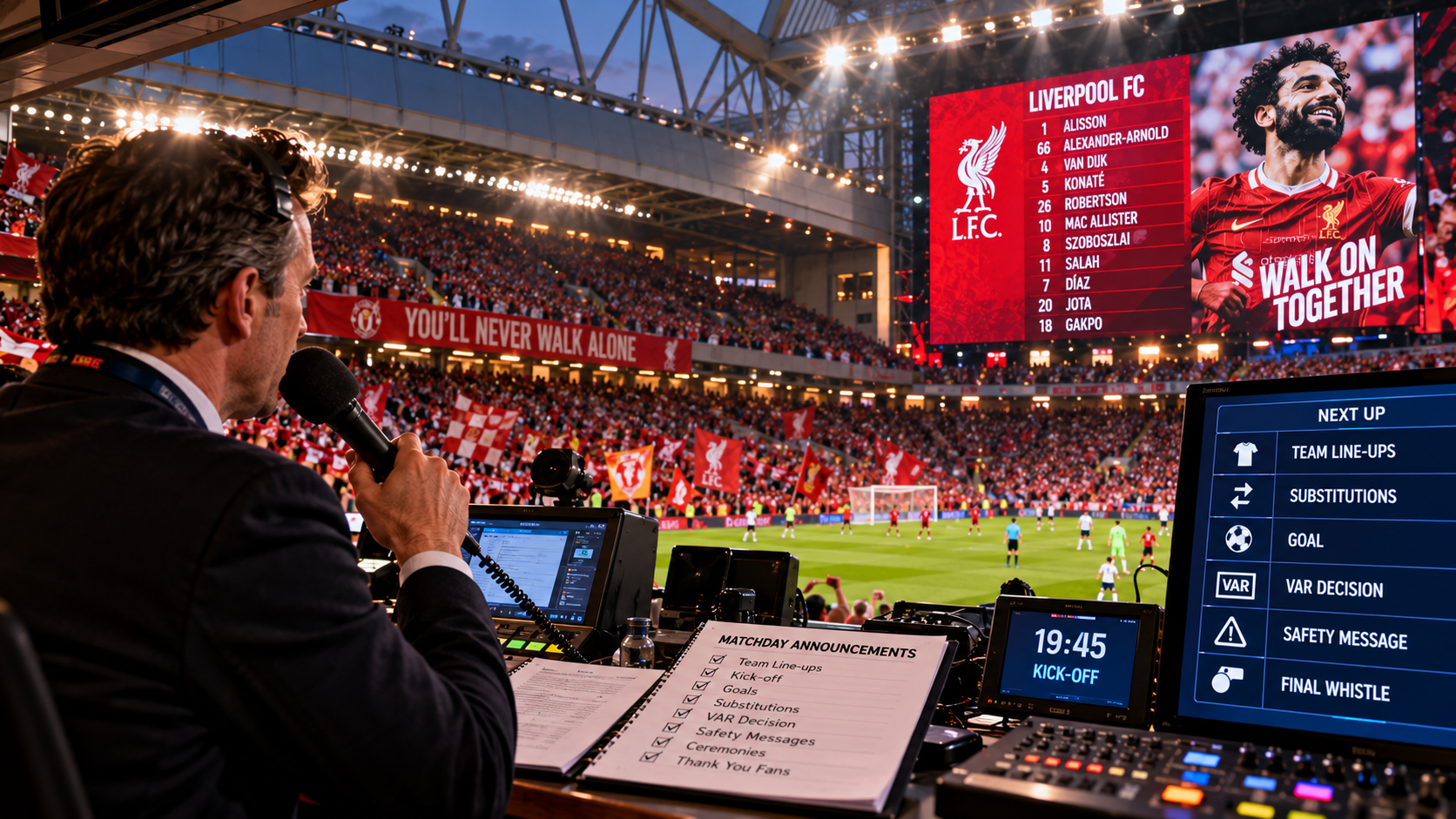
The stadium announcer helps shape the rhythm of matchday through lineups, goals, substitutions, ceremonies, and safety messages. Explore how a familiar voice can become part of a club’s identity.
Football rarely changes one element in isolation. The timeline moves from Early loudspeaker era, where stadium PA systems allowed organizers to address large crowds directly, to Modern identity, where some announcers developed recognizable styles associated with clubs. For football stadium PA announcers, the developments between those points also changed expectations around the subject.
Written by: SwiftPeakX Editorial Team
Last editorial review: October 2026
Editorial note: This article was reviewed for topic-specific wording, historical clarity, source transparency and natural readability. References are listed at the end for verification and further reading.
Key Takeaways
PA announcers perform practical tasks such as line-ups, goals, substitutions, safety messages and event instructions.
A distinctive delivery can become part of club identity without the announcer becoming the focus of the match.
The role requires accuracy because names, numbers and emergency information are operational rather than decorative.
Modern stadium production integrates the announcer with screens, music, lighting and control-room systems.
Historical Foundations
A public-address announcer is heard far more often than noticed. The voice reads team lineups, confirms substitutions, announces goals, provides safety messages, recognizes sponsors, and guides ceremonial moments. Done well, the announcements feel like part of the stadium rather than an interruption.
Styles vary widely. Some grounds favor restrained formality; others encourage call-and-response when announcing scorers or lineups. Language choice can reflect local identity, especially in multilingual regions. Music cues and sound design increasingly interact with the announcer’s role.
The job carries responsibility because clarity matters during emergencies. An announcer must shift instantly from entertainment to instruction if safety information is required. That makes the role part performance and part operational communication.
Supporters can associate a familiar announcer with years of matchdays in the same way they recognize a tunnel song or stadium clock. Repeated phrases become rituals. The best stadium voices understand when to create energy and when to step aside so the crowd can make its own sound. Their influence is subtle: they frame moments without becoming the main event.
The announcer’s first job is clarity
Supporters need accurate information about players, substitutions and official instructions, often in a noisy environment. A good stadium voice uses pacing and pronunciation that remain understandable through reverberation and crowd sound.
This is less glamorous than celebratory goal calls but more important operationally. The role begins as communication before it becomes entertainment.
A familiar voice becomes part of place
Supporters hear the same announcer across seasons, which creates continuity even as players and coaches change. Repeated phrases, pronunciation and timing can become part of the sensory memory of the stadium.
That familiarity is difficult to manufacture quickly. Like a stand name or entrance song, the voice becomes meaningful through repetition.
Goal calls and ceremony require restraint
An announcer can amplify excitement after a goal or trophy presentation, but over-performance risks sounding artificial or disrespectful. Different football cultures tolerate different levels of theatricality.
The best style fits the club and competition rather than copying another sport’s presentation. Matchday identity works when production supports the crowd instead of trying to replace it.
Safety changes the stakes
The PA system may be needed for emergency instructions, crowd movement or transport disruption, so reliability matters beyond entertainment. Announcements must coordinate with security and control-room protocols.
In a serious incident, the familiar voice can help reduce uncertainty if instructions are concise and credible. That responsibility is why stadium communication is part of event safety planning.
Digital screens did not make the voice obsolete
Scoreboards and apps provide visual information, but supporters do not watch screens continuously and accessibility needs vary. Audio can reach people while they are moving, looking at the pitch or unable to see a display. That makes digital screens did not make the voice obsolete a genuine turning point in the wider story of The Voice of the Stadium rather than a minor historical detail.
Modern venues therefore combine channels rather than choosing one. The announcer remains useful because live events need a shared source of information that can interrupt the environment instantly.
Timeline: Key Turning Points
Period Development Why It Mattered
Early loudspeaker era Stadium PA systems allowed organizers to address large crowds directly. Information no longer depended only on signs or word of mouth.
Post-war stadium growth Announcers became standard parts of larger matchday operations. Line-ups and result information reached entire grounds.
Entertainment era Music and scripted presentation expanded around the announcer. Matchday production became more theatrical.
Integrated control rooms PA, scoreboards, video and safety systems became coordinated. The announcer worked inside a broader event-production team.
Modern identity Some announcers developed recognizable styles associated with clubs. A functional voice could become a tradition in its own right.
Why This Still Matters
The stadium announcer occupies a role that is easy to notice only when something goes wrong. Names must be correct, timing must fit the competition operation, and emergency messages must be clear enough to cut through noise. At the same time, familiar voices, goal announcements and music can become part of a club’s identity. The job therefore sits between safety-critical communication and entertainment. That combination explains why professionalism matters even when the best performance feels effortless to the crowd.
Different competitions also place limits on how much personality an announcer can show. A domestic league may encourage distinctive goal calls or local traditions, while an international event can require a more neutral script and tighter coordination with tournament operations. The best announcers adapt without losing clarity. Their craft lies partly in knowing when the stadium needs energy and when it simply needs accurate information.
Preparation before kickoff is a large part of the job. Pronunciation guides, team sheets, sponsor obligations and emergency scripts need to be checked before the crowd arrives. The announcer’s confidence on the microphone is often the visible result of detailed coordination that supporters never see.
Common Misconceptions
The stadium announcer is mainly there to hype the crowd.
Entertainment is only part of the job; accurate operational and safety information is fundamental.
Screens have replaced PA announcements.
Audio remains important for real-time information and emergency communication across the venue.
Any energetic voice works.
Pronunciation, timing, restraint, coordination and reliability are as important as enthusiasm.
Related SwiftPeakX Reading
Goal Celebrations: How Scoring Became a Language of Emotion and Identity
Fan Zones: How Public Viewing Spaces Changed the Way Supporters Gather
Frequently Asked Questions
Who tells the announcer about substitutions and official changes?
The role normally works within match operations and receives confirmed information from the stadium control or competition process.
Why do announcers pronounce names so carefully?
Accuracy shows respect to players and prevents confusion in a noisy venue.
Can announcers influence atmosphere?
Yes, especially through timing and tone, although the crowd remains the primary source of matchday atmosphere.
Why is the PA system part of safety planning?
It provides a venue-wide channel for urgent instructions when supporters need coordinated information quickly.
The Announcer Is Part Information System, Part Tradition
The timeline opens with Early loudspeaker era. Stadium PA systems allowed organizers to address large crowds directly. Information no longer depended only on signs or word of mouth.
The next entry is Post-war stadium growth. Announcers became standard parts of larger matchday operations. Line-ups and result information reached entire grounds.
The middle of the timeline reaches Entertainment era. Music and scripted presentation expanded around the announcer. Matchday production became more theatrical.
A later entry, Integrated control rooms, shows another change. PA, scoreboards, video and safety systems became coordinated. The announcer worked inside a broader event-production team.
The sequence ends with Modern identity. Some announcers developed recognizable styles associated with clubs. A functional voice could become a tradition in its own right.
What Changed—and What Stayed Recognizable
Comparing Early loudspeaker era with Modern identity makes the scale of change in The Voice of the Stadium easier to judge. Early in the story, stadium PA systems allowed organizers to address large crowds directly. Information no longer depended only on signs or word of mouth. By the later stage, some announcers developed recognizable styles associated with clubs. A functional voice could become a tradition in its own right. For The Voice of the Stadium, that contrast matters because the modern practice inherited an older purpose even though the tools, expectations or institutions around it had changed.
One way to test that continuity is to revisit the misconception that the stadium announcer is mainly there to hype the crowd. Entertainment is only part of the job; accurate operational and safety information is fundamental. For The Voice of the Stadium, correcting that misconception matters because it separates the enduring purpose from details that changed over time. For The Voice of the Stadium,
The Bottom Line
Taken as a whole, the story of The Voice of the Stadium shows why historical context matters. The subject moved from the conditions represented by Early loudspeaker era to those represented by Modern identity through a series of practical decisions rather than one clean break. That balance between continuity and change remains central.
Sources & Further Reading
FIFA — Stadium Guidelines
UEFA — Stadium infrastructure and safety
FIFA — Tournament organisation