
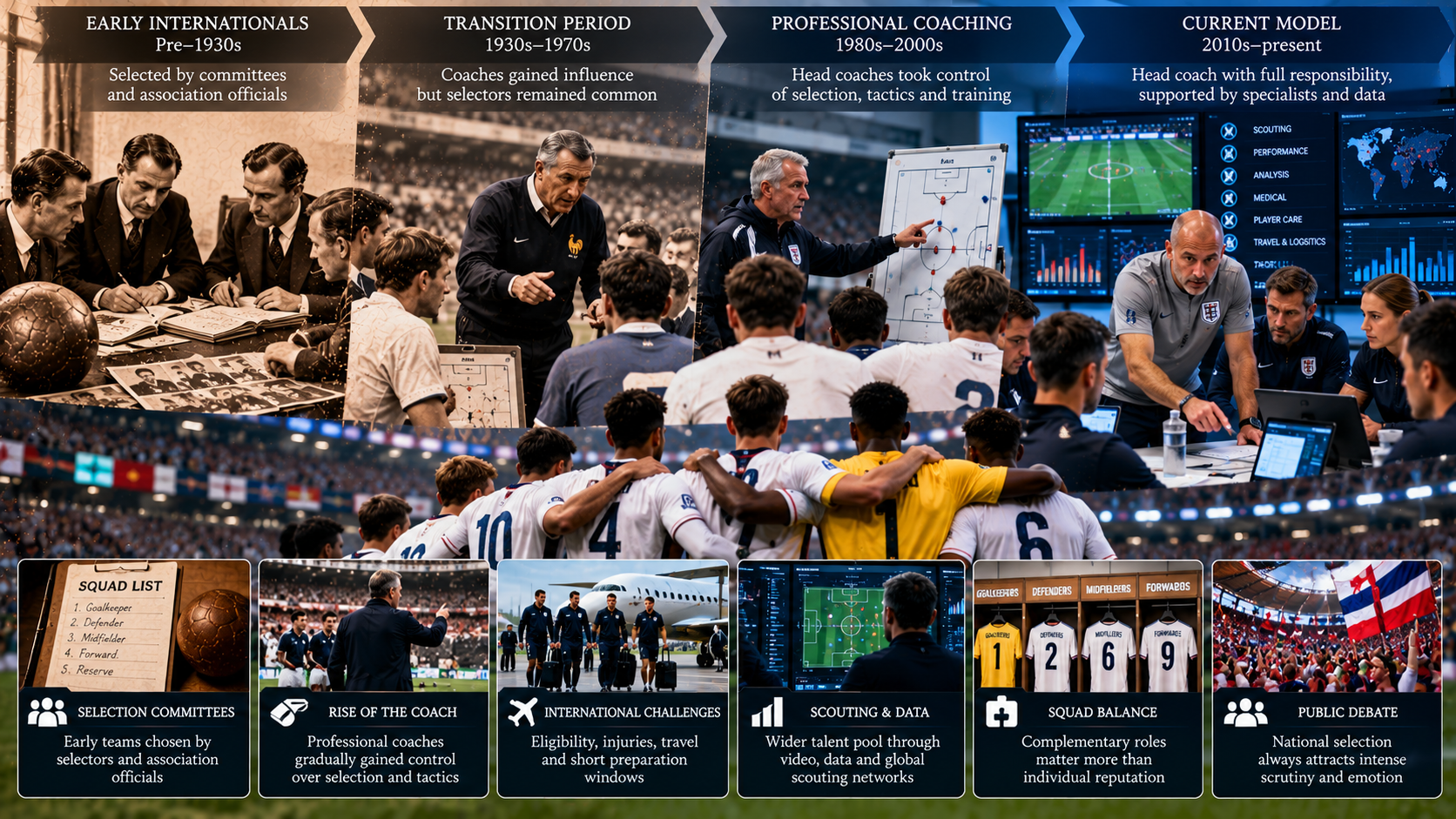
National teams were not always selected by a single head coach. Learn how selection committees gave way to professional coaching staffs and why building a balanced squad is more complex than choosing the biggest names.
The clearest way to understand this subject is to compare the first and last entries in its timeline. Early internationals records that associations and selection committees often chose squads; Current model records that head coaches are formally responsible for selection, tactics and training in elite competitions.
Written by: SwiftPeakX Editorial Team
Last editorial review: October 2026
Editorial note: This article was reviewed for topic-specific wording, historical clarity, source transparency and natural readability. References are listed at the end for verification and further reading.
Key Takeaways
Many early national teams were chosen by selectors or committees rather than one all-powerful coach.
Professional coaching gradually concentrated responsibility for squad selection, tactics and training in the head coach.
International selection is constrained by eligibility, injuries, travel, short preparation windows and limited squad size.
Modern national-team staffs use scouting and data, but selection remains a judgment about role balance rather than simply choosing the most famous players.
Historical Foundations
Modern supporters expect a national-team coach to choose the squad, but that model was not universal in football’s early international era. In several countries, committees or association officials selected players. The coach, if there was one, could have less authority than the selectors.
As tactics, preparation, and opposition analysis became more important, the logic of centralized selection strengthened. A coach responsible for the team’s performance needed greater control over who was called up and how the squad fit together. Professional managers and technical staffs gradually replaced committee-led systems in many national associations.
Selection also became more complicated. Coaches now evaluate players across multiple leagues, track fitness remotely, consider tactical roles, negotiate club release issues, and comply with eligibility regulations. Data and video allow staff to monitor a larger pool than earlier selectors could realistically observe.
International coaches have limited training time, so compatibility matters. A squad needs positional balance, substitutes who can change games, players willing to accept different roles, and enough tactical flexibility for tournament football. Reputation alone is not enough. The move from committees to professional coaching staffs reflects a deeper change: selection became part of a coherent football strategy rather than a list of individually admired players.
Why committees once made sense
Early associations were administrative bodies first, and specialist coaching authority was not yet organized as it is today. Selectors could represent different regions, clubs or perspectives when information about players was fragmented. That makes why committees once made sense a genuine turning point in the wider story of From Selection Committees to National Team Coaches rather than a minor historical detail.
The weakness was diffusion of responsibility: the people choosing the squad were not always the same people designing the tactics. A dedicated coach made selection and game model easier to connect.
International coaching is a different job
Club coaches work with players daily, while national-team coaches may have only a handful of sessions before an important match. That makes role clarity and prior tactical learning unusually important.
A national coach often selects players partly because they can solve a specific problem quickly, not because they are the most impressive names in isolation. The short calendar also makes communication with clubs and medical staffs essential.
Eligibility shapes the talent pool
International football is governed by nationality and eligibility rules, so the available squad is not simply a list of the best players in a league. Dual-national players and residency histories can make eligibility questions significant.
Once eligible, a player’s club role may still differ from the role the national coach needs. Selection therefore combines legal eligibility with football suitability.
Balance matters more than a ranking of stars
A tournament squad needs goalkeepers, defenders with different profiles, midfield functions, attackers and substitutes who can change game states. Picking several players who excel in the same role may create less value than selecting complementary profiles.
Set-piece ability, versatility and experience can matter disproportionately in a short competition. A squad is an ecosystem, not an all-star list.
Why selections create endless debate
National teams carry identity and emotion far beyond ordinary roster decisions, so every omission becomes public argument. Supporters compare club form, reputation and personal preference, while the coach has access to tactical and medical information that may not be public.
That asymmetry makes selection one of football’s most visible judgment calls. The move from committees to head coaches did not remove controversy; it simply made responsibility easier to locate.
Timeline: Key Turning Points
Period Development Why It Mattered
Early internationals Associations and selection committees often chose squads. Team choice reflected organizational traditions before modern coaching staffs.
Managerial transition National associations increasingly appointed dedicated managers or head coaches. Selection and tactics became more unified.
Tournament specialization Backroom staffs expanded to include analysts, medical staff and goalkeeper specialists. Short international camps became more structured.
Data and video era Coaches could monitor players across many leagues without attending every match live. The scouting pool widened.
Current model Head coaches are formally responsible for selection, tactics and training in elite competitions. Accountability is clearer even though decisions are supported by large staffs.
Why This Still Matters
National-team selection became more specialized as international football demanded year-round scouting, tactical preparation and coordination with clubs. A committee can represent institutional judgment, while a dedicated coach can build a clearer footballing idea and take direct responsibility for difficult choices. Neither model eliminates controversy because selection is always comparative: including one player means excluding another. What changed is the expectation that squad choices should fit an identifiable technical plan rather than emerge mainly from collective administration.
Modern selection is also shaped by information that earlier committees could not access easily. Coaches can review club matches from multiple leagues, speak with performance staff, study positional data and monitor players who live far outside the national association’s domestic competition. More information does not make the final choice objective, but it changes the quality of the debate. Selection remains a judgment about form, role, chemistry and tournament needs, not a ranking generated by one statistic.
Tournament selection adds another complication because the best individual players do not automatically make the best final squad. Coaches need positional cover, set-piece options, different profiles for different opponents and enough balance to cope with injuries or suspensions. The move toward a clearly accountable national-team coach made those trade-offs easier to attribute to one technical vision, even though public debate over omissions has never disappeared.
Common Misconceptions
The national coach should pick the 23 or 26 most famous players.
A balanced squad needs complementary roles, tactical fit and coverage for different match situations.
Club form is the only relevant criterion.
Form matters, but fitness, role fit, international experience and the needs of the squad also influence selection.
National-team coaches have lots of training time.
International windows are short, which limits how much new tactical detail can be installed between club commitments.
Related SwiftPeakX Reading
From Secretary-Manager to Head Coach: How Football Management Became a Profession
Why FIFA Was Created: The Origins of Global Football Governance
Frequently Asked Questions
Who chooses a modern national-team squad?
The head coach is normally responsible, supported by scouts, analysts, medical staff and association structures.
Why might a strong club player be omitted?
The coach may prefer different role profiles, need positional balance, have fitness concerns or judge that another player fits the intended plan better.
How do coaches scout players abroad?
Live scouting is combined with match video, data and communication with clubs and local contacts.
Why are versatile players useful in tournament squads?
Squad sizes are limited, so a player who can cover several roles gives the coach more flexibility when injuries or tactical changes occur.
Selection Moved From Committee Judgment to Technical Leadership
First comes Early internationals. Associations and selection committees often chose squads. Team choice reflected organizational traditions before modern coaching staffs.
Then comes Managerial transition. National associations increasingly appointed dedicated managers or head coaches. Selection and tactics became more unified.
Another important entry is Tournament specialization. Backroom staffs expanded to include analysts, medical staff and goalkeeper specialists. Short international camps became more structured.
The next major step appears under Data and video era. Coaches could monitor players across many leagues without attending every match live. The scouting pool widened.
The final entry is Current model. Head coaches are formally responsible for selection, tactics and training in elite competitions. Accountability is clearer even though decisions are supported by large staffs.
The Bottom Line
The history of From Selection Committees to National Team Coaches: How. is not a straight line toward a perfect modern version. The Early internationals stage reflects one set of needs, while Current model reflects another. Seeing both stages together makes current debates more precise because it separates the underlying purpose from the particular method used in any one era.
Sources & Further Reading
UEFA EURO Regulations 2026–28 — Head coach responsibility
FIFA — Regulations and circulars
UEFA — Coaching licences


