
Football training has moved far beyond long runs and repetition. Discover how sports science, GPS tracking, recovery, nutrition, and performance data transformed the way teams prepare players for competition.
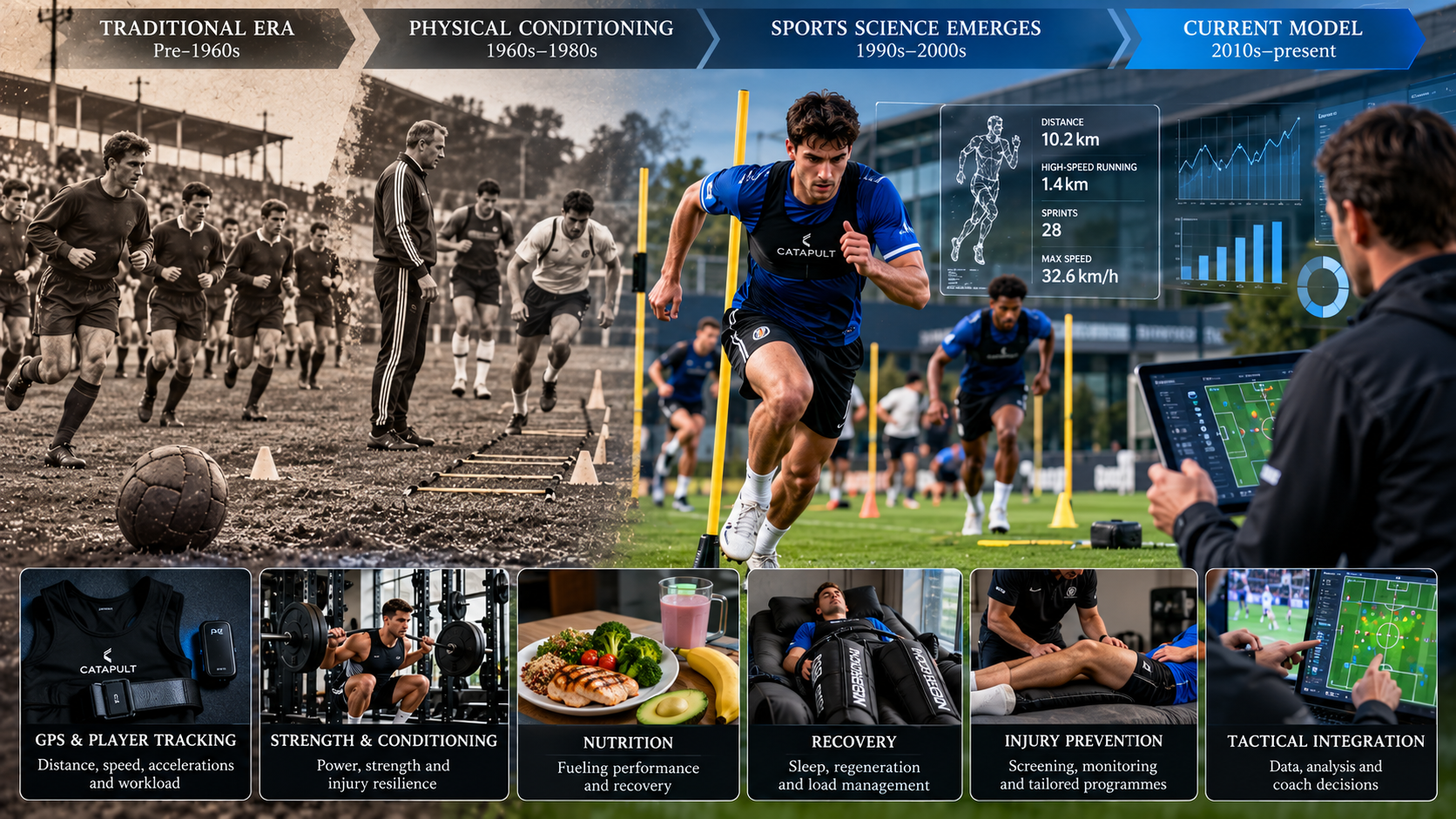
Football rarely changes one element in isolation. The timeline moves from Traditional era, where training often emphasized running, ball repetition and coach-led conditioning with limited objective measurement, to Current model, where load data are combined with wellness, medical, tactical and scheduling information. The developments between those points also changed expectations around the subject.
Written by: SwiftPeakX Editorial Team
Last editorial review: October 2026
Editorial note: This article was reviewed for topic-specific wording, historical clarity, source transparency and natural readability. References are listed at the end for verification and further reading.
Key Takeaways
Football training once depended far more on tradition, coach intuition and general conditioning than on individualized measurement.
Sports science added structured testing, workload monitoring and evidence-based recovery without replacing coaching judgment.
GPS and tracking systems help staff understand distance, speed, accelerations and exposure to high-intensity work.
Modern preparation is multidisciplinary, linking coaches with strength staff, analysts, nutritionists, medical teams and performance scientists.
Historical Foundations
For much of football history, training relied on repetition, running, small-sided games, and the personal judgement of coaches. Fitness work could be blunt: long-distance runs, calisthenics, and heavy sessions designed to build toughness. As exercise physiology entered professional sport, clubs began to distinguish endurance, speed, strength, recovery, and position-specific demands more carefully.
The scientific turn accelerated with heart-rate monitoring, GPS tracking, blood and saliva testing, force plates, wellness questionnaires, and detailed video analysis. Coaches can now estimate high-speed running loads, accelerations, decelerations, and fatigue. Nutrition and sleep have also become part of preparation rather than private matters left entirely to players.
Sports science did not replace coaching intuition; it gave coaches another language for decisions. Data can warn that a player’s workload is rising too quickly, but context still matters: travel, recent injuries, match importance, tactical role, and individual resilience all influence the interpretation. Elite preparation is therefore interdisciplinary, bringing together coaches, performance scientists, analysts, physiotherapists, doctors, nutritionists, and psychologists.
Measurement is useful only when it changes a decision. Collecting dozens of metrics can create noise if staff do not know which indicators are meaningful. Football is especially difficult because match actions are intermittent and tactical: the same running distance can represent very different effort depending on pressing, possession, and game state. The best performance departments therefore combine numbers with observation and communicate findings in a form the coach and player can actually use.
From hard work to targeted work
Traditional football culture often treated visible exhaustion as evidence of a good session. Sports science challenged that assumption by distinguishing useful training stimulus from fatigue that adds little adaptation. That makes from hard work to targeted work a genuine turning point in the wider story of From Training Runs to Sports Science rather than a minor historical detail.
A conditioning session now has a defined purpose: aerobic development, repeated sprint exposure, speed, strength or recovery rather than punishment. The shift does not make training easier; it makes the reason for each load more explicit.
What tracking data can and cannot tell a coach
Wearable and optical systems can quantify distance, high-speed running, accelerations, decelerations and positional movement. Those numbers help compare what a player did with what the role and match schedule require.
But a kilometre total cannot explain decision quality, tactical discipline or how stressful the session felt internally. The strongest departments therefore combine external load with coaching observation and athlete feedback instead of treating one dashboard as the truth.
Recovery became part of preparation
Sleep, nutrition, hydration, travel and the spacing of demanding sessions influence whether players can adapt between matches. Recovery is not a single gadget or treatment; it is the management of time and resources after training.
A congested schedule may force coaches to reduce field load while substitutes complete top-up work to maintain conditioning. This individualized approach would be difficult in a model where every player completes the same session regardless of minutes played.
Injury prevention is probabilistic, not perfect
Modern clubs screen players, monitor workloads and use structured warm-ups because reducing avoidable risk can protect availability. No monitoring system can guarantee that a player will remain injury-free in a contact sport.
Evidence-based prevention programmes work by shifting risk across a squad, not by predicting the exact day one hamstring will fail. That distinction keeps sports science useful without turning it into false certainty.
The coach still sets the football problem
Performance staff can describe what the body did, but the head coach decides what the team is trying to become. A pressing team, a low-block team and a possession team may need different physical qualities even within the same competition.
The most effective preparation therefore begins with the football model and works backward to training design. Sports science is strongest when it sharpens coaching decisions rather than operating as a separate laboratory beside the team.
Timeline: Key Turning Points
Period Development Why It Mattered
Traditional era Training often emphasized running, ball repetition and coach-led conditioning with limited objective measurement. Players were commonly prepared as a group rather than as individual physical profiles.
Late 20th century Exercise physiology and strength-and-conditioning methods became more embedded in professional clubs. Preparation became more systematic and periodized.
1990s–2000s Dedicated performance and medical departments expanded. Clubs began integrating testing, rehabilitation and injury prevention.
Tracking era GPS and optical tracking made external workload visible in daily training. Staff could compare sessions and match demands in detail.
Current model Load data are combined with wellness, medical, tactical and scheduling information. The goal is not maximum work every day but the right stimulus at the right time.
Why This Still Matters
Sports science did not replace coaching intuition; it changed the information available to coaches. Load data, video, nutrition, sleep, rehabilitation and medical screening can help a staff distinguish productive stress from avoidable overload, but none of those measures automatically dictates a decision. The central challenge is integration. A useful performance department turns multiple signals into a plan that players understand, rather than collecting numbers for their own sake. That is why the evolution from generic fitness work to multidisciplinary preparation is as much an organizational story as a technological one.
The practical effect is visible in weekly planning. A team preparing for one match can train differently from a side playing every three days, and an injured player may need a separate progression even while joining parts of group work. Modern preparation is therefore less about finding one ideal session than about matching load to context. That flexibility is one of the clearest differences between contemporary performance systems and older one-size-fits-all conditioning.
Common Misconceptions
Modern teams train less hard because they use data.
Data often reveal where high intensity is needed and where unnecessary fatigue can be removed; demanding work is still central.
GPS tells coaches how well a player performed.
It measures physical movement, not the full quality of tactical or technical performance.
Recovery technology can replace sleep and nutrition.
Basic recovery behaviors remain more important than fashionable devices for most athletes.
Related SwiftPeakX Reading
The Evolution of Football Pitches: From Muddy Fields to Hybrid Grass
The Offside Rule: How Football’s Most Debated Law Evolved
Frequently Asked Questions
What does GPS measure in football training?
Depending on the system, it can estimate distance, speed zones, accelerations, decelerations and other movement-load variables.
Why do substitutes often run after a match?
Players who completed few minutes may need additional work to maintain the training load that starters received through match play.
Does sports science prevent all injuries?
No. It can help manage risk and preparation, but collisions, individual susceptibility and unpredictable events remain part of football.
Why is sports science multidisciplinary?
Physical load interacts with tactics, medical status, nutrition, psychology, travel and recovery, so no single specialist can interpret preparation alone.
Preparation Became an Interdisciplinary System
The timeline opens with Traditional era. Training often emphasized running, ball repetition and coach-led conditioning with limited objective measurement. Players were commonly prepared as a group rather than as individual physical profiles.
The next entry is Late 20th century. Exercise physiology and strength-and-conditioning methods became more embedded in professional clubs. Preparation became more systematic and periodized.
The middle of the timeline reaches 1990s–2000s. Dedicated performance and medical departments expanded. Clubs began integrating testing, rehabilitation and injury prevention.
A later entry, Tracking era, shows another change. GPS and optical tracking made external workload visible in daily training. Staff could compare sessions and match demands in detail.
The sequence ends with Current model. Load data are combined with wellness, medical, tactical and scheduling information. The goal is not maximum work every day but the right stimulus at the right time.
The Bottom Line
Taken as a whole, the story of From Training Runs to Sports Science shows why historical context matters. The subject moved from the conditions represented by Traditional era to those represented by Current model through a series of practical decisions rather than one clean break. That balance between continuity and change remains central.
Sources & Further Reading
FIFA Training Centre
FIFA — Electronic Performance & Tracking Systems
British Journal of Sports Medicine — F-MARC history


