
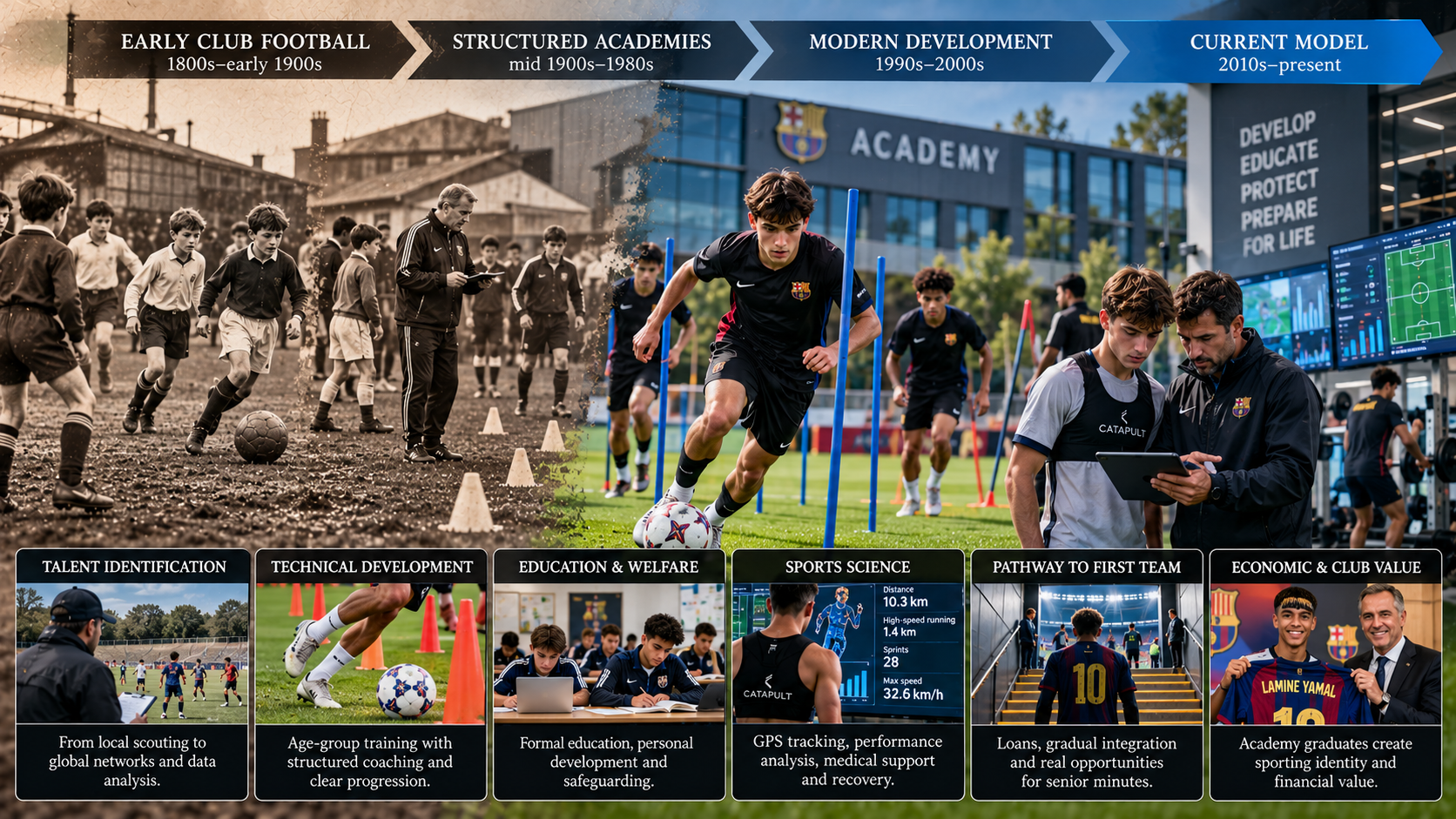
Youth academies changed how football clubs identify, educate, and develop future players. Explore the rise of structured pathways, their economic value, and the challenges young prospects face on the road to the first team.
A useful starting point is the original environment in which the practice took shape. The first entry, Early club football, shows that young players were often recruited locally through schools, community teams and informal networks. The final entry, Modern model, shows that clubs and associations focus on player pathways, safeguarding and transition to senior football.
Written by: SwiftPeakX Editorial Team
Last editorial review: October 2026
Editorial note: This article was reviewed for topic-specific wording, historical clarity, source transparency and natural readability. References are listed at the end for verification and further reading.
Key Takeaways
Youth development evolved from informal local recruitment into organized academy systems with age-group coaching and long-term plans.
Academies create sporting and economic value, but the percentage of players who reach senior professional football remains small.
Modern development includes education, welfare and safeguarding as well as technical training.
The best pathways connect youth coaching with a realistic route into senior minutes rather than treating academy success as youth trophies alone.
Historical Foundations
Football clubs have always searched for young talent, but the modern academy is far more structured than the informal scouting and reserve systems of earlier eras. As professional clubs became larger organizations, youth development moved toward age-group coaching, education, medical support, performance analysis, and defined progression routes.
Different countries built distinctive models. Some emphasized club academies; others relied heavily on local associations, schools, or national training centers. Regulations concerning youth recruitment, compensation, schooling, safeguarding, and international transfers gradually expanded as the stakes increased. The academy became both a sporting institution and a significant investment decision.
A successful academy can supply first-team players, generate transfer income, reinforce club identity, and create a style of play that survives changes of head coach. Yet the pathway is narrow. Thousands of young players enter development systems while only a minority become established professionals. That reality has increased attention to education, mental health, release processes, and life beyond elite football.
Developing a player internally can create enormous sporting and financial value. An academy graduate may cost less in transfer fees, count favorably under certain squad-registration rules, and carry symbolic importance for supporters. Selling graduates can also fund the wider club. At the same time, this economic logic can create pressure to identify children earlier and trade prospects as assets. The modern academy therefore sits at the intersection of coaching, education, welfare, and business.
Why academies changed club strategy
Developing a first-team player internally can create sporting continuity and significant financial value. Homegrown players often understand the club’s style and culture before entering the senior dressing room.
That potential encourages clubs to invest years before there is any certainty of return. An academy is therefore both a football department and a long-term portfolio of uncertain development projects.
Talent is not a straight line
Early physical maturity can make a teenager look more advanced even when later-developing peers may have equal or greater long-term potential. Good academies try to separate current performance from future capacity.
Selection decisions are difficult because growth, motivation, injury, family environment and opportunity all change during adolescence. That uncertainty is why development systems need repeated assessment rather than one decisive trial at a young age.
Education and welfare are part of the job
Most academy players will not establish long professional careers, so a responsible programme cannot treat school and personal development as distractions. Education gives young athletes options and reduces the cost of an unsuccessful football outcome.
Safeguarding standards also matter because the power imbalance between clubs and ambitious families can be substantial. A high-performance environment should raise standards without making a child’s entire identity depend on selection.
The bottleneck is senior opportunity
A productive academy can still fail as a pathway if first-team squads leave no route for young players to accumulate meaningful minutes. Loans, reserve competition and staged integration are attempts to bridge the gap between youth football and senior pressure.
The jump involves more than technique: speed of decision, physical contact, tactical discipline and emotional resilience all increase. The pathway is therefore incomplete until development connects with genuine adult competition.
Why national associations care about club academies
Domestic academies influence the future player pool available to national teams. That is why FIFA and national associations increasingly support coordinated talent-development systems rather than leaving youth development entirely fragmented.
Shared standards can improve coach education and access while still allowing clubs to preserve distinct philosophies. The broader objective is to reduce the chance that potential is lost simply because a player was born outside a strong local pathway.
Timeline: Key Turning Points
Period Development Why It Mattered
Early club football Young players were often recruited locally through schools, community teams and informal networks. Development depended heavily on geography and individual contacts.
Structured youth systems Clubs built dedicated youth teams, coaches and training programmes. Player development became an institutional responsibility.
Academy era Facilities, education support, sports science and age-specific curricula expanded. Youth development became a major investment area.
Global recruitment era Scouting networks widened and regulations around minors became increasingly important. Talent pathways became international but more heavily governed.
Modern model Clubs and associations focus on player pathways, safeguarding and transition to senior football. The challenge is no longer just finding talent but developing and retaining it responsibly.
Why This Still Matters
The strongest academy systems cannot be judged only by the number of teenagers who reach the senior team. Development also includes education, safeguarding, appropriate competition, physical maturation and honest decisions about players who will continue elsewhere. The pathway is therefore both a sporting opportunity and a duty of care. As clubs professionalized youth development, they gained better coaching and planning but also greater responsibility for children whose identities can become closely tied to selection. That tension is central to any serious discussion of academy success.
A pathway also depends on opportunities after development. Producing technically capable teenagers means little if there is no sensible route into senior minutes, loans or another level of professional football. Clubs increasingly have to connect academy coaching with squad planning so that promising players are not trapped between youth competition and a first team that has no space for them. The quality of transition can matter as much as the quality of training.
Parents and schools are part of this pathway too. Because academy schedules can shape education and family life, communication outside the training ground matters. A development model is more credible when football ambition is balanced with realistic planning for the many young players who will not become senior professionals.
Common Misconceptions
Academy success means winning youth trophies.
Results can matter, but development is better judged by player progression, learning and the quality of the route into senior football.
The best player at age 13 will usually be the best at 23.
Growth, maturation, coaching, motivation and opportunity make long-term prediction highly uncertain.
An academy is only a football programme.
Modern systems also involve education, safeguarding, medical care, psychology and family communication.
Related SwiftPeakX Reading
From Training Runs to Sports Science: How Football Preparation Evolved
Frequently Asked Questions
Why do clubs invest so heavily in academies?
A successful pathway can produce first-team players, transfer value and a stronger connection between the club and its local identity.
Why are academy releases so difficult?
Young players and families may invest years in the pathway, while professional opportunities remain limited; responsible transition support therefore matters.
What is a homegrown player?
The exact definition depends on competition rules, but it generally refers to a player trained for a specified period within a club or national association system while young.
Do academies all teach the same style?
No. Regulations and welfare standards may be shared, but clubs can still build different technical and tactical identities.
Academy Success Is More Than Producing Stars
First comes Early club football. Young players were often recruited locally through schools, community teams and informal networks. Development depended heavily on geography and individual contacts.
Then comes Structured youth systems. Clubs built dedicated youth teams, coaches and training programmes. Player development became an institutional responsibility.
Another important entry is Academy era. Facilities, education support, sports science and age-specific curricula expanded. Youth development became a major investment area.
The next major step appears under Global recruitment era. Scouting networks widened and regulations around minors became increasingly important. Talent pathways became international but more heavily governed.
The final entry is Modern model. Clubs and associations focus on player pathways, safeguarding and transition to senior football. The challenge is no longer just finding talent but developing and retaining it responsibly.
The Bottom Line
There is no single moment that created the modern form of The Rise of Youth Academies. The timeline begins with Early club football: young players were often recruited locally through schools, community teams and informal networks. It ends with Modern model: clubs and associations focus on player pathways, safeguarding and transition to senior football. The path between them makes present-day arguments easier to evaluate because it shows which problems each change was meant to address.
Sources & Further Reading
FIFA — Academy system
FIFA — Talent Development
UEFA — Grassroots tools and programmes


