
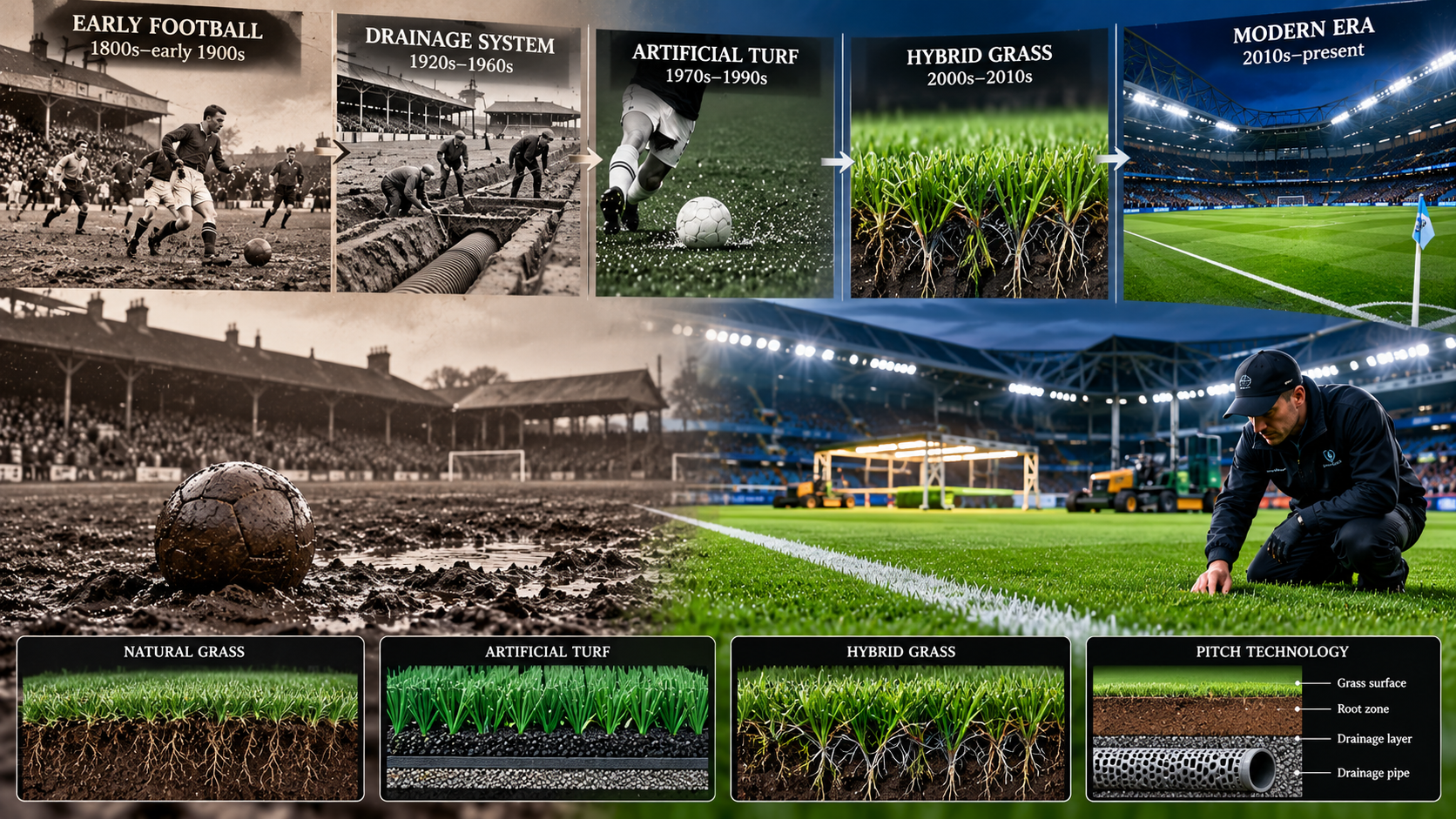
Football pitches have evolved from uneven, muddy grounds into carefully engineered playing surfaces. Explore the rise of drainage systems, artificial turf, hybrid grass, and the science behind the modern pitch.
This is a story of accumulated adjustments rather than one decisive invention. The Early organized football stage saw clubs often played on natural grounds with limited drainage and inconsistent maintenance; the Hybrid era stage saw natural grass reinforced with synthetic fibres became widespread at high-level stadiums.
Written by: SwiftPeakX Editorial Team
Last editorial review: October 2026
Editorial note: This article was reviewed for topic-specific wording, historical clarity, source transparency and natural readability. References are listed at the end for verification and further reading.
Key Takeaways
Early football grounds were far more vulnerable to weather, wear and uneven maintenance than modern elite pitches.
Drainage, irrigation, heating, lighting and turf management turned the playing surface into an engineered system.
Artificial turf improved durability, while hybrid surfaces combine natural grass with synthetic reinforcement.
Modern pitch standards focus on ball behavior, player interaction, safety, consistency and maintenance rather than appearance alone.
Historical Foundations
The quality of a football pitch once depended heavily on weather, drainage, local soil, and whatever maintenance a club could afford. Winter matches could turn grass into mud, while uneven surfaces made passing unpredictable. As stadiums professionalized, groundskeeping became a technical discipline involving drainage, mowing patterns, irrigation, undersoil heating, artificial lighting, and carefully selected grass varieties.
Artificial turf offered one route around weather and maintenance problems, though early generations developed a poor reputation among many players because of hardness, bounce, and abrasion. Newer synthetic systems improved significantly. At elite level, hybrid surfaces became especially influential: natural grass is reinforced with synthetic fibers so that the pitch retains the feel and performance of grass while tolerating greater wear.
Modern pitches are engineered environments. Grounds teams monitor moisture, root depth, nutrient levels, disease, shade, and compaction. Retractable roofs and multi-use stadiums create additional challenges because concerts and events can damage the playing surface. Some venues use movable pitches or sophisticated grow-light rigs to preserve quality. The “field” is now part agronomy, part infrastructure, and part sporting technology.
A consistent pitch supports faster passing, cleaner first touches, and more predictable ball movement. Poor surfaces can reward direct play because dribbling and short combinations become riskier. That means pitch technology can indirectly influence tactical style. It also affects injury concerns, scheduling reliability, and the commercial ability of a stadium to host other events. The evolution from muddy winter grounds to reinforced grass therefore reflects football’s broader shift from local pastime to globally managed entertainment product.
Why the surface changes the sport
The pitch affects traction, ball speed, bounce, footing and the confidence with which players can turn or slide. A muddy or uneven field rewards different decisions from a firm, uniform surface, so pitch quality can influence style as well as aesthetics.
Modern elite teams expect the ball to travel predictably enough for fast combination play and coordinated pressing. That expectation would have been unrealistic on many historic grounds after weeks of rain and heavy use.
Drainage and irrigation transformed reliability
A high-quality grass pitch is not simply a lawn cut short; its root zone, drainage profile and watering system are designed to control moisture. Removing excess water protects stability, while irrigation prevents the surface from becoming overly hard or patchy. That makes drainage and irrigation transformed reliability a genuine turning point in the wider story of The Evolution of Football Pitches rather than a minor historical detail.
Grounds teams also manage mowing height, aeration, nutrition and disease pressure throughout the season. The result is a surface engineered for repeated sporting stress rather than ordinary landscaping.
Artificial turf solved one problem and created others
Synthetic surfaces can tolerate intensive use and difficult climates better than natural grass, which made them attractive
Modern certified systems are assessed for player-surface interaction, ball behavior, durability and construction. The debate is therefore less about whether “plastic grass” is automatically good or bad and more about where each surface type is appropriate.
Why hybrid grass became popular
Hybrid systems reinforce natural turf with synthetic elements while keeping grass as the dominant playing surface. The reinforcement helps roots and soil resist divoting under repeated sprints, tackles and events.
Elite stadiums with heavy schedules often prefer this compromise because it combines natural-grass feel with improved resilience. Hybrid does not remove the need for expert maintenance; it changes the engineering options available to the grounds team.
The pitch is now part of performance planning
Clubs monitor surface hardness, moisture, grass coverage and other variables because small changes can affect loading and ball behavior. Stadium architecture also matters: roofs, shade and restricted airflow can make grass growth difficult even in wealthy venues.
Grow lights and environmental monitoring compensate for conditions created by modern enclosed stadiums. The pitch has therefore moved from background scenery to a managed performance asset with its own specialists, budgets and data.
Timeline: Key Turning Points
Period Development Why It Mattered
Early organized football Clubs often played on natural grounds with limited drainage and inconsistent maintenance. Weather could radically change the character of a match.
20th century Dedicated grounds staff, drainage systems and better grass management improved reliability. Clubs began treating the pitch as specialist infrastructure.
1960s onward Artificial turf appeared in sport and later developed through multiple generations. Durability improved, but football had to address concerns about performance and safety.
Late 20th–21st century Undersoil heating, grow lights, sophisticated irrigation and data-led maintenance became common at elite venues. Surface quality became more consistent across seasons.
Hybrid era Natural grass reinforced with synthetic fibres became widespread at high-level stadiums. Clubs could retain natural playing characteristics while improving stability and wear resistance.
Why This Still Matters
Modern pitch quality is an invisible performance technology. Drainage, grass selection, undersoil systems, grow lights, reinforcement fibres and maintenance data all shape how reliably the ball moves and how confidently players can accelerate or change direction. Better surfaces do not remove weather or wear, and clubs still make choices based on climate, budgets and stadium design. What has changed is the expectation that elite football should be played on a surface engineered for consistency. The pitch is no longer treated as passive ground beneath the match; it is managed as part of the sporting environment.
Surface consistency also affects the kind of football teams are willing to play. A predictable bounce supports quicker passing and tighter spacing, while poor drainage or uneven turf can force a more cautious style. Pitch technology therefore influences tactics indirectly by changing how much players can trust the ground beneath them.
Common Misconceptions
A greener pitch is automatically a better pitch.
Color can be influenced by presentation and grass health, but performance also depends on firmness, traction, moisture, evenness and maintenance.
Hybrid grass is the same as artificial turf.
No. Hybrid surfaces remain predominantly natural grass reinforced by synthetic fibres or structures.
Artificial pitches require no maintenance.
They avoid some natural-grass tasks but still require grooming, infill management, cleaning, inspection and eventual renewal.
Related SwiftPeakX Reading
The Offside Rule: How Football’s Most Debated Law Evolved
The History of the Throw-In: How Football Settled the Restart From Touch
Frequently Asked Questions
Why do elite clubs use grow lights?
Large stands and roofs can limit sunlight, so supplemental lighting helps maintain grass growth and recovery in shaded areas.
What is undersoil heating for?
It helps prevent the ground from freezing and can support winter pitch management, although it is only one part of surface preparation.
Why are hybrid pitches common in major stadiums?
They offer a natural-grass playing surface with additional structural reinforcement for intensive use.
Does FIFA certify football turf?
Yes. FIFA operates quality programmes with laboratory and field testing for football turf and also publishes standards for natural playing surfaces.
The Pitch Became Part of Football Technology
The first entry, Early organized football, establishes the baseline. Clubs often played on natural grounds with limited drainage and inconsistent maintenance. Weather could radically change the character of a match.
A second stage appears under 20th century. Dedicated grounds staff, drainage systems and better grass management improved reliability. Clubs began treating the pitch as specialist infrastructure.
A further turning point appears at 1960s onward. Artificial turf appeared in sport and later developed through multiple generations. Durability improved, but football had to address concerns about performance and safety.
Another shift is visible in Late 20th–21st century. Undersoil heating, grow lights, sophisticated irrigation and data-led maintenance became common at elite venues. Surface quality became more consistent across seasons.
The chronology closes under Hybrid era. Natural grass reinforced with synthetic fibres became widespread at high-level stadiums. Clubs could retain natural playing characteristics while improving stability and wear resistance.
The Bottom Line
The enduring lesson is that The Evolution of Football Pitches has always been shaped by context. The Early organized football entry answers one set of conditions; the Hybrid era entry answers another. Future changes will face the same test: whether they improve the experience without losing the function people still value.
Sources & Further Reading
FIFA — Turf and pitch design
FIFA — Quality Programme for Football Turf
FIFA — Quality Programme for Natural Playing Surfaces


