
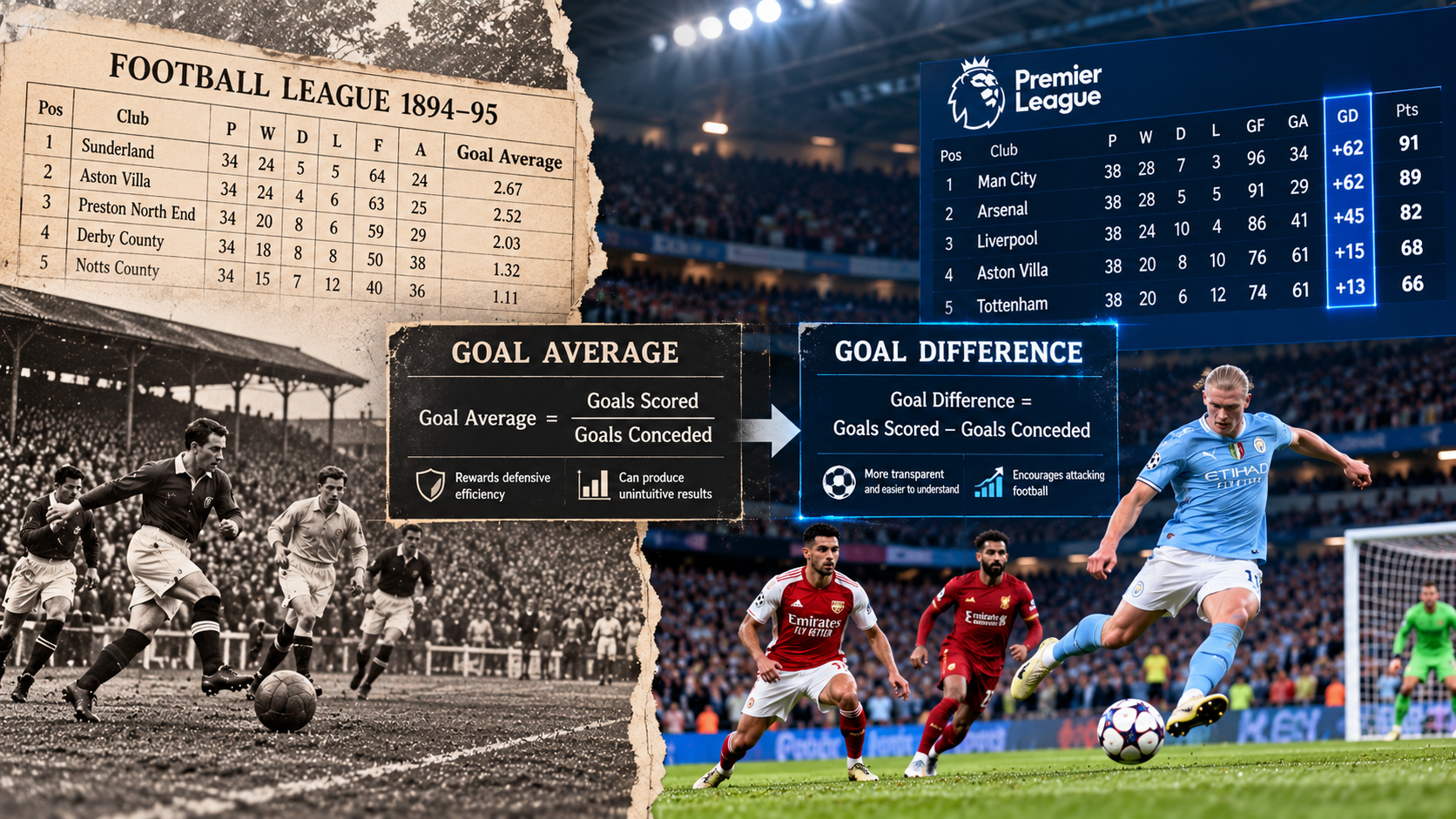
League tables once used goal average rather than goal difference to separate tied teams. Learn why football changed the formula, how the new method altered incentives, and why tie-break rules matter.
The beginning and end of the timeline show the scale of the change. Under 1894–95, goal average became the Football League’s long-running method for separating teams level on points. Under Modern era, goal difference remains a primary separator in many competitions, followed by goals scored or head-to-head criteria.
Written by: SwiftPeakX Editorial Team
Last editorial review: October 2026
Editorial note: This article was reviewed for topic-specific wording, historical clarity, source transparency and natural readability. References are listed at the end for verification and further reading.
Key Takeaways
Goal average divides goals scored by goals conceded, while goal difference subtracts goals conceded from goals scored.
The English Football League used goal average for decades before changing to goal difference for the 1976–77 season.
The two systems reward scoring and defending differently, so a tie-break rule can influence late-season incentives.
Modern leagues often add further tiebreakers such as goals scored or head-to-head results after goal difference.
Historical Foundations
League tables look inevitable today, but ranking teams with equal points required experimentation. Early competitions often used goal average, calculated by dividing goals scored by goals conceded. The method rewarded defensive efficiency because conceding fewer goals could dramatically improve the ratio. It also produced unintuitive outcomes and was harder for supporters to calculate quickly.
Goal difference—goals scored minus goals conceded—offered a more transparent alternative. Major leagues adopted it at different times, with the English Football League making the change in the 1970s. The new method subtly changed incentives: scoring an additional goal could always improve a team’s difference by one, whereas goal average created nonlinear effects. In some competitions goals scored became an additional tie-breaker, followed by head-to-head records or other criteria.
Tie-break rules matter because they shape behavior before a tie actually occurs. A team protecting a narrow lead may still have reason to attack if goal difference could decide a title, qualification place, or relegation battle months later. Modern fans therefore track not only points but also margins. Data graphics, live tables, and predictive models have made tie-break mathematics part of everyday football literacy.
A standings formula is not neutral. Goal average rewarded reducing the denominator—goals conceded—while goal difference treats scoring and conceding symmetrically. That distinction can influence how clubs think about late-game risk. Although no tie-breaker can guarantee attacking football, goal difference is easier to understand and easier to connect to performance across a season. Its success shows how administrative rules can reshape the strategic environment without changing the laws used during the match itself.
Two formulas, two incentives
Goal average is a ratio: goals for divided by goals against. Goal difference is an arithmetic margin: goals for minus goals against. Those calculations can rank the same records differently because a ratio becomes extremely sensitive when a team concedes very few goals.
A 2–1 record has a goal average of 2.0, while a 10–5 record has the same ratio despite a much larger scoring margin. Goal difference makes every additional goal for or against count in a more transparent one-for-one way.
Why administrators preferred goal difference
The Football League’s 1976–77 change was partly motivated by the belief that goal average could encourage overly defensive behavior. Under a ratio, protecting the denominator can be disproportionately valuable, especially for teams with strong defensive records.
Goal difference offered a simple message: score more and concede fewer, with each goal affecting the table by one. The change illustrates how competition rules can be designed to influence behavior without changing what happens inside a single match.
How supporters experience a tiebreak
A good tiebreak should be understandable enough that fans can calculate the stakes while watching simultaneous final-day matches. Goal difference works well in that environment because a team can immediately see how another goal changes the margin. That makes how supporters experience a tiebreak a genuine turning point in the wider story of From Goal Average to Goal Difference rather than a minor historical detail.
That clarity has become part of football drama, particularly when title, promotion or relegation races remain level on points. The table is not just administrative bookkeeping; its formula shapes how supporters interpret urgency in real time.
Why one tiebreak is rarely enough
Two clubs can finish level on points and goal difference, so competitions need additional criteria. Goals scored, head-to-head points, head-to-head away goals and even a playoff can sit further down the sequence depending on the league.
The Premier League, for example, uses goal difference before goals scored and head-to-head measures. The hierarchy matters because every extra criterion carries its own ideas about what performance should be rewarded.
The lesson for competition design
Tiebreakers reveal that a league table is a designed system rather than a neutral reflection of results. Administrators must decide whether they want to reward attacking output, direct results between tied clubs, season-long consistency or a decisive playoff.
No system is perfectly value-free, but transparent rules let clubs know the incentives before the season begins. That predictability is essential because teams may make tactical decisions late in a season based on the exact order of the criteria.
Timeline: Key Turning Points
Period Development Why It Mattered
1894–95 Goal average became the Football League’s long-running method for separating teams level on points. League position depended on a scoring ratio rather than a simple net total.
Mid-20th century Supporters and administrators became increasingly familiar with the limitations of the ratio. The method could reward protecting a low number of goals conceded more strongly than adding extra goals.
1976–77 The Football League adopted goal difference. The new calculation was easier to understand and was intended to encourage attacking incentives.
1988–89 Arsenal won the English title at Anfield with goals scored separating the top two after points and goal difference aligned. It showed why leagues need a hierarchy of tiebreakers rather than one formula alone.
Modern era Goal difference remains a primary separator in many competitions, followed by goals scored or head-to-head criteria. Table rules now form an explicit part of competition design.
Why This Still Matters
Goal difference changed more than a line in the standings. Compared with goal average, it made the value of scoring and conceding easier to understand because each additional goal changes the margin directly rather than through a ratio. That can influence how teams approach matches late in a season, especially when league positions are tight. No tiebreaker is perfectly neutral, but the move illustrates an important design principle in competition rules: the method should be transparent enough that players and supporters can see how match events affect the table without needing a calculation that behaves unpredictably at different scoring levels.
Common Misconceptions
Goal average and goal difference usually produce identical rankings.
They often agree, but not always; the ratio and the net-goal formula can reward different scoring profiles.
Goal difference was always the English league standard.
No. Goal average was used for many decades before the Football League changed for 1976–77.
If points and goal difference are equal, teams are simply joint.
Modern competitions normally specify additional criteria such as goals scored and head-to-head records.
Related SwiftPeakX Reading
The Offside Rule: How Football’s Most Debated Law Evolved
Why Football Has Extra Time: The History of Playing Beyond 90 Minutes
The History of the Throw-In: How Football Settled the Restart From Touch
Frequently Asked Questions
How do you calculate goal average?
Divide goals scored by goals conceded, subject to the competition’s historical treatment of unusual cases such as zero goals conceded.
How do you calculate goal difference?
Subtract goals conceded from goals scored. A team with 60 goals for and 40 against has a goal difference of +20.
Why was goal difference considered more attacking?
It gives the same one-goal value to every additional goal scored, rather than changing a ratio whose effect depends on the number already conceded.
What happens after goal difference in the Premier League?
Goals scored is next, followed by head-to-head criteria and, if necessary in specified decisive situations, a playoff.
What Goal Difference Changed Strategically
The opening phase is labeled 1894–95. Goal average became the Football League’s long-running method for separating teams level on points. League position depended on a scoring ratio rather than a simple net total.
The sequence moves next to Mid-20th century. Supporters and administrators became increasingly familiar with the limitations of the ratio. The method could reward protecting a low number of goals conceded more strongly than adding extra goals.
The sequence continues with 1976–77. The Football League adopted goal difference. The new calculation was easier to understand and was intended to encourage attacking incentives.
The chronology then reaches 1988–89. Arsenal won the English title at Anfield with goals scored separating the top two after points and goal difference aligned. It showed why leagues need a hierarchy of tiebreakers rather than one formula alone.
The last stage shown here is Modern era. Goal difference remains a primary separator in many competitions, followed by goals scored or head-to-head criteria. Table rules now form an explicit part of competition design.
The Bottom Line
Looking across the full timeline, From Goal Average to Goal Difference reflects football’s habit of adapting without completely severing its past. The contrast between the 1894–95 and Modern era stages explains why modern debates often combine practical questions with arguments about identity, fairness or tradition.
Sources & Further Reading
11v11 — Football League tables and goal-average notes
Premier League — How the league table works
EFL — Historical records


