
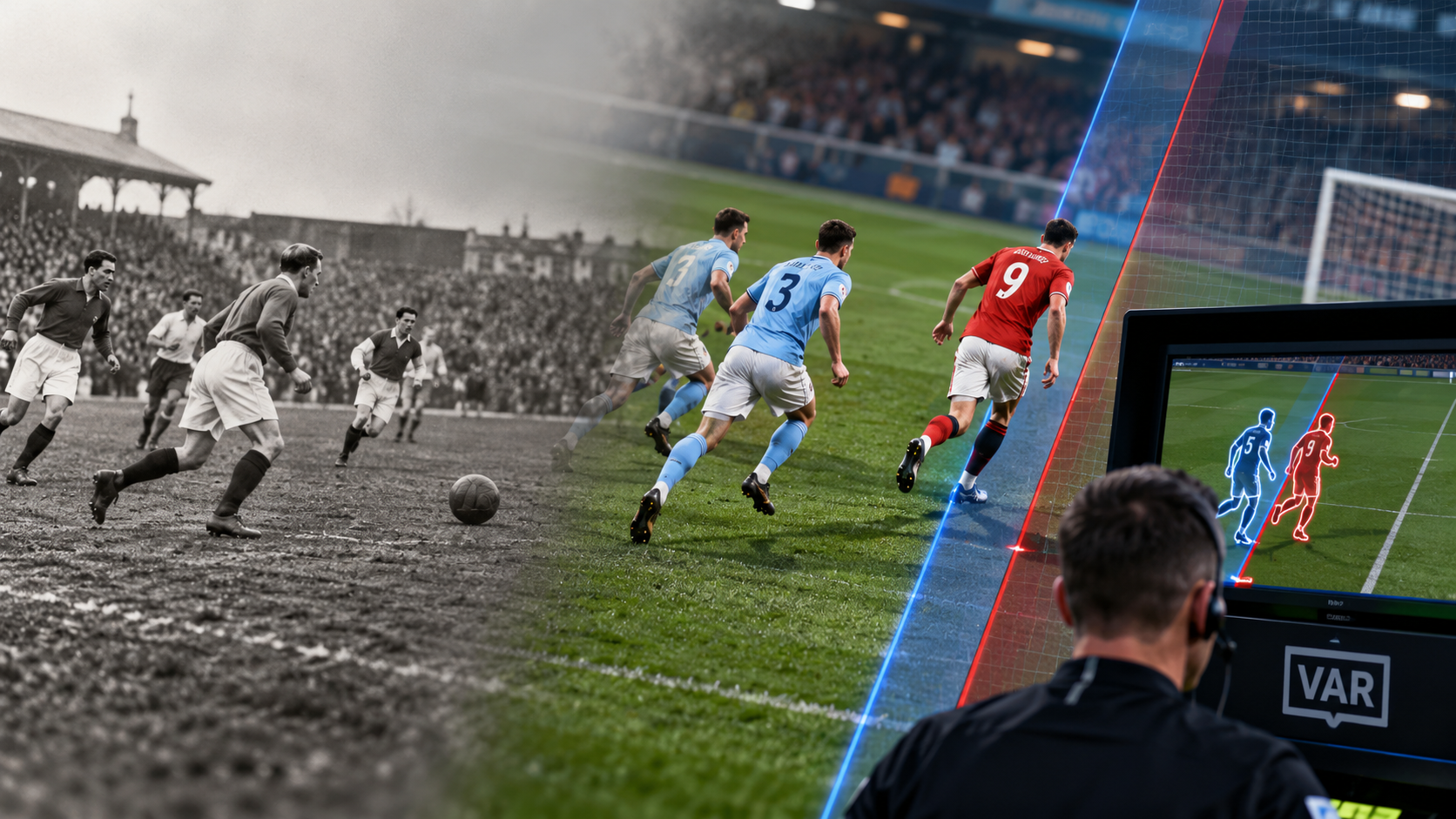
The offside rule has shaped football tactics for more than a century. Explore how its definition evolved from the game’s earliest laws to the VAR era—and why it remains one of football’s most debated rules.
The timeline opens with 1863: the first Football Association laws used a very restrictive offside principle. It closes with VAR era: video review and later semi-automated offside technology brought calibrated lines and tracking data into elite competitions. That span shows how a familiar part of football changed as the sport became faster, more organized and more closely scrutinized.
Written by: SwiftPeakX Editorial Team
Last editorial review: October 2026
Editorial note: This article was reviewed for topic-specific wording, historical clarity, source transparency and natural readability. References are listed at the end for verification and further reading.
Key Takeaways
The earliest association laws used offside to stop attackers from simply waiting near goal, but the threshold changed as forward passing became central to the sport.
The 1925 move from three opponents to two transformed scoring patterns and defensive organization.
Modern offside depends not only on position but also on active involvement, deliberate play and the exact moment a team-mate plays the ball.
VAR and semi-automated systems improved measurement while creating new debates about precision, delay and the spirit of the law.
Historical Foundations
Offside is one of football’s oldest attempts to balance freedom of attack with the idea that a forward should not simply wait beside the opposition goal. Early forms of football often had strict “hacking-game” style restrictions on passing forward, and the first Football Association laws of 1863 reflected that caution. The law then changed as passing became central to the sport. In 1866 the requirement was relaxed so that three opponents could keep an attacker onside, a change that encouraged more combination play. In 1925 the threshold fell from three opponents to two, a famous amendment associated with a sharp rise in goals and tactical rethinking.
The law has never been only about a line on the pitch. It has forced teams to invent ways of stretching, compressing, and timing space. Defenders learned to step forward together; attackers learned curved runs and delayed movement. The offside trap became a collective defensive weapon, while modern pressing systems made the timing of the back line even more important. Interpretations of “interfering with play,” “interfering with an opponent,” and “gaining an advantage” have also been refined over time because a player can influence a phase without touching the ball.
Television and then video review changed the public experience of offside. Decisions that once disappeared into the flow of a match can now be frozen, magnified, and debated frame by frame. VAR introduced a new tension: technology can improve consistency, but extremely tight decisions can feel detached from the original spirit of preventing goal-hanging. Semi-automated offside technology has tried to speed up the process by combining tracking data with human confirmation. The result is a law that remains simple in principle but technically demanding in practice.
Offside is unusually difficult because the assistant referee must process several moving objects at the same instant: the passer, the receiving attacker, the second-last opponent, and the exact moment the ball is played. Perspective can distort what the eye sees, especially at speed. Technology reduces some uncertainty, yet it also exposes questions about frame selection, body parts that can legally score, and whether a millimetre-scale decision matches supporters’ intuitive sense of fairness. That is why offside remains both a legal rule and a recurring argument about what football wants to reward.
Why football needed an offside law
Without offside, an attacker could stay close to goal and wait
The best attacking runs begin from legal positions and exploit the instant a pass is released, which turns offside into a test of synchronization between passer and runner. That purpose explains why offside survives even when its wording changes: football still wants attacking freedom without rewarding permanent goal-hanging.
The 1925 change and tactical shock
Reducing the number of opponents required to keep an attacker onside changed the geometry of the pitch almost immediately. Defenders could no longer rely on the older spacing, so coaches had to rethink how the centre-half and full-backs protected space.
The rise of the WM formation is commonly linked with the need to respond to the more attack-friendly law and the increase in scoring that followed. The important point is not that one rule “invented” one formation, but that rule design changes the incentives to which tactical systems respond.
Position is only the first question
A player can stand in an offside position without committing an offence; the sanction comes only when that player becomes involved in active play under the law. That distinction lets attackers occupy advanced spaces without stopping every phase at the instant of the pass.
Current law separates interfering with play, interfering with an opponent and gaining an advantage, which is why a player who never touches the ball may still be penalized. For supporters, many confusing decisions become clearer once position and offence are treated as two separate steps.
Why human perception struggles
Assistant referees must judge several moving reference points at the same instant, often while sprinting and looking across a line that is not perfectly square to the camera or touchline. Small timing errors can make a legal run look illegal or vice versa, especially when players are moving in opposite directions.
Replay technology exposes this difficulty by freezing the exact kick point and comparing body parts that the eye had to process in real time. Technology can reduce measurement error, but it does not eliminate interpretive questions such as whether a defender deliberately played the ball.
Precision versus the spirit of the law
The most controversial modern decisions are often not about the basic rule but about how much precision football should demand. A millimetre-scale line may be consistent with a technical measurement system while still feeling harsh to viewers who understand offside mainly as an anti-goal-hanging rule.
Semi-automated systems try to reduce delay by combining player tracking and ball data before officials validate the proposed decision. The debate is therefore partly philosophical: should offside be treated like an exact boundary, or should the law create a visible margin for attacking benefit?
Timeline: Key Turning Points
Period Development Why It Mattered
1863 The first Football Association laws used a very restrictive offside principle. It reflected a game still closely connected to older football codes in which forward passing was limited.
1866 The law was relaxed so that three opponents could keep an attacker onside. Combination passing became more practical and attacking structures widened.
1925 The threshold changed from three opponents to two. The amendment encouraged more goals and helped trigger major tactical reorganization.
1990 A player level with the second-last opponent was treated as onside. Attackers gained a small but meaningful positional advantage.
VAR era Video review and later semi-automated offside technology brought calibrated lines and tracking data into elite competitions. Offside became more measurable, but also more visibly contested.
Why This Still Matters
The most useful way to read offside history is as a sequence of trade-offs. Looser rules created more room for combination play and scoring, but they also forced defenders to coordinate more aggressively. Video review solved a different problem—measurement—but exposed how uncomfortable supporters can be when a law designed around obvious positional advantage is applied at very fine margins. That does not make technology inherently wrong; it shows that accuracy and acceptance are separate questions. Any future reform will have to decide whether offside is primarily an exact boundary or a mechanism for preventing clearly unfair positioning.
Common Misconceptions
Being in an offside position is automatically an offence.
It is not. A player is penalized only after becoming involved in active play in one of the ways defined by Law 11.
Only the goalkeeper matters when judging offside.
The reference is the second-last opponent, who is often but not always a goalkeeper-plus-defender combination.
VAR removed judgment from offside.
Technology helps locate players and the kick point, but officials still make interpretive decisions about involvement, deliberate play and other aspects of the phase.
Frequently Asked Questions
Can you be offside from a throw-in?
No. A player cannot be penalized for offside when receiving the ball directly from a throw-in, goal kick or corner kick.
Can a player be offside in their own half?
No. A player must have a relevant part of the head, body or feet in the opponents’ half to be in an offside position.
Why did football change the law in 1925?
The change made attacking play less restricted and was followed by a clear increase in scoring, forcing teams to reorganize defensively.
Why are modern offside decisions sometimes so close?
Elite attacks and defensive lines are synchronized to fractions of a second, while video systems can measure positions far more precisely than the naked eye.
From Anti-Goal-Hanging to Calibrated Lines
The timeline opens with 1863. The first Football Association laws used a very restrictive offside principle. It reflected a game still closely connected to older football codes in which forward passing was limited.
The next entry is 1866. The law was relaxed so that three opponents could keep an attacker onside. Combination passing became more practical and attacking structures widened.
The middle of the timeline reaches 1925. The threshold changed from three opponents to two. The amendment encouraged more goals and helped trigger major tactical reorganization.
A later entry, 1990, shows another change. A player level with the second-last opponent was treated as onside. Attackers gained a small but meaningful positional advantage.
The sequence ends with VAR era. Video review and later semi-automated offside technology brought calibrated lines and tracking data into elite competitions. Offside became more measurable, but also more visibly contested.
The Bottom Line
The Offside Rule is easier to understand as an evolving solution than as a fixed tradition. The timeline moves from 1863 to VAR era. At the first stage, the first Football Association laws used a very restrictive offside principle. At the later stage, video review and later semi-automated offside technology brought calibrated lines and tracking data into elite competitions. The distance between those points shows why future changes should be judged by the purpose they serve, not simply by whether they look more modern.
Sources & Further Reading
IFAB — Law 11: Offside
IFAB — Laws of the Game archive
FIFA — Semi-automated offside technology


