
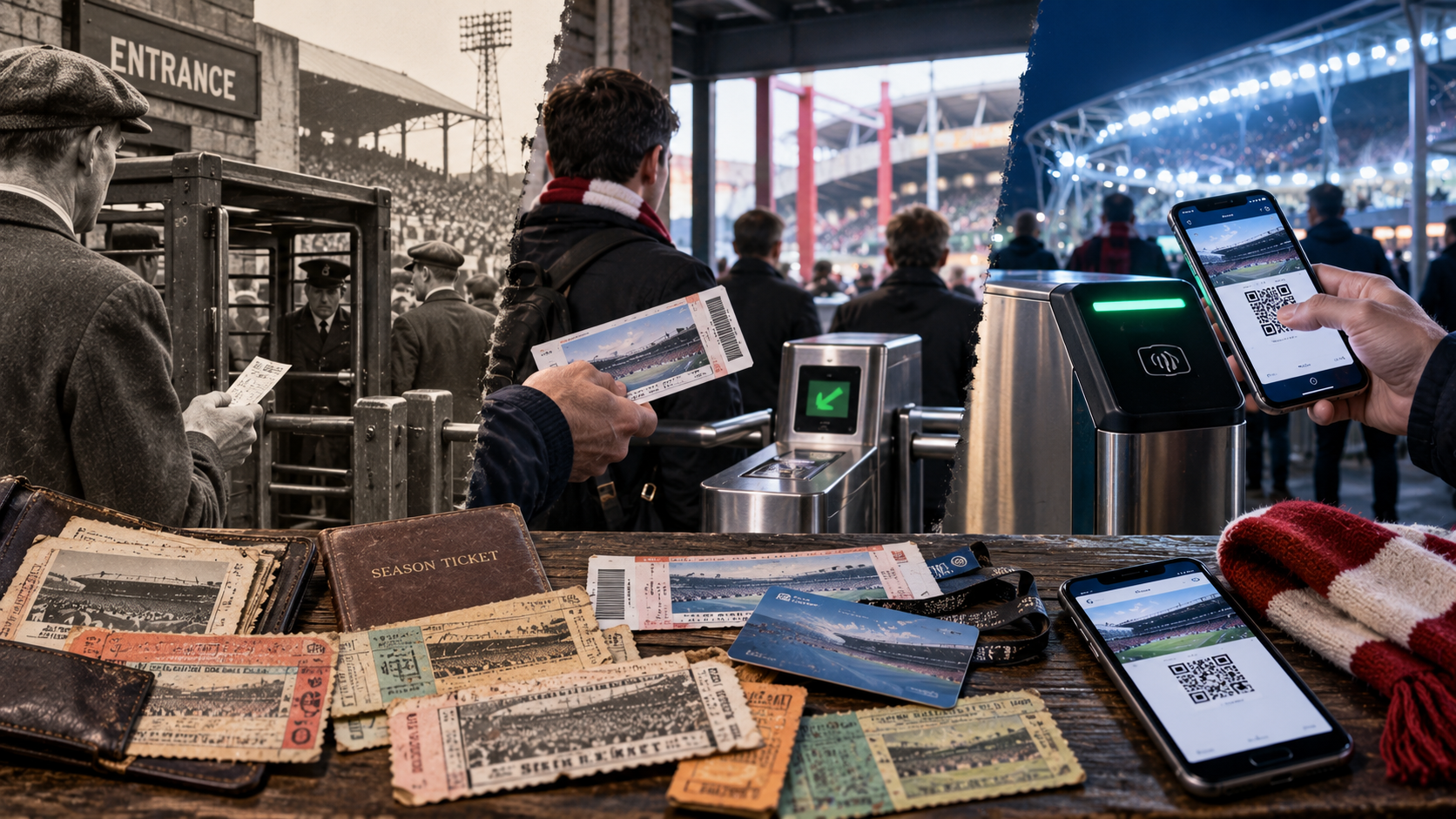
A football ticket appears to have a simple purpose. It proves that its holder is entitled to enter a stadium, identifies a match, and sometimes specifies a stand, block, row, or seat. Once the turnstile has been passed, the practical job of the ticket is almost finished.
For generations of supporters, however, tickets became much more than permission to enter. Torn stubs survived in wallets, drawers, scrapbooks, programme collections, and picture frames long after the match itself had ended. A small piece of card could recall a first game with a parent, an unforgettable away trip, a cup final, a demolished stadium, or an ordinary match that became important only because of the people who were there. As football moves increasingly toward smartphones and digital entry, the culture surrounding the ticket is changing with it.
The Ticket Begins as a Practical Object
At its most basic, ticketing solves an organizational problem. A football club needs to control how many people enter a ground, determine which parts of the stadium they can access, and establish who has paid for admission. The ticket gives the supporter evidence that this transaction has taken place.
That function became increasingly important as football crowds grew. A small local ground might once have relied heavily on cash admission at the gate, but large stadiums required more structured systems. Tickets helped clubs separate stands, allocate capacity, manage high-demand matches, distinguish different price categories, and control access to specific areas.
Paying at the Turnstile Created Its Own Matchday Ritual
Older football culture did not always begin with weeks of online preparation. For many ordinary league matches, supporters could arrive at the ground, join a queue, pay at a turnstile, and walk onto a terrace. Admission could feel immediate: money changed hands and within seconds the supporter was inside.
The turnstile therefore became part of the physical rhythm of matchday. Supporters approached the stadium through crowded streets, separated into entrances, passed through narrow gates, and suddenly emerged into the interior of the ground. Long before digital scanners, that mechanical movement from public street to football space formed part of the sense of arrival.
Paper Tickets Added Information to Admission
Printed tickets could carry much more information than a simple cash transaction. They might contain the club or competition name, date, kick-off time, opponent, entrance, stand, price, seat details, serial number, and instructions for the holder.
The design also reflected its era. Some tickets were plain and functional. Others used club colours, illustrations of stadiums, competition branding, decorative borders, security patterns, or images connected with an important final. Even when supporters did not think of them as graphic design, football tickets quietly recorded how clubs presented themselves visually.
A Used Ticket Could Become More Valuable Emotionally
Before the match, the ticket’s value came from the access it provided. After the final whistle, its financial usefulness largely disappeared. Yet that was often the moment when its emotional value began.
A used ticket could prove that somebody was there. Supporters kept stubs from first matches, cup finals, derby victories, European trips, promotions, relegations, and visits to famous grounds. The ticket became a physical link between an individual memory and a documented event.
Ticket Stubs Became Small Pieces of Personal History
Football memories rarely exist as complete recordings in a supporter’s mind. Small objects help bring them back. A ticket may recall the weather, the train journey, the person sitting beside you, the pub visited before kick-off, the view from the stand, or the feeling of walking into a particular stadium for the first time.
This is why collections of old tickets can look insignificant to an outsider but deeply meaningful to their owner. A drawer containing faded pieces of card may represent several decades of weekends, relationships, journeys, victories, disappointments, and changing football grounds.
The Price Printed on a Ticket Becomes Historical Evidence
Old tickets also record the economics of attending football. A surviving stub can show exactly what somebody paid to enter a particular match at a particular time. Decades later, the price may appear surprisingly low, although comparisons must take inflation and historical incomes into account.
Collections published by supporters contain striking examples: tickets from cup finals, European matches, internationals, and ordinary league games often preserve their original prices alongside stand or terrace information. In this sense, ticket stubs are small economic records as well as souvenirs.
A Ticket Could Record the Stadium as It Once Existed
Stadiums change constantly. Terraces become seats, stands are renamed, entrances are rebuilt, clubs relocate, and old grounds disappear completely. Tickets preserve the language of those lost spaces.
A ticket naming a terrace, paddock, stand, gate, or enclosure that no longer exists can become evidence of how supporters once moved through the stadium. When combined with programmes, photographs, and memories, tickets help reconstruct matchdays that modern visitors can no longer experience.
SwiftPeakX explores the physical transformation of football grounds in From Terraces to All-Seater Stadiums: The Evolution of Football Grounds.
Numbered Seating Changed What a Ticket Had to Do
A standing ticket often needed only to admit somebody to the correct part of the ground. Reserved seating required more precision. Tickets increasingly identified stand, block, row, and seat, turning them into navigation documents as well as proof of admission.
This altered the supporter experience. Instead of entering a terrace and choosing where to stand, a spectator might be assigned one specific position before arriving. The ticket told the supporter not only that they could enter the stadium, but exactly where their match would be experienced from.
Season Tickets Created a Different Relationship With Entry
A supporter attending one match traditionally received an object connected with one fixture. Season-ticket holders developed a different form of access. Booklets, cards, passes, and eventually smart cards could provide entry across an entire campaign.
This was convenient, but it also changed the souvenir trail. A supporter attending twenty home matches might possess one season card rather than twenty individual ticket stubs. As clubs adopted reusable access cards, the direct physical connection between each match and one unique object began to weaken.
Away Tickets Could Represent the Journey as Much as the Match
Away tickets often carry particular emotional weight because obtaining the ticket is only the beginning of the experience. The supporter may travel for hours, visit an unfamiliar town, enter a different stadium, and spend the match surrounded by people who made the same journey.
Years later, the small ticket can represent the entire day rather than only ninety minutes of football. That connection between admission and travel is one reason ticket stubs frequently appear alongside train tickets, programmes, photographs, badges, and other items preserved from away trips.
For more on this relationship between travel and supporter identity, see The Culture of Away Days: Why Football Fans Travel for Their Team.
Major Matches Turned Tickets Into Collectible Objects
A ticket from an ordinary league match may be treasured because of personal memory. A ticket from a historically important final can acquire another type of significance. Collectors may seek tickets connected with World Cups, European finals, famous domestic cup matches, historic stadiums, or landmark moments in a club’s history.
The attraction is partly scarcity. Many tickets were torn, damaged, discarded, or simply lost after use. A surviving example from an older match can therefore become a rare piece of memorabilia, especially when it remains clearly identifiable and connected to a significant event.
Collectors Do Not Always Need to Have Attended the Match
There is an important difference between keeping tickets from matches personally attended and collecting historical football tickets. Some supporters value only the objects connected with their own experiences. Others deliberately acquire tickets from famous matches they never witnessed.
Both forms of collecting preserve football history, but they create different meanings. One ticket says, “I was there.” Another says, “This event matters to the history I care about.” The same piece of paper can therefore operate as autobiography, memorabilia, or historical artefact depending on who owns it.
Football Tickets Became Part of Family Memory
Old football memorabilia often survives because one generation passes it to another. A child may inherit a parent’s cup-final ticket, a grandparent’s season book, or a collection of stubs from a stadium that closed before they were born.
The object then connects two different supporter experiences. The younger fan may never have stood on the old terrace or travelled to the original match, but the ticket provides something tangible around which family stories can be told.
The Ticket Office Was Once an Important Football Place
Before online sales became dominant, purchasing a ticket could require visiting or contacting the club directly. Ticket-office windows, postal applications, vouchers, queues, telephone bookings, and supporter-club allocations were all part of obtaining access.
For high-demand matches, securing the ticket could become a story in itself. Supporters might queue early, collect tokens from previous fixtures, send applications by post, or depend on loyalty arrangements. The effort required made the physical ticket feel like the final reward for a process completed successfully.
Computerised Ticketing Changed Distribution
As stadium operations became more computerized, ticketing systems could connect individual purchases with detailed seating plans and supporter records. Barcodes and machine-readable information made it possible for automated turnstiles to validate entry rather than relying entirely on a person inspecting or tearing the ticket.
This improved the ability to manage capacity and specific seats, but it also changed the appearance of tickets. Security information, barcodes, reference numbers, and increasingly standardized formats occupied space that older tickets might have used for more decorative designs.
Print-at-Home Tickets Were an Important Transitional Stage
Digital purchasing did not immediately mean digital entry. For a period, supporters could buy a ticket online and print the document themselves. The transaction had moved to the internet, but the supporter still carried a physical sheet to the stadium.
This was convenient because clubs no longer needed to post every ticket or hold it for collection. Yet from a cultural perspective, the object changed dramatically. A home-printed page rarely possessed the same visual or material character as a purpose-designed ticket produced by the club or competition.
Smart Cards Made the Match Ticket Almost Invisible
Reusable access cards took the transition further. Instead of receiving a new physical object for every home fixture, season-ticket holders could present the same card repeatedly. The right to attend a particular match existed electronically within the ticketing system.
This was efficient, but it removed one of the traditional souvenirs of regular attendance. A supporter could attend an entire decade of home matches while accumulating far fewer physical objects than somebody following the same club in an earlier era.
The Smartphone Eventually Became the Ticket
Mobile ticketing changed the relationship again. The supporter may no longer carry a separate ticket at all. The entitlement to enter appears inside an app or digital wallet on a device already used for communication, photography, maps, banking, travel, and countless other parts of everyday life.
At the stadium entrance, the supporter presents a phone to a scanner or activates the required digital ticket. What once existed as a dedicated object has become a temporary piece of information displayed on a multipurpose screen.
Major Tournaments Helped Accelerate Mobile Ticketing
UEFA used mobile ticketing extensively for the inaugural Nations League Finals in 2019 and subsequently planned distribution of more than one million mobile tickets for UEFA EURO 2020. The system was designed to support secure distribution, ticket transfers, and entry across tournament venues while reducing reliance on paper.
By the mid-2020s, mobile-only systems had become normal for major competitions. UEFA club competition finals use digital tickets through the official mobile ticketing application, while FIFA used mobile-only entry for the 2026 World Cup.
A Modern Digital Ticket Can Change Until Matchday
A paper ticket normally contains all of its useful information when it is printed. Modern mobile systems can behave differently. Security features can activate close to the match, tickets can sometimes be transferred electronically, and access credentials can be designed so that static screenshots are not valid substitutes.
For the 2026 World Cup, FIFA stated that mobile tickets could not be downloaded as PDFs and that screenshots or photographs would not provide stadium entry. The QR code required for access appeared only a few hours before gates opened. The ticket had become a controlled digital credential rather than a permanent image.
Digital Ticketing Can Make Duplication More Difficult
One reason governing bodies favour controlled mobile systems is security. A printed ticket or static digital file can potentially be copied and distributed to multiple people even though only one valid entry exists.
Mobile systems can restrict transfers, connect tickets to specific accounts or devices, and use changing or activated access information. UEFA has explicitly described these security features as tools for reducing unauthorized resale, duplication, and misuse.
But the Digital Ticket Creates New Dependencies
The paper ticket has obvious weaknesses: it can be lost, stolen, damaged, or counterfeited. Digital access solves some problems while creating others. Supporters must have compatible technology, sufficient battery power, access to the correct account or application, and an understanding of how the system works.
A forgotten paper ticket and a dead smartphone are different problems with the same result: difficulty entering the stadium. Modern ticketing therefore places more responsibility on digital infrastructure and on supporters arriving prepared to use it.
Accessibility Matters During the Digital Transition
Not every supporter uses technology in the same way. Age, disability, device ownership, confidence with apps, language, connectivity, and personal circumstances can all affect whether mobile ticketing feels convenient or exclusionary.
This means clubs and competition organisers must think beyond the average smartphone user. A ticketing system can be technologically sophisticated while still creating frustration if the process for supporters who need assistance is unclear or difficult to access.
Digital Tickets Also Change the Experience of Giving Someone a Ticket
A paper ticket can simply be placed into another person’s hand. That small act has been part of football culture for generations: a parent giving a child their first ticket, a friend producing an unexpected spare, or a supporter passing an away ticket to somebody travelling with the group.
Digital transfer can be faster across long distances, but it feels different. The recipient receives access through an account or application rather than a physical object. The function may be more efficient while the ceremony becomes less visible.
The Disappearance of Paper Changes Football Collecting
The most obvious cultural loss is physical evidence. A supporter cannot place a temporary QR code in a scrapbook in quite the same way as a printed ticket stub. Screenshots may preserve the visual appearance, but some modern systems deliberately prevent screenshots from functioning as valid tickets, and digital files do not age like physical objects.
A paper ticket changes over time. It becomes creased, faded, torn, stained, or covered with handwriting. Those imperfections can become part of its history. A digital ticket normally disappears into an account after serving its purpose, leaving photographs and transaction records rather than a worn object shaped by the day itself.
Supporters Find New Ways to Preserve Digital Matchdays
The disappearance of the stub does not mean supporters stop collecting memories. The archive simply changes. Photographs of the stadium, screenshots of fixture information, digital programmes, travel confirmations, social-media posts, and saved emails can all become evidence of attendance.
Some clubs and supporters also create commemorative physical tickets after the event. These objects are no longer required for admission, but that is precisely the point: they exist because people still want a tangible object connected with an experience that has become digitally administered.
Groundhoppers Feel the Loss of Physical Tickets Especially Strongly
Groundhoppers traditionally use tickets as evidence and souvenirs of stadium visits. A collection of stubs can function almost like a travel diary, with each ticket representing another ground and another match.
Mobile entry changes that archive. The stadium visit still exists, but one of its easiest physical records disappears. This makes photographs, programmes, badges, and personal notebooks increasingly important for supporters who want something permanent from each trip.
SwiftPeakX explores that culture in The Culture of Groundhopping: Why Fans Visit Stadiums Beyond Their Own Club.
Ticketing Also Shapes Who Can Attend
A ticket is not only a souvenir after the match; before the match it is a mechanism of access. Price, availability, membership rules, loyalty requirements, away allocations, sale windows, and resale procedures can determine which supporters are able to enter.
This makes ticketing culturally important even when the physical ticket disappears. How clubs distribute scarce seats influences who sits together, who can attend high-demand matches, whether younger supporters can build attendance histories, and how easily occasional fans can experience the stadium.
Scarcity Gives Tickets Social Value
When demand exceeds capacity, securing a ticket can become a mark of commitment. Supporters may accumulate loyalty points, maintain memberships, attend less glamorous matches, or rely on long-established distribution systems in order to qualify for high-demand fixtures.
This can strengthen the connection between regular attendance and access, but it can also make football difficult for newcomers to enter. Ticketing systems therefore sit at the intersection of loyalty, fairness, commercial demand, and the limited physical capacity of the stadium.
Ticket Resale Has Always Created Tension
Scarce tickets also create secondary demand. Supporters unable to obtain official tickets may look elsewhere, while others may attempt to profit from access to popular matches. The result is an enduring tension between legitimate transfer, organized resale, touting, fraud, and supporter demand.
Digital systems give organisers new tools to control this process. Transfer restrictions, official resale platforms, account-linked tickets, and mobile security features can reduce some forms of misuse, although no ticketing system completely removes the economic pressure created when far more people want to attend than the stadium can accommodate.
The Ticket Is Part of Stadium Architecture Too
Ticketing systems influence how supporters physically move through a ground. Turnstile placement, entrance zones, concourses, barriers, digital scanners, accessibility gates, and seat numbering all connect the ticket to stadium design.
A poorly designed access system can create congestion even when the stadium itself is modern. A well-organized one can move thousands of people from streets into stands with surprisingly little friction. For more on how the physical ground shapes supporter behaviour, see How Stadium Architecture Shapes the Football Matchday Experience.
Tickets Record Changes in Football’s Commercial Identity
Look through several decades of football tickets and another history becomes visible. Sponsor names appear and disappear. Competition branding changes. Stadium names change. Security features become more complex. Prices rise. Seat categories multiply. Corporate hospitality becomes more prominent.
The ticket therefore records the commercial environment surrounding a match. What looks like a small administrative object can reveal who sponsored the competition, how the club branded itself, what categories of spectators existed, and how football sold access during a particular period.
A Ticket Can Outlive the Competition Printed on It
Competitions are renamed, sponsors change, clubs move, stadiums disappear, and ticketing companies cease to exist. The surviving ticket freezes those temporary arrangements in physical form.
This is why old ticket collections become useful historical material. They preserve names, logos, prices, entrances, dates, and commercial relationships that may no longer exist anywhere except in archives and personal collections.
The Most Ordinary Tickets Can Become the Most Personal
A famous final is obviously collectible, but cultural value does not always follow sporting importance. The ticket from a routine league match may matter more because it was a child’s first visit, the final match attended with a parent, or the last game at an old ground before redevelopment.
Football memory is personal rather than perfectly aligned with official history. The match that means almost nothing to the record books can become central to one supporter’s relationship with the sport.
Paper Tickets Made Attendance Tangible
The phrase “I was there” carries unusual power in football because stadium attendance is an experience that cannot be repeated exactly. Even if two clubs meet again, the crowd, players, stakes, weather, stadium, and people beside you will be different.
A ticket stub gave that claim a tangible form. It did not prove every memory attached to the match, but it placed a date, venue, and fixture into the supporter’s hand. That is why people who never considered themselves serious collectors still kept certain tickets for decades.
Mobile Entry Is Better at Access Than Memory
Digital ticketing has clear practical strengths. Tickets can be distributed rapidly, transferred under controlled conditions, updated close to the event, integrated with account systems, and protected by security features that static paper cannot provide.
What it does less naturally is become a keepsake. The mobile ticket is designed to solve an access problem efficiently. Once the match is over, there is often little reason for the system to preserve the ticket as a permanent object. Supporters who want a lasting record must create one themselves.
Football Culture Often Survives Technological Change
Football has repeatedly replaced familiar objects with more efficient technology. Scoreboards change, stadiums modernize, programmes compete with smartphones, and turnstiles become electronic. Supporters usually adapt while finding ways to preserve the emotional functions of what disappeared.
Ticket culture is likely to follow the same pattern. The paper stub may become increasingly rare, but the desire to remember attendance will remain. Supporters will continue saving photographs, digital records, programmes, badges, scarves, and whatever objects connect a particular match with their own lives.
From Passport to the Match to Digital Permission
The football ticket has travelled an unusual path. It began as a practical proof of payment, developed into a designed object containing information about a particular match, became a souvenir after use, and eventually turned into electronic permission stored inside a database and displayed on a phone.
Each stage solved the same fundamental problem differently: who is allowed through the stadium gate? Yet the cultural consequences were not the same. Paper tickets accidentally became archives because supporters could keep them. Digital tickets are more efficient precisely because the physical object is no longer necessary.
What Is Lost When the Stub Disappears?
Football does not need paper tickets in order to preserve atmosphere, loyalty, or matchday identity. Millions of supporters can have meaningful experiences after entering with a smartphone. The disappearance of paper is therefore not the disappearance of supporter culture.
But something small does change. Previous generations could empty a drawer decades later and discover their own football history printed on worn pieces of card. Future supporters may have far more photographs and digital data, but fewer accidental objects waiting to be rediscovered. The ticket remains a passport into the stadium; what has changed is whether that passport can still sit in your hand long after the journey is over.
Continue Exploring SwiftPeakX
Football tickets connect matchday access with travel, stadium design, and personal memory. Continue with The Culture of Groundhopping: Why Fans Visit Stadiums Beyond Their Own Club, The Culture of Away Days: Why Football Fans Travel for Their Team, and How Stadium Architecture Shapes the Football Matchday Experience to explore how supporters experience football through places and journeys as well as the match itself.


