
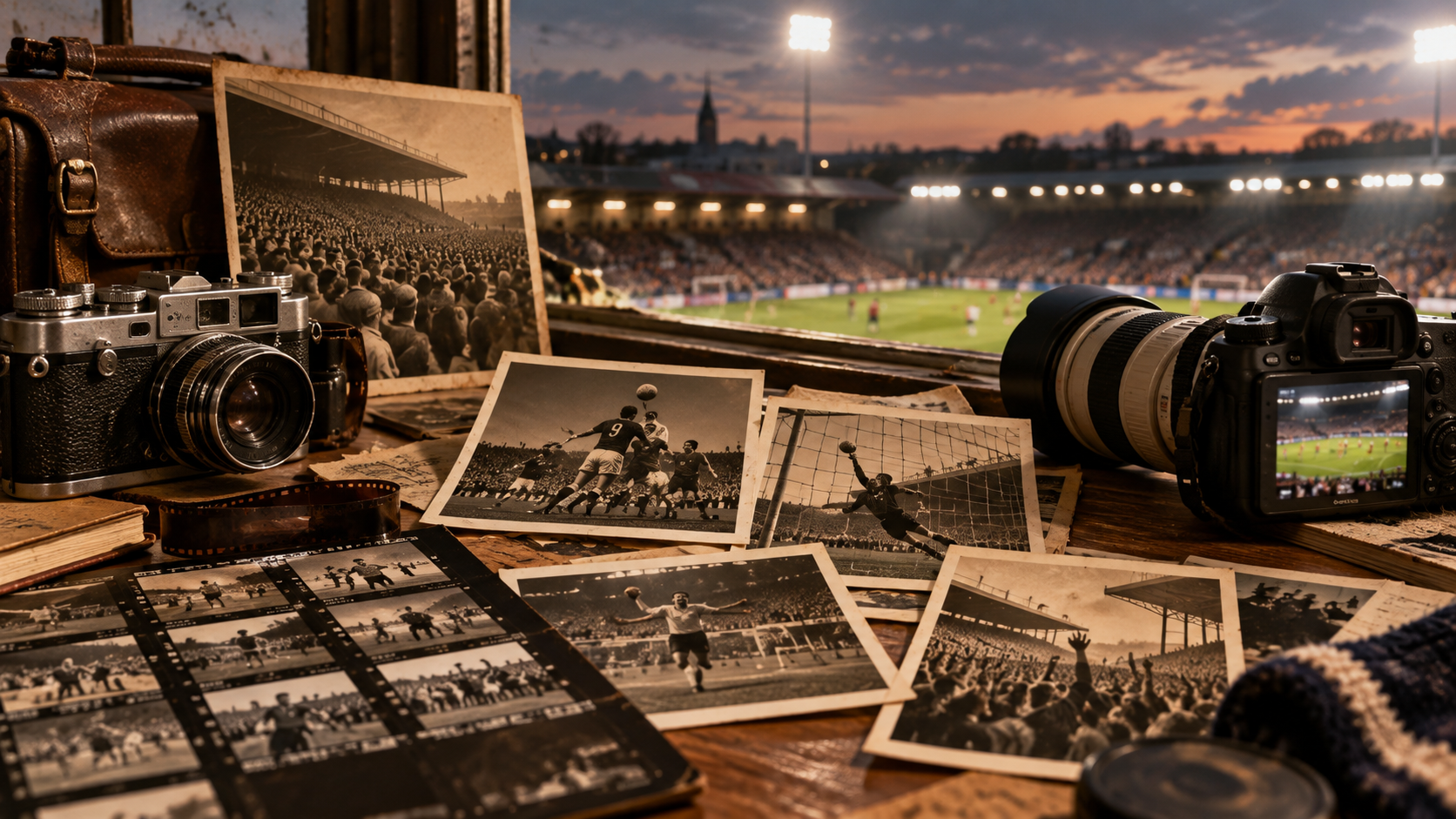
Football is experienced in movement, but much of its history survives in still images. Supporters may remember a match through a photograph of a goalkeeper stretching toward the corner, a player collapsing after defeat, thousands of scarves raised before kick-off, or a terrace that disappeared decades ago. The original moment may have lasted less than a second, yet the photograph can be reproduced in newspapers, books, museums, documentaries, posters, social media, and family collections for generations.
This gives football photography an unusual power. A camera does not preserve an entire match. It isolates one viewpoint, one fraction of time, and one selection from thousands of possible scenes. Once that frame becomes famous, however, it can shape how later generations imagine the event itself. Football photography therefore records history while also helping decide which parts of that history remain most visible.
Early Football Was Difficult to Photograph
Football presented obvious problems for early photographers. The game was fast, players changed direction unpredictably, action covered a large field, and photographers worked with equipment far slower and heavier than modern digital cameras. Formal team portraits and arranged scenes were therefore much easier to produce than sharp images of a decisive moment during play.
Technological improvements gradually changed what could be photographed. More sensitive photographic plates and faster exposures made genuinely instantaneous photographs increasingly possible during the late nineteenth century. Football could begin to appear not only as groups of players standing still for the camera but as a sport defined by movement, collision, jumping, running, saving, shooting, and celebration.
Team Photographs Created an Early Visual Record
Before action photography became technically practical on a large scale, team photographs already served an important historical function. Players stood in rows wearing kits that now reveal shirt design, collars, boots, shorts, hairstyles, badges, and the changing appearance of footballers across generations.
These photographs can also preserve people whose careers left relatively few written records. A name on a team list may tell historians that someone played, but an image reveals age, posture, clothing, teammates, surroundings, and sometimes the social atmosphere of the club itself. National Football Museum collections include early photographs of university, league, and international teams alongside images of players, match line-ups, stadiums, and supporters.
Photography Preserved Stadiums That No Longer Exist
One of photography’s most valuable contributions to football history is architectural memory. Stadiums are continually rebuilt, expanded, converted to seating, relocated, or demolished. Once a terrace or stand disappears, photographs may become the clearest evidence of what the space actually looked like when supporters occupied it.
A photograph can preserve narrow tunnels, wooden grandstands, advertising boards, uncovered terraces, floodlight pylons, turnstiles, perimeter fences, roof structures, and streets immediately outside the ground. These details allow later supporters to see that football grounds were lived environments rather than abstract names in historical records.
Crowd Photographs Reveal More Than Attendance Numbers
An attendance figure may tell us that fifty thousand people were present, but a photograph can reveal how those people experienced the event. It can show whether they stood tightly packed, wore hats or replica shirts, carried banners, included children, climbed onto barriers, or gathered behind particular goals.
Crowd photography therefore provides evidence about fashion, class, gender, age, stadium design, policing, supporter symbols, and everyday behaviour. The National Science and Media Museum’s Daily Herald collection includes images such as the crowd at Arsenal versus Sheffield Wednesday in 1933 and young supporters at Birmingham City versus Aston Villa in 1962, preserving forms of matchday life that written reports rarely describe in comparable detail.
The Press Turned Football Photography Into Mass Memory
A photograph becomes culturally influential not simply because it exists but because people see it repeatedly. Newspapers were crucial to this process. Match reports could explain what happened, while photographs provided faces, gestures, crowds, goals, and stadium scenes that readers could study long after the final whistle.
Picture desks selected which photographs appeared, how large they were printed, and how they were cropped. That editorial process helped create public memory. Thousands of frames might exist from one match, but only one could appear prominently on the back page the following morning. The chosen image could then become the visual shorthand for the entire event.
Smaller Cameras Changed Photojournalism
The development of lighter and more flexible cameras gave photographers new freedom. National Science and Media Museum records show that press photographer James Jarché moved from a traditional 9×12 plate camera toward the Leica 35mm format during the early 1930s. He recognized that a camera capable of making many exposures on a roll could transform newspaper photography.
For football, greater mobility mattered enormously. Photographers could react more quickly, change position, take sequences of images, and work less rigidly than earlier equipment allowed. Technology did not automatically create better photographs, but it expanded the number of moments a photographer had a realistic chance of capturing.
The Touchline Became a Workplace
Modern supporters are accustomed to seeing photographers positioned behind advertising boards and around the goals. That location is not accidental. Photographers need angles from which attacking movement, goalkeeping, celebration, and emotional reaction can be captured clearly without interfering with play.
The position also shapes the images produced. A photographer behind the goal sees football differently from someone sitting high in a television gantry. Ground-level photography exaggerates speed, facial expression, physical contact, and the scale of players against the crowd. The camera location therefore becomes part of the interpretation.
A Photograph Can Capture What Television Passes Over
Moving images provide more context, but still photography has a different strength. Television continues immediately to the next pass, replay, or interview. A photograph removes movement and gives the viewer unlimited time to inspect one moment.
The position of a goalkeeper’s hand, the expression of a substitute, the reaction of a supporter in the second row, or the mud covering a player’s shirt can become visible precisely because the frame does not move. SwiftPeakX explores the parallel development of moving images in How Television Changed Football Forever.
The Moment Before the Goal Can Be as Powerful as the Goal
Football photography does not always need to show the ball crossing the line. Sometimes the strongest image captures anticipation: the striker preparing to shoot, a goalkeeper already committing to one side, defenders turning desperately, or supporters beginning to rise before they know the outcome.
This creates an unusual relationship between still photography and football knowledge. Someone who already knows what happened can look at the frozen frame and mentally complete the action. The photograph becomes powerful partly because the viewer supplies the seconds immediately before and after it.
Celebration Became One of Football Photography’s Great Subjects
A goal celebration provides photographers with a concentration of emotion that is difficult to produce artificially. Players shout, run, fall into one another, slide across the grass, point toward supporters, or disappear beneath teammates. The crowd behind them often reacts simultaneously.
The photograph can therefore combine individual and collective emotion inside one frame. A scorer’s face may dominate the foreground while thousands of blurred supporters raise their arms behind. The image communicates what the goal meant without requiring the viewer to know every tactical detail that produced it.
Defeat Has Its Own Visual Language
Football photographers also preserve the opposite emotion. A player sitting alone after a final, a goalkeeper remaining on the ground after conceding, supporters covering their faces, or teammates watching an opponent celebrate can become equally memorable images.
These photographs matter because football history is often written around winners. Still images can preserve what defeat looked like for the people experiencing it. The same tournament that creates one team’s iconic celebration also produces another team’s enduring image of disappointment.
One Frame Can Become the Memory of an Entire Tournament
Major tournaments generate enormous photographic archives, yet a small number of frames repeatedly return in books, documentaries, exhibitions, and anniversaries. Their repetition gradually turns them into visual symbols of the event.
World Press Photo’s historical archive, for example, includes Gunnar Tingsvall’s photograph of Pelé after Brazil won the 1958 World Cup. The tournament contained many matches and thousands of moments, but images associated with the young Pelé’s triumph became part of the way that victory has been visually remembered across generations.
Repetition Gives Some Photographs More Power Than Others
An iconic image is not necessarily the only accurate photograph of an event. It may simply be the frame that editors, publishers, museums, broadcasters, and later digital platforms reproduced most frequently. Familiarity then reinforces importance: the more often people see the photograph, the more strongly it becomes associated with the historical moment.
This is why visual history should be read carefully. Another photographer standing ten metres away may have produced a completely different image of the same second. One frame can become famous without representing every perspective that existed inside the stadium.
Cropping Can Change the Meaning of a Football Photograph
A photograph is already a selection, but publication can alter it further. Editors may crop away empty space, remove distracting figures, emphasize the player at the centre, or change the balance between athlete and crowd.
The Daily Herald archive preserved by the Science Museum Group is particularly valuable because surviving photographs can reveal evidence of cropping and editorial treatment. Studying those choices helps historians understand not only what photographers recorded but how newspapers shaped the photographs readers actually encountered.
Captions Also Shape Interpretation
The same image can carry different meanings depending on its caption. A photograph of supporters climbing a barrier could be described as enthusiasm, disorder, danger, or celebration. The visual evidence remains similar, but the words surrounding it guide interpretation.
This makes newspaper archives especially valuable when photographs are preserved alongside their original publication context. Historians can compare the image with the language used at the time rather than assuming that modern viewers interpret the scene in exactly the same way.
Football Photography Preserved Everyday Work Around the Game
Some of the most useful historical football photographs contain no famous goal at all. Images show groundsmen clearing snow, players training, managers greeting new signings, supporters waiting outside gates, employees preparing stadiums, and teams travelling between matches.
The Daily Herald collection includes photographs of Fulham players clearing snow before a 1939 cup tie, Arsenal training sessions, player transfers, and many other scenes away from the ninety minutes themselves. Such images remind us that professional football has always depended on labour extending far beyond the players visible during a match.
Photographs Preserve Football Fashion
Football images also document clothing more effectively than most written descriptions. Supporters’ coats, hats, scarves, replica shirts, hairstyles, footwear, banners, and casual fashion can reveal immediately which era a crowd belongs to.
The same applies to players. Shirt cuts, collars, shorts, socks, boots, goalkeeper clothing, sponsor logos, and manufacturing techniques change over time. A photograph can therefore become evidence for the development of football design as well as the match it originally documented.
Terrace Photography Preserved a Disappearing Culture
Changes to stadium safety and architecture transformed many grounds during the late twentieth century. Large standing terraces disappeared from numerous major stadiums, and newer all-seater structures created different patterns of crowd distribution.
Photography preserves the physical appearance of those lost environments: densely packed supporters, barriers, roofs, fences, entrances, and viewing positions that later generations may never experience directly. For the wider architectural history, see From Terraces to All-Seater Stadiums: The Evolution of Football Grounds.
Photography Can Recover Supporters Who Were Underrepresented in Written History
Official football histories traditionally concentrated heavily on clubs, administrators, managers, male first-team players, and major competitions. Photographs can reveal people whose participation was less frequently documented in written institutional records.
Women supporters, children, stadium workers, grassroots players, minority communities, and informal supporter groups may appear in images even when they occupy little space in official reports. The photograph does not automatically explain their experience, but it can establish presence and provide evidence from which better historical questions can begin.
Women’s Football Shows Why Visual Archives Matter
The historical unevenness of women’s football coverage makes photography especially valuable. National Football Museum collections include early women’s football photographs as well as material from the 1970s and 1980s, helping preserve teams and players whose careers received far less media attention than men’s football.
The museum has described photographs from England’s participation in the 1981 Mundialito in Japan as particularly rare, noting that some appear to be among the earlier colour images of that national side. Without private collections and preservation work, parts of that visual history could easily have disappeared.
The Photographer Decides Where to Look
A photograph records something that genuinely stood in front of the camera, but that does not make it neutral. The photographer chooses the subject, lens, position, moment, exposure, and frame. Turning toward a celebrating player means turning away from something else happening simultaneously.
This selection is not a flaw; it is part of photography. Problems arise only when later viewers mistake one selected view for the complete event. Historical photographs should therefore be read alongside match reports, video, oral testimony, club archives, and other images whenever the wider context matters.
Accreditation Determines Who Gets Close to the Action
Professional photographers cannot simply stand anywhere they choose inside a major stadium. Accreditation, competition rules, security requirements, advertising positions, broadcast equipment, and designated photography zones shape where cameras can operate.
These restrictions influence the visual record. If dozens of photographers are concentrated behind the same goal, they may produce variations of a similar perspective. Supporter photography from the stands can therefore provide entirely different viewpoints even when technical image quality is lower.
Official Photography and Documentary Photography Can Tell Different Stories
A club’s official photographer has different priorities from an independent documentary photographer. Official channels naturally need images of players, sponsors, trophies, community events, and positive club activity. The photographs serve communication as well as historical documentation.
Independent photographers may instead focus on supporters waiting for buses, ageing stadium streets, ticket protests, empty pubs, policing, rain, food stalls, or the ordinary moments surrounding a match. Both approaches can be valuable, but together they provide a more complete visual record than either could create alone.
Stuart Roy Clarke Made the Supporter Environment Part of the Subject
Football documentary photography increasingly demonstrated that the game did not need to be photographed only through goals and star players. Photographers such as Stuart Roy Clarke built long-term bodies of work around supporters, stadiums, landscapes, and the relationship between football grounds and their communities.
The National Football Museum holds material from Clarke’s photographic collection and has exhibited his work on the changing face of football. This approach treats the person walking toward the stadium or standing on a terrace as part of football history rather than simply background scenery.
Photography Helps Connect Clubs With Place
A stadium photograph often contains more than the ground itself. Terraced houses, factories, churches, railway lines, tower blocks, shops, hills, docks, or city skylines can appear around it. These surroundings demonstrate how football grounds fit into the geography that created them.
When clubs move, such images become particularly important because the physical relationship between stadium and neighbourhood may disappear. SwiftPeakX explores that connection in Football and Local Identity: Why Clubs Represent Their Communities.
Colour Photography Changed Historical Imagination
Black-and-white photography dominates much of the popular visual memory of older football. This can make earlier decades feel more distant than they actually were. Colour photographs immediately restore details that monochrome images translate into shades of grey: shirt colors, painted stands, advertising, scarves, grass, skin tones, and street environments.
Rare early colour photographs can therefore change how people imagine an era. They do not make the history more authentic than black-and-white photography, but they can reduce the psychological distance between contemporary viewers and people who lived through the event.
Digital Cameras Changed the Volume of Football Images
Film placed practical limits on how many photographs could be made and how quickly they could be reviewed and distributed. Digital photography transformed that workflow. Professional photographers could capture large bursts of frames, inspect them immediately, transmit selected images quickly, and work across a match with far greater volume.
This increased the chance of capturing the precise instant of a tackle, save, facial expression, or celebration. It also changed editorial selection. The challenge became less about whether a usable image existed and more about finding the strongest frame among hundreds or thousands produced during a single match.
The Smartphone Turned Supporters Into Photographers
The most dramatic change in the social history of football photography may not have come from professional equipment at all. Smartphones gave almost every supporter a camera capable of producing, editing, publishing, and transmitting images from inside the stadium within seconds.
The visual archive of a modern match is therefore enormous. Supporters photograph railway journeys, meeting places, food, tickets, tifos, warm-ups, goals, half-time concourses, celebrations, and the journey home. Professional photographers no longer have anything close to a monopoly over the visual record.
Supporter Photography Preserves Different Moments
A professional camera is usually pointed toward the pitch at decisive moments. A supporter’s phone may be pointed in the opposite direction. It can record friends embracing after a goal, a child attending for the first time, an unusual banner, a train platform full of scarves, or a pub hours before kick-off.
These images may have little immediate journalistic value, but decades later they could become important cultural evidence. Ordinary photographs frequently become more historically valuable as the ordinary world they depict begins to disappear.
Constant Recording Can Also Change the Experience
The smartphone created a paradox. Supporters can preserve more of matchday than any previous generation, but the desire to record events can sometimes compete with experiencing them directly. A spectacular moment may be viewed partly through a screen because the person wants evidence that they were there.
This tension is not unique to football, but stadiums make it particularly visible. Thousands of phones can rise simultaneously during trophy celebrations or major set pieces. Photography is no longer only documenting supporter behaviour; recording has itself become part of that behaviour.
Social Media Determines Which Images Travel Furthest
Newspapers once played the dominant role in selecting football images for mass audiences. Today photographs circulate through club accounts, leagues, photographers, supporters, news organisations, players, fan pages, and algorithms.
This increases access while creating a new form of selection. Dramatic celebrations, unusual gestures, controversy, and visually striking crowd displays can spread rapidly, while quieter photographs documenting everyday football may receive little attention. Popularity and historical importance are not necessarily the same thing.
Metadata Creates a New Kind of Historical Evidence
Digital photography can preserve information that older prints often lost: creation time, camera details, location data, file history, and other metadata. When properly preserved, this information can help archivists identify where and when an image was created.
But digital photographs create new preservation problems too. Phones are replaced, accounts disappear, cloud services close, file formats change, and enormous collections become difficult to organize. Producing more images does not automatically guarantee that more will survive.
Physical Prints Can Survive Because Someone Decided to Keep Them
Old football photographs often survive for simple personal reasons. Someone placed them in an album, newspaper archive, club office, family drawer, supporter scrapbook, or photographer’s collection and decided not to throw them away.
That survival is selective. Countless photographs have been lost through neglect, disposal, poor storage, fire, water, or the disappearance of organisations. The visual history available today is therefore only a fraction of the images that once existed.
Museums Give Football Photographs New Context
When photographs enter museums and archives, they change function. An image once produced for tomorrow morning’s newspaper may later be catalogued as historical evidence. Names, dates, photographers, locations, competitions, and subjects can be researched and attached to the image for future users.
The National Football Museum now preserves photography alongside shirts, trophies, programmes, supporter objects, film, and other material culture. Photography becomes one piece of evidence within a larger historical collection rather than a disposable illustration of yesterday’s match.
Copyright Matters When Historical Images Are Reused
An old football photograph should not automatically be treated as free material simply because the event happened many years ago. Copyright can remain with photographers, agencies, newspapers, archives, estates, or other rights holders depending on the image and jurisdiction.
For publishers, this distinction matters. A photograph can be historically important and still require permission or licensing before reproduction. Responsible football history therefore involves not only identifying the image correctly but respecting the rights attached to it.
AI and Image Manipulation Create a New Historical Problem
Digital editing has always required viewers to consider whether an image has been altered, but generative technology makes the issue more complicated. Images can now be created that resemble historical football photographs without documenting any real event.
This increases the importance of provenance. Archives, original negatives, publication records, captions, photographer credits, and trustworthy collections help establish whether a photograph genuinely records the past. A visually convincing image is not automatically historical evidence.
A Photograph Is Evidence, Not the Entire Truth
The strongest way to use football photography historically is neither to distrust every image nor to accept every image without question. Photographs contain real visual information, but their meaning depends on who made them, why they were made, where the camera stood, how the image was edited, and what happened outside the frame.
Comparing photographs with newspapers, official records, video, oral history, stadium plans, programmes, and supporter testimony allows a more complete picture to emerge. The photograph becomes one witness among several rather than a complete replacement for historical investigation.
Football Photography Shapes Nostalgia
Supporters often encounter the past through carefully selected images: packed terraces, muddy pitches, simple kits, floodlights in fog, crowded streets, and legendary players. Repeated photographs can create a powerful impression that an earlier period had one consistent atmosphere.
The reality was always more complicated. For every beautiful terrace photograph there were ordinary matches, poor views, uncomfortable facilities, empty sections, and experiences that cameras ignored. Photography can preserve nostalgia, but historical understanding requires remembering that the most attractive surviving images are not necessarily representative of everyday life.
Photography Makes Lost Football Feel Present Again
Despite those limitations, few historical sources can collapse time as effectively as a photograph. A supporter can look directly into the face of someone standing on a terrace eighty years earlier, notice the same nervous expression before kick-off, and recognize gestures that remain familiar in modern football.
This visual continuity connects generations. Stadiums, clothing, cameras, and competitions may have changed, but photographs reveal emotions that remain recognizable: anticipation, boredom, anger, celebration, anxiety, pride, and disappointment.
The Images We Preserve Will Shape Future Football History
Today’s football is photographed more extensively than any previous era, but future historians will still depend on choices made now. Clubs, newspapers, supporters, photographers, museums, and digital platforms all influence what is stored, described, and made accessible.
If archives preserve only trophy lifts and famous players, future generations will understand less about ordinary matchday life. Photographs of supporters, workers, neighbourhoods, women’s football, grassroots games, protests, travel, and everyday stadium routines may eventually become just as valuable as images of championship celebrations.
Football Memory Is Built One Frame at a Time
Football photography does more than illustrate stories that already exist. It helps determine which moments acquire a visible afterlife. A match lasts ninety minutes, a stadium may stand for a century, and a player’s career can stretch across many seasons, yet one photograph can become the image through which all of them are remembered.
That power makes football photographs valuable but also demands careful reading. The camera preserves, selects, excludes, and interprets simultaneously. The strongest football history therefore asks not only what an image shows, but who made it, why it survived, what existed beyond the frame, and why this particular picture became the one later generations continued to see.
Continue Exploring SwiftPeakX
Football photography connects directly with broadcasting, stadium change, and the relationship between clubs and place. Continue with How Television Changed Football Forever for the development of moving football images, From Terraces to All-Seater Stadiums: The Evolution of Football Grounds for the physical environments preserved by generations of photographers, and Football and Local Identity: Why Clubs Represent Their Communities for the connection between stadium imagery, neighbourhoods, and supporter identity.
Recommended Sources for Further Reading
- National Football Museum — football photography, film, objects, and archive collections
- National Science and Media Museum — Daily Herald Archive and the history of press photography
- Science Museum Group Collection — football photojournalism and historical sports photography
- FIFA Museum — historical photography, tournament archives, and football exhibitions
- World Press Photo — historic sports and football photojournalism


