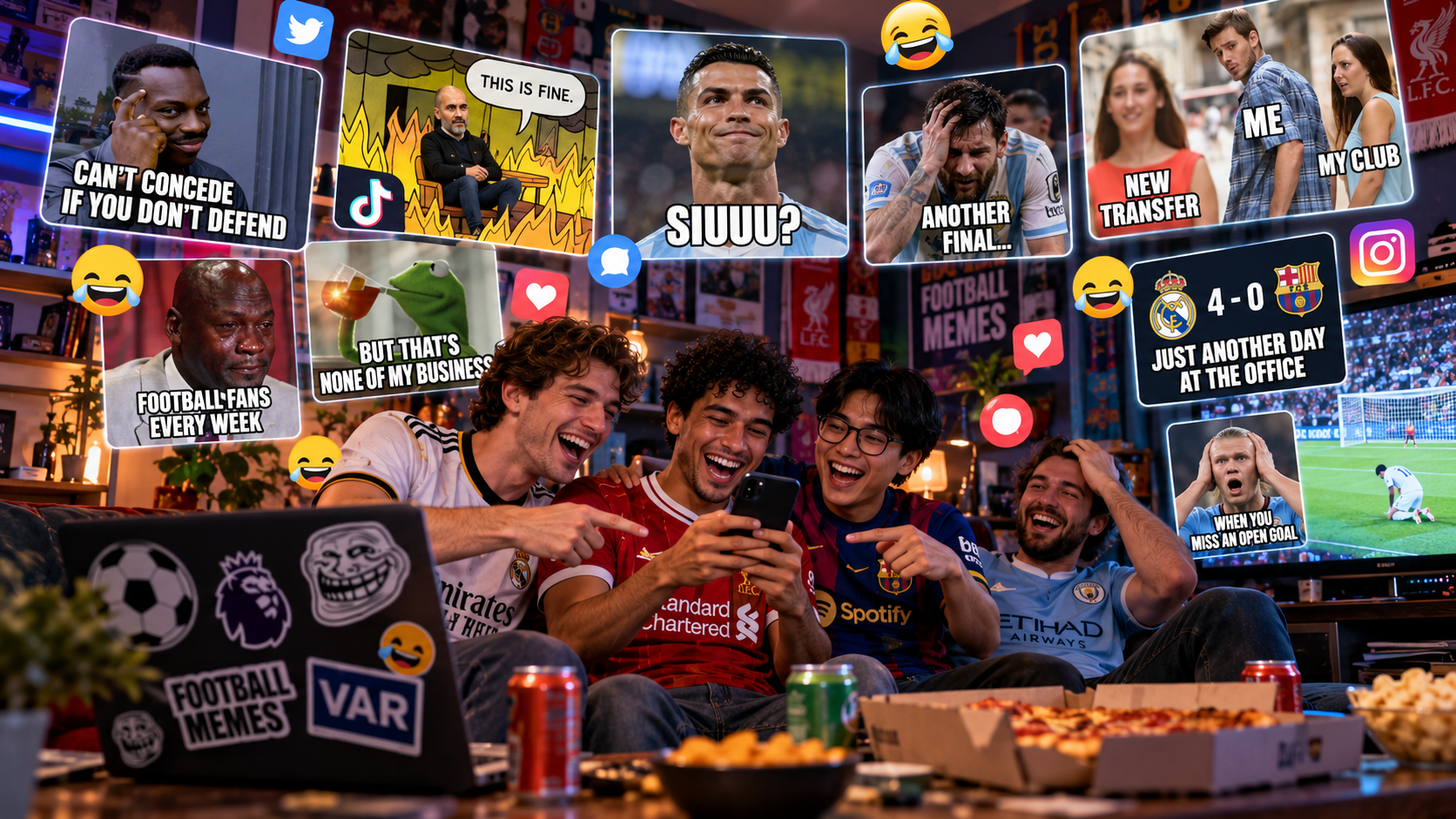
Football memes can turn a missed chance, facial expression, or quote into a global joke within minutes. Explore how internet humor became part of fan culture, memory, and digital football conversation.
The modern practice carries traces of several earlier eras. Its timeline stretches from Pre-internet humor, when cartoons, terrace songs, nicknames and newspaper jokes already turned football into shared comedy, to Algorithmic era, when platforms can push successful memes far beyond the original fan community.
Written by: SwiftPeakX Editorial Team
Last editorial review: October 2026
Editorial note: This article was reviewed for topic-specific wording, historical clarity, source transparency and natural readability. References are listed at the end for verification and further reading.
Key Takeaways
Football memes work because supporters share enough context to recognize a joke from a small image or phrase.
Memes can preserve moments by repeatedly reviving them whenever similar events occur.
The same speed that creates collective humor can also amplify harassment, stereotypes and discriminatory content.
Meme culture is a form of fan participation: supporters do not merely consume football media, they remix it.
Historical Foundations
Football has always produced jokes, nicknames, cartoons, and terrace humor. The internet accelerated the process. A missed chance, unusual facial expression, managerial quote, or refereeing controversy can become a meme within minutes and circulate across languages before the match is over.
Memes compress complicated events into recognizable images or phrases. They reward fans who understand the context while allowing outsiders to join once the joke spreads. Repetition creates a shared vocabulary: old moments are revived whenever a similar situation occurs.
The speed of meme culture can also be cruel. Players may become targets after mistakes, and humor can slide into harassment or discriminatory abuse. The same participatory culture that creates brilliant collective comedy can amplify hostility.
A successful meme records what supporters thought was emotionally important about a moment. It may exaggerate, but that exaggeration itself is evidence of fan interpretation. Years later, a meme can instantly recall a match, player, or era. Digital humor has therefore become a form of unofficial football archiving—messy, selective, and highly social.
Why memes are efficient football language
A single image can carry the memory of a missed chance, famous quote or managerial reaction without explaining the full story. That compression rewards people who know the context and invites newcomers to learn it.
Repeated use turns the image into shorthand. Memes therefore function like digital chants: meaning depends on collective recognition more than on formal authorship.
Memes archive emotion, not objective history
The moment that becomes a meme is usually the one fans found funniest, most painful or most absurd, not necessarily the most tactically important. This makes meme culture a record of interpretation rather than a neutral archive.
Years later, one joke may be remembered more clearly than the match itself. Digital memory preserves what communities repeat.
Humor travels across languages
Visual templates, scorelines and player expressions can cross linguistic boundaries easily, helping jokes circulate between fan cultures. Local captions then adapt the same image to different rivalries. That makes humor travels across languages a genuine turning point in the wider story of Football Memes rather than a minor historical detail.
This remixing is part of the creativity of online football culture. It also means authorship becomes hard to trace as a joke is copied, cropped and repurposed repeatedly.
The harmful side of meme culture
Humor can become a shield
The speed and repeatability of templates make harmful content difficult to contain once it gains traction. A healthy fan culture can defend satire while still recognizing when a target is being reduced to abuse.
Clubs and brands now speak meme language
Official accounts increasingly use jokes, reaction images and self-aware references because supporters expect a conversational tone online. This can make communication feel less corporate when done well.
It can also feel forced when an institution tries too hard to imitate fan language. The distinction is authenticity: memes work because communities understand the context, not because an image format is inherently funny.
Timeline: Key Turning Points
Period Development Why It Mattered
Pre-internet humor Cartoons, terrace songs, nicknames and newspaper jokes already turned football into shared comedy. Digital memes inherited an older tradition of supporter satire.
Forum era Images and recurring jokes circulated through fan boards. Communities built insider references.
Social-media era Real-time posting made memes appear during matches. Humor became almost simultaneous with the event.
GIF and short-video era Moving clips expanded the vocabulary beyond static images. Gestures and reactions became reusable templates.
Algorithmic era Platforms can push successful memes far beyond the original fan community. Local jokes can become global while harmful material can spread just as quickly.
Why This Still Matters
Memes compress complicated football moments into instantly recognizable jokes. A facial expression, tactical error or transfer rumour can become a template within minutes, giving supporters a shared language that crosses clubs and countries. Speed is both the strength and the problem. Humor can build community, but discriminatory or decontextualized material can spread before anyone considers its consequences. Football meme culture is therefore not trivial background noise; it is one of the ways contemporary supporters interpret events and police group boundaries.
The life cycle of a meme is usually short, but some formats become part of a season’s shared vocabulary. Supporters reuse them to interpret later events, so a joke that began with one match can become shorthand for a player, manager or club. That process is similar to terrace humor in speed but different in scale: digital circulation allows the same joke to cross languages and leagues almost immediately.
Because memes rely on recognition, they also reveal who understands the references circulating inside a fan community. Knowing the original clip, quote or match can signal belonging. That makes meme culture a form of social shorthand: funny on the surface, but also useful for mapping how supporters create and recognize shared knowledge.
Common Misconceptions
Memes are too trivial to matter to football culture.
They shape what moments are remembered, how rivalries are narrated and how fans participate in digital conversation.
Online humor is harmless because it is not serious.
Research has documented discriminatory and racializing meme practices in football spaces.
Clubs invented football meme culture.
Supporters developed and circulated digital jokes long before official accounts adopted the style.
Related SwiftPeakX Reading
From Console Classics to Online Play: How Football Video Games Shaped Fan Culture
Fantasy Football: How Supporters Became Data-Driven Armchair Managers
From Message Boards to Matchday Threads: How Online Communities Changed Football Fandom
Frequently Asked Questions
Why do the same football memes keep returning?
A familiar template becomes useful whenever a new event resembles the original context, so repetition is part of the joke.
Can memes preserve football history?
They preserve a selective emotional memory of events, although they should not replace factual historical sources.
Why are player reaction shots so common?
Facial expressions are visually simple, instantly readable and easy to reuse in unrelated situations.
Where is the line between banter and abuse?
Context matters, but discriminatory stereotypes, harassment and dehumanization go beyond ordinary competitive humor.
Memes Accelerate Football’s Inside Jokes
Pre-internet humor is the earliest point shown here. Cartoons, terrace songs, nicknames and newspaper jokes already turned football into shared comedy. Digital memes inherited an older tradition of supporter satire.
Forum era shows the first major shift. Images and recurring jokes circulated through fan boards. Communities built insider references.
Social-media era adds a new layer to the story. Real-time posting made memes appear during matches. Humor became almost simultaneous with the event.
GIF and short-video era marks a later phase in the transition. Moving clips expanded the vocabulary beyond static images. Gestures and reactions became reusable templates.
Algorithmic era brings the timeline into its latest phase. Platforms can push successful memes far beyond the original fan community. Local jokes can become global while harmful material can spread just as quickly.
What Changed—and What Stayed Recognizable
Comparing Pre-internet humor with Algorithmic era makes the scale of change in Football Memes easier to judge. Early in the story, cartoons, terrace songs, nicknames and newspaper jokes already turned football into shared comedy. Digital memes inherited an older tradition of supporter satire. By the later stage, platforms can push successful memes far beyond the original fan community. Local jokes can become global while harmful material can spread just as quickly. For Football Memes, that contrast matters because the modern practice inherited an older purpose even though the tools, expectations or institutions around it had changed.
One way to test that continuity is to revisit the misconception that memes are too trivial to matter to football culture. They shape what moments are remembered, how rivalries are narrated and how fans participate in digital conversation. For Football Memes, correcting that misconception matters because it separates the enduring purpose from details that changed over time. For Football Memes,
The Bottom Line
Football Memes demonstrates that football traditions can be both durable and flexible. The early Pre-internet humor stage set one baseline, while Algorithmic era reflects the demands of a different era. For football memes fan culture, the history matters because it reveals not only what changed, but why some changes lasted.
Sources & Further Reading
SAGE — Discriminatory Meme Culture on Football Twitter
Abertay University — Football fandom in digital spaces
FIFA Museum