Futsal grew from South American indoor courts into a global sport with its own identity. Discover how its tight spaces, quick decisions, and technical demands influenced the development of modern footballers.
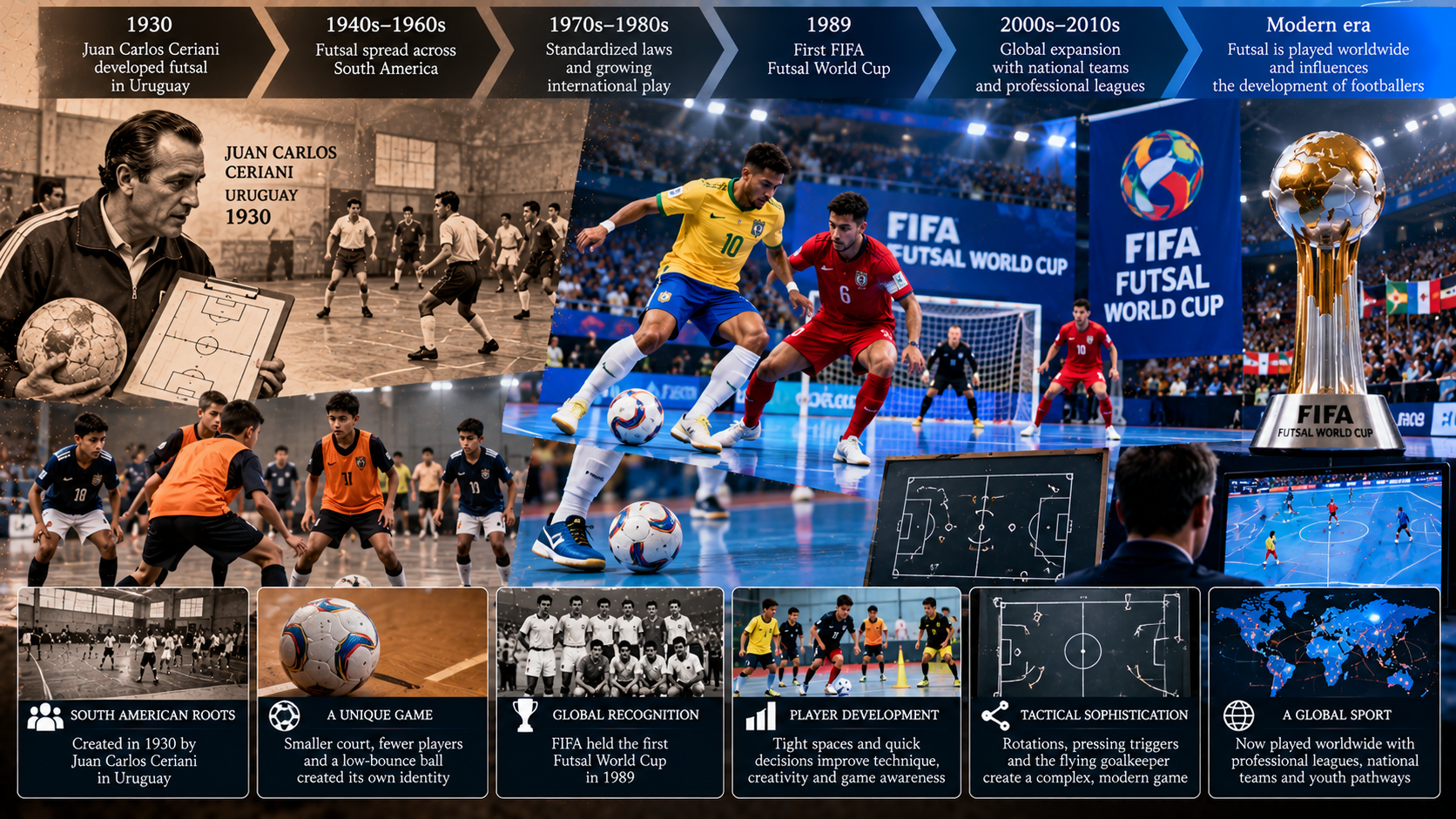
The beginning and end of the timeline show the scale of the change. Under 1930, juan Carlos Ceriani developed an indoor small-sided game in Uruguay. Under Modern era, futsal is played worldwide with specialist clubs, national teams and youth pathways.
Written by: SwiftPeakX Editorial Team
Last editorial review: October 2026
Editorial note: This article was reviewed for topic-specific wording, historical clarity, source transparency and natural readability. References are listed at the end for verification and further reading.
Key Takeaways
Futsal is generally traced to Uruguay in 1930 and Juan Carlos Ceriani, who designed a small-sided indoor form of football.
The sport developed its own laws and identity rather than functioning merely as indoor eleven-a-side football.
FIFA staged its first Futsal World Cup in 1989, helping expand the game internationally.
Futsal’s smaller court, low-bounce ball and frequent transitions create technical and perceptual demands that many football coaches value for development.
Historical Foundations
Futsal developed as a small-sided indoor game in South America during the twentieth century, with Uruguay and Brazil especially important to its early growth. Smaller courts, fewer players, and a low-bounce ball created a game built around quick combinations, close control, rotation, and rapid decisions.
As rules became standardized and international competitions expanded, futsal developed its own identity rather than remaining merely indoor football. FIFA organized a world championship from 1989, while national associations built leagues and youth programs. The sport spread well beyond its South American roots.
Futsal’s influence on football is often discussed through player development. Tight spaces demand frequent touches and constant scanning. Players learn to receive under pressure, combine quickly, disguise passes, and protect the ball with the body. Many elite footballers from futsal-playing cultures have credited the game with shaping their technique.
The two sports reward overlapping skills but operate under different tactical and physical conditions. A futsal pivot is not simply a football striker, and the court does not reproduce the long sprints or aerial duels of an eleven-a-side pitch. Its value lies in complementing development. Coaches can borrow ideas about spacing, rotations, pressing, and first touch without pretending that one sport is a miniature copy of the other.
Why the court changes decision-making
Futsal compresses players into a smaller space with fewer team-mates and less time before pressure arrives. That environment rewards scanning, close control, body orientation and fast combinations.
A technical mistake is difficult to hide because transitions happen immediately and every player is frequently involved. The format therefore creates many repetitions of decisions that occur less often in a full eleven-a-side match.
The ball matters
A futsal ball is designed for reduced bounce, helping keep play on the floor and encouraging close technical interaction. That characteristic supports quick passing and controlled receiving in tight spaces.
It also means futsal should not be described simply as outdoor football moved into a gym. The equipment, laws, substitutions and tactical structures give the sport its own logic.
Why famous footballers mention futsal
Many elite players from futsal-strong countries have credited small-sided play with sharpening technique and creativity. The developmental value comes from repetition and pressure, not from a magical transfer effect.
A young player still needs to learn the running, aerial play and larger-space decisions of eleven-a-side football. Futsal is most useful when treated as a complementary environment rather than a guaranteed production line for stars.
Futsal tactics are sophisticated in their own right
Rotations, goalkeeper participation, pressing triggers and the flying goalkeeper create tactical problems unique to the sport. Elite teams manipulate spacing and numerical advantages with the same seriousness seen in outdoor football.
That specialization is important because calling futsal only a training tool underestimates its competitive identity. Its influence on football is strongest precisely because it has developed as a demanding sport rather than as a drill.
Global growth changed the competitive map
FIFA World Cups helped expose contrasting futsal traditions and accelerated coaching exchange between regions. Brazil historically dominated many editions, while Spain, Argentina, Portugal and others demonstrated the game’s widening elite base. That makes global growth changed the competitive map a genuine turning point in the wider story of How Futsal Grew Into a Global Game and Influenced Modern Football rather than a minor historical detail.
The 2024 tournament added another chapter to that global history. Futsal’s spread shows how a format born from local constraints can become an international game with its own stars and styles.
Timeline: Key Turning Points
Period Development Why It Mattered
1930 Juan Carlos Ceriani developed an indoor small-sided game in Uruguay. The new format responded to limited outdoor space and borrowed ideas from other indoor sports.
Mid-20th century The game spread through South America and built its own competitive culture. Brazil and neighboring countries became major centres.
1965 A South American futsal federation was formed. Regional governance helped organize the sport beyond local play.
1989 FIFA held the first Futsal World Championship in the Netherlands. The game gained a global elite competition under FIFA.
Modern era Futsal is played worldwide with specialist clubs, national teams and youth pathways. Its relationship with football development remains strong but it also stands as a distinct sport.
Why This Still Matters
Futsal should not be treated merely as small-sided outdoor football moved indoors. Its court, ball, substitution patterns, restart rules and tight spaces create a distinct rhythm that rewards quick support, deception and close control. Those qualities can complement player development for the outdoor game, but futsal also has its own competitions, specialists and tactical traditions. Its global growth matters because it shows how a related code can influence football while still maintaining an identity that deserves to be understood on its own terms.
Futsal’s influence is easiest to see in habits rather than claims that it automatically produces elite outdoor players. Tight spaces reward receiving under pressure, using the sole of the foot, quick combinations and constant support angles. Those habits can transfer, but outdoor football adds different physical distances, aerial play and tactical structures. Treating futsal as complementary rather than as a shortcut gives a more accurate picture of why many coaches value it in development environments.
The international growth of futsal also depended on codification. Once rules, court dimensions and competition structures became more consistent, the game could travel more easily between countries and support elite tournaments. Standardization did not erase local styles; it created a common framework in which those styles could meet. That is similar to association football’s own history, but futsal reached that stage on a different timeline and under different spatial demands.
Common Misconceptions
Futsal is just five-a-side football with a different name.
It has its own laws, ball characteristics, restart procedures and tactical conventions.
Futsal automatically makes every young player technically elite.
It provides useful repetitions, but development still depends on coaching, practice quality and individual progression.
Futsal exists only as a development tool for outdoor football.
It is a standalone international sport with professional players and FIFA competitions.
Related SwiftPeakX Reading
From Training Runs to Sports Science: How Football Preparation Evolved
The Rise of Youth Academies: How Clubs Built Pathways From Childhood to the First Team
Frequently Asked Questions
Where did futsal begin?
The sport is widely traced to Uruguay in 1930, where Juan Carlos Ceriani developed rules for an indoor small-sided game.
When was the first FIFA Futsal World Cup?
The first FIFA tournament was held in the Netherlands in 1989.
Why does the futsal ball bounce less?
Reduced bounce helps keep the game controlled on a hard indoor surface and supports the close technical style of play.
How can futsal help football development?
The small space creates frequent touches, pressure and fast decisions, which can complement the skills required in eleven-a-side football.
Why Futsal Developed Its Own Football Identity
The opening phase is labeled 1930. Juan Carlos Ceriani developed an indoor small-sided game in Uruguay. The new format responded to limited outdoor space and borrowed ideas from other indoor sports.
The sequence moves next to Mid-20th century. The game spread through South America and built its own competitive culture. Brazil and neighboring countries became major centres.
The sequence continues with 1965. A South American futsal federation was formed. Regional governance helped organize the sport beyond local play.
The chronology then reaches 1989. FIFA held the first Futsal World Championship in the Netherlands. The game gained a global elite competition under FIFA.
The last stage shown here is Modern era. Futsal is played worldwide with specialist clubs, national teams and youth pathways. Its relationship with football development remains strong but it also stands as a distinct sport.
The Bottom Line
Looking across the full timeline, How Futsal Grew Into a Global Game and Influenced Modern. reflects football’s habit of adapting without completely severing its past. The contrast between the 1930 and Modern era stages explains why modern debates often combine practical questions with arguments about identity, fairness or tradition.
Sources & Further Reading
FIFA — Origins of futsal
FIFA — Memories of the first Futsal World Cup
FIFA — Futsal World Cup history and statistics