
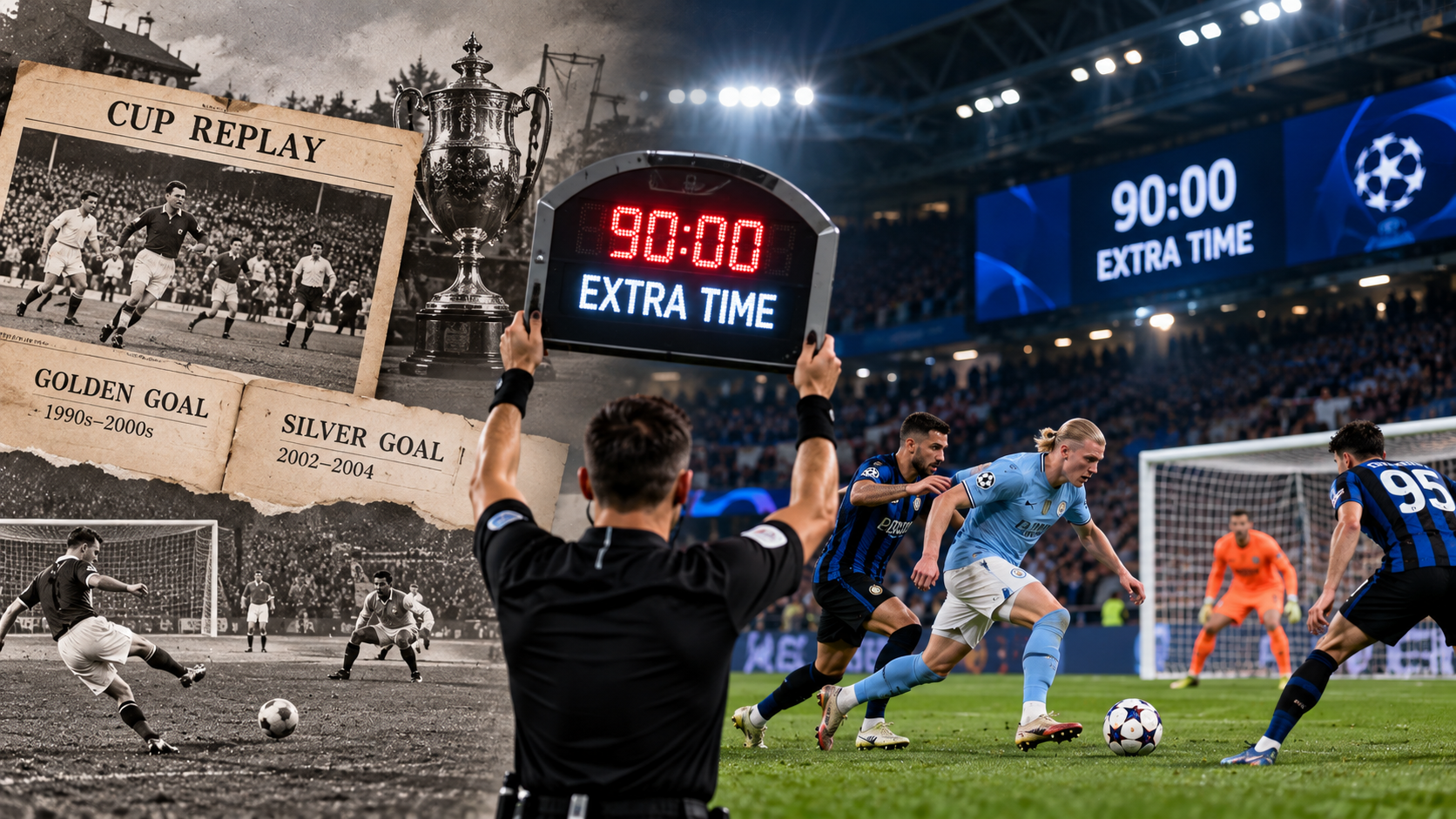
Why does football continue beyond 90 minutes in knockout matches? Trace the origins of extra time, the experiments with golden and silver goals, and the reasons the game still relies on this dramatic extension.
The clearest way to understand this subject is to compare the first and last entries in its timeline. Early cup football records that drawn knockout matches were often replayed or settled by competition-specific procedures; 2004 onward records that golden and silver goal were dropped from major law frameworks.
Written by: SwiftPeakX Editorial Team
Last editorial review: October 2026
Editorial note: This article was reviewed for topic-specific wording, historical clarity, source transparency and natural readability. References are listed at the end for verification and further reading.
Key Takeaways
Extra time exists because knockout competitions need a winner even when regulation time ends level.
Replays once solved many drawn cup ties, but modern calendars favor same-day resolution.
Golden-goal and silver-goal experiments were intended to make extra time more decisive, yet both were abandoned.
Extra time is now a distinct tactical phase shaped by fatigue, substitutions, game state and the threat of penalties.
Historical Foundations
Football needed a method for knockout matches that could not end in a draw. League football could simply award a point or replay a fixture, but cup competitions demanded a winner. Before standard solutions became common, organizers sometimes relied on replays, additional periods, or locally defined procedures. Extra time gradually became the practical compromise: preserve football itself for a little longer before turning to another tie-break method.
The familiar thirty minutes, usually split into two fifteen-minute periods, became embedded in major competitions because it extended the same contest rather than replacing it. Yet football has repeatedly experimented with what extra time should mean. The “golden goal” era tried to create sudden death, ending the match immediately when one team scored. The “silver goal” briefly offered a softer variation. Both ideas were eventually abandoned because they changed incentives and often made teams more cautious rather than more adventurous.
Today extra time survives because it sits between regulation time and penalties. It gives teams another tactical phase in which fatigue, substitutions, risk management, and squad depth become decisive. Modern competitions have adjusted substitution rules partly because players are asked to perform longer and at higher intensity than in earlier eras. The debate continues, especially as fixture congestion and player welfare receive more attention.
Replays once had a strong place in cup football because they avoided deciding a tie through an artificial mechanism. But they also created scheduling problems, travel costs, uncertain broadcasting plans, and additional physical demands. As competitions became international and calendars became denser, replaying drawn matches became harder to sustain. Extra time offered something organizers increasingly valued: a result on the same day, in the same stadium, within a predictable broadcast window.
The problem a knockout competition must solve
A league can tolerate a draw because standings accumulate over many matches, but an elimination tie eventually needs one team to advance. Extra time preserves the same sport for a little longer before a separate tiebreak such as penalties is used.
That makes it less arbitrary than drawing lots and less disruptive than scheduling an entirely new match. Its basic appeal is continuity: the teams are given additional football rather than an immediate switch to a different contest.
Why replays became harder to sustain
Cup replays once carried tradition and commercial value, especially when calendars were less crowded and broadcasting windows were more flexible. As domestic, continental and international schedules expanded, an uncertain extra fixture became a bigger burden for players, travel planning and television.
Same-day resolution gives organizers certainty about who advances and when the next round can be scheduled. The decline of replays therefore reflects the economics and logistics of modern football as much as any preference about sporting fairness.
What golden goal was trying to fix
Golden goal was designed to create immediate drama and prevent extra time from becoming a cautious waiting room for penalties. In practice, the possibility that one mistake would end the match could make teams more risk-averse rather than more adventurous.
The silver-goal experiment tried to preserve some urgency while allowing a trailing team until the end of the period to respond. Neither experiment produced a compelling enough improvement to replace ordinary extra time permanently.
Fatigue changes the game
The additional thirty minutes are not simply more of the first ninety; they arrive after players have already accumulated physical and cognitive fatigue. Space often opens, pressing becomes harder to sustain and substitutions can have an outsized effect.
A fresh runner against a tired full-back can matter more in minute 110 than the same matchup would have mattered early in the match. Coaches therefore manage extra time as a separate phase with its own pacing, risk and personnel decisions.
Why penalties still sit behind extra time
Penalty shoot-outs provide a clear and relatively quick tiebreak, but they test a narrower set of skills than open play. Extra time gives teams one final opportunity to separate themselves through normal attacking, defending and tactical adaptation. That makes why penalties still sit behind extra time a genuine turning point in the wider story of Why Football Has Extra Time rather than a minor historical detail.
Some competitions have debated skipping extra time, particularly when player welfare and scheduling are priorities. The continuing argument shows that there is no perfect balance between sporting completeness, drama, fairness and physical load.
Timeline: Key Turning Points
Period Development Why It Mattered
Early cup football Drawn knockout matches were often replayed or settled by competition-specific procedures. There was no single universal method for deciding every tied match.
Standard era Two additional periods totaling thirty minutes became the familiar elite format. The contest could continue under normal football rules before another tiebreak was needed.
1990s The golden-goal experiment introduced sudden death in selected competitions. A goal could end the match immediately, changing risk calculations.
Early 2000s The silver-goal variation briefly allowed a team leading at the end of an extra-time half to win. It tried to soften sudden death without returning fully to normal extra time.
2004 onward Golden and silver goal were dropped from major law frameworks. Traditional extra time followed by penalties again became the standard knockout sequence.
Why This Still Matters
Extra time has survived repeated experiments because it offers something neither a replay nor an immediate shootout can provide: more football under broadly normal playing rules. The cost is physical. Fatigue changes pressing, recovery runs, substitution choices and the willingness to take risks. Golden and silver goal tried to make the period more dramatic and decisive, but both changed incentives in ways that did not become permanent. The modern format therefore reflects a compromise between sporting continuation, television scheduling, player workload and the need to settle a knockout tie on the day.
Common Misconceptions
Extra time is the same as added time.
Added time compensates for time lost within a half; extra time is an additional period used by competition rules to decide certain tied matches.
Every knockout match must use extra time.
Competition rules decide the procedure. Some ties can go directly to penalties or use other formats.
Golden goal made extra time universally more attacking.
It often produced the opposite incentive because conceding once meant immediate elimination.
Related SwiftPeakX Reading
The Offside Rule: How Football’s Most Debated Law Evolved
Frequently Asked Questions
How long is extra time in standard elite football?
Usually thirty minutes, played as two equal fifteen-minute periods when the competition rules require it.
Do teams change ends in extra time?
Yes. Extra time is divided into two halves and teams change ends between them.
Can competitions skip extra time and go straight to penalties?
Yes. The competition regulations determine whether extra time is played before kicks from the penalty mark.
Why did golden goal disappear?
Football authorities concluded that the experiment did not improve the game enough to justify keeping a sudden-death format.
Why Thirty Extra Minutes Survived
First comes Early cup football. Drawn knockout matches were often replayed or settled by competition-specific procedures. There was no single universal method for deciding every tied match.
Then comes Standard era. Two additional periods totaling thirty minutes became the familiar elite format. The contest could continue under normal football rules before another tiebreak was needed.
Another important entry is 1990s. The golden-goal experiment introduced sudden death in selected competitions. A goal could end the match immediately, changing risk calculations.
The next major step appears under Early 2000s. The silver-goal variation briefly allowed a team leading at the end of an extra-time half to win. It tried to soften sudden death without returning fully to normal extra time.
The final entry is 2004 onward. Golden and silver goal were dropped from major law frameworks. Traditional extra time followed by penalties again became the standard knockout sequence.
The Bottom Line
The history of Why Football Has Extra Time is not a straight line toward a perfect modern version. The Early cup football stage reflects one set of needs, while 2004 onward reflects another. Seeing both stages together makes current debates more precise because it separates the underlying purpose from the particular method used in any one era.
Sources & Further Reading
IFAB — Law 7: The Duration of the Match
IFAB — Law 10: Determining the Outcome of a Match
IFAB — Laws of the Game archive


